• Home
  • CV
  • Exhibitions
  • Works
    • AI
    • Drawings
    • Paintings
    • Photograpy
    • Bioart
    • Soundart
      • Sounds
      • Notations
      • Radio
      • CDs
    • Videoart
    • Netart
    • Performances
    • Installations
    • Artist’s Books
    • Poetry
    • Books
    • DVDs
  • Portfolios
  • Press
  • News
  • Contact

Marcello Mercado

  • Museo Caraffa: 100 años de plástica en Córdoba

    Museo Caraffa: 100 años de plástica en Córdoba

    24.03.2004 – 30.05.2004


    Museo Caraffa: 100 años de plástica en Córdoba


    La Voz del Interior 02.04.2004


    Artists:


    José Aguilera
    Fernando Allievi
    Carlos Alonso
    Henry Arán
    Ananké Asseff
    Alberto Barral
    Carlos Bazzini Barros
    Natalia Blanch
    Pablo Canedo
    Josefina Cangiano
    Emilio Caraffa
    Diego Cuquejo
    Ernesto Fariña
    Clara Ferrer Serrano
    Marcelo Hepp
    Benjamín Krivoruk
    Juan Kronfuss
    Mauricio Lasansky
    Marcello Mercado
    Gaspar De Miguel
    Eduardo Moisset de Espanes
    José de Monte
    Honorio Mossi
    José Cárrega Núñez
    Olimpia Payer
    Raúl Pecker
    Jose Pizarro
    Vicente Roberto Puig
    Oscar Páez
    Tulio Romano
    Luis Saavedra
    Pablo Scheibengraf
    Jorge Simes
    Ernesto Soneira
    Lino Enea Spilimbergo
    Luis Tessandori
    Héctor Valazza


    Museo Emilio Caraffa

    Av. Hipólito Irigoyen 651 – Plaza España
    Cordoba
    Argentina


    23 marzo, 2004
  • PIXXELPOINT 2003

    PIXXELPOINT 2003

    28.11.2003 – 05.12.2003


    PIXXELPOINT 2003


    With each next generation of hardware when the computer performance usually doubles, the ability to visualize faces us with new challenges. Undoubtedly, both hardware and computer screens face the biggest challenge when it comes to 3D visualizing, either because three dimensions must be represented on a 2D surface or because of the animation or digital film scripts. Until we see holograms arise in front of us, the 2D surface of paper, film/video projections or sreens remain the only areas for space representation which took shape with the invention of painter’s perspective. In its attempt to present to our mind a spatial experience only in two dimensions, representation is always a deception of the sight with regard to either spatial forms, architectures or city spaces and non-spaces.

    Yet even the latest tehnological innovations do not neglect the essential rules and criteria which have become established with a view of human being’s ability to watch and perceive. Primitive drawings which functioned like markers of space were followed by dosproportionate representations of cities on icons, spatial representations and planning which have, in turn, been complemented by plane geometries and topographies of cities and territories, thus falling predominantly in the domain of painter’s abstractions. But it was quatrocento that saw the invention of perspective, as a result of the need to represent the city space. However, it was not before the intervention of the computer that the representation of architecture and cities gained new impetus and through rendering spaces and objects entered the field of animation and eventually film which shows us long-gone historical places and not-yet-seen futuristic representations.

    Arguably, with the development of electronic media and tools, the ability to render 2D presentations of 3D objects and spaces has long ago ceased beguiling with abstractions, which were built on construction and colour machines (perspectives) for the adjustment of eyesight, thus approaching hyper-realistic spatial experiences in, for example, digital film scripts.

    Yet realistic representations are only one of the possible interpretations of space. There is another spatial category which struggles to symbolize the unspatial internet. Here, connectivity and bandwidth are on the same level, similarly as with geometry where the category of the coordinate system functions as the basis for spatial representation. If internet represents a perfect tool for visualizing and mapping, allowing us to create virtual cities and within them real communes, manipulations with space provide us with a unique oportunity – by means of the digital interface the Internet allows us to act in real space or in the lives of real people.

    In this way the gap between virtual and real spaces is closing, causing the real space to search for new standards in representing the space. Projects based on the computer-games culture require more and more sophisticated interfaces to move around in virtual spaces while projects that are founded on scientific and techological paradigms require accurate and responsive interfaces since human beings’ lives depend upon them. The virtual and the video-produced image has become palpable and real through the responsiveness of digital fingers and movements of our bodies. VR helmets, VR gloves and other cyber extensions provide us with a means to exist in a world which has lost its status of a fake, spare and second-rate space, since it provides us with an adequate experience of the spatial dimension. In some developed systems a specific kind of moving is developed which is not a replacement as it arises from the specificity of numerical spaces. Virtual reality is slowly losing its abstractness that functioned as the poetics of reading metaphors as reading a fake reality, thus positioning itself on par with the reality as a legitimate, parallel reality.

    With strategies of rendering on 2D surfaces the possibility which presupposes a third dimension on our side of the paper or screen is often neglected. What we have in mind here is especially 2D presentations that are responsive or even interactive with the user or visitor. The 2D space becomes a groundfloor upon which we move and cause it to change, or alternatively, the changes on the 2D groundfloor affects our perception. The immersion into the virtual world of numerical spaces is not necessarily an escape from reality since by means of interfaces, we can experience virtual spaces in the same way as we experience real places.

    PixxelCity has become a synonym for the most complex forms of spatial dimension in which we find filled spaces as well as emptiness between them, spaces which are inhabited and equipped with urban fixtures, both real and imaginary, and in which we can move and position 3D objects. This can be either an archaic or a futuristic space which constantly changes since it is inhabited with life


    CURATOR: Jurij Krpan


    Moderna galerija
    Cankarjeva 15,

    1000 Ljubljana

    SLOVENIA


    27 noviembre, 2003
  • ArchivesSpace Public Interface

    10.10.2003


    ArchivesSpace Public Interface


    From the Collection: The collection consists of office files, artists files, audio and video recordings, programs, posters, photographs and artifacts and ephemera relating to the Performance Art Festival (PAF) held annually from 1988-1999 in Cleveland, OH. Created and collected by festival founder Thomas Mulready, the PAF Archive was donated to Case Western Reserve University in 2015.


    These files contain application forms, photographs, newspaper clippings, books, and other textual explanatory material. They may also include audiocasettes, CDs and CD-ROMs, posters, correspondence between the artist and Mulready.

    Also, of note are the festival performances that were recorded on video tape, usually from two camera angles, and which make up a large part of the archive. Over 100 performers would participate over the several days of the festival each year.


    Mercado, Marcello, 2003

    File — Box: 12, Folder: 26
    Identifier: 4


    ArchivesSpace Public Interface


    Built for archives by archivists, ArchivesSpace is the open source archives information management application for managing and providing web access to archives, manuscripts and digital objects.


    9 octubre, 2003
  • 14th Festival Videobrasil

    14th Festival Videobrasil


    22.09.2003 – 19.10.2003


    14th Festival Videobrasil


    The fourteenth edition, held in Sesc Pompeia, celebrated a special occasion: the 20th anniversary of Videobrasil International Electronic Art Festival, by now already recognized worldwide as the main convergence point for the so-called southern scene artistic output. The long-lasting partnership with SESC-SP gave birth to the largest exhibition ever, featuring the “Displacements” theme, a phenomenon which permeates contemporary life. Artists from Latin America, Africa, the Caribbean, Middle East, Southeast Asia, Oceania, and Eastern Europe were featured in the event, which focused on work from the geopolitical south of art for the first time. A retrospective show of 30 years of video’s national production, curated by Arlindo Machado, was included in the History Axis, while the Contemporary Axis featured an important exhibition of art from Lebanon, a country constantly facing the “Displacements” concept. Christine Tohme and Akram Zaatari curated this exhibition. Festival payed tribute to Brazilian artist Waly Salomão, an active collaborator with Associação Cultural Videobrasil. A DVD entitled “Nomadismos: Homenagem a Waly Salomão” (Nomadisms: A tribute to Waly Salomão) was released. The DVD was specially produced with the aid of friends and partners. Waly, who integrated the programming commission, died a few months prior to the Festival. Beginning with this edition, video and new medias now competed in the same category.


    Associação Cultural Videobrasil

    SESC São Paulo

    55 11 36450516

    Rua Jaguaré Mirim, 210

    Vila Leopoldina – São Paulo

    SP BR
05311 020


    Featured artists

    • A Revolução Não Será Televisionada
    • Ádám Lendvai
    • Adriana Varella
    • Aggéo Simões
    • Agnaldo Mori
    • Akram Zaatari
    • Alain Bourges
    • Alex Stikich
    • Alexandre da Cunha
    • Alexandre Kassin
    • Alfredo Nagib
    • Almir Almas
    • Ana Siqueira
    • Analívia Cordeiro
    • André Amparo
    • André Isn’t
    • Andrea Tonacci
    • Andries Botha
    • Angela Detanico
    • Angela Ferreira
    • Anikó Lórant
    • Anita Bacic
    • Anita Cheng
    • Anita Sárosi
    • Anna Barros
    • Anna Bella Geiger
    • Arnaldo Antunes
    • Arnon Amitai
    • Artur Matuck
    • Bárbara Soalheiro
    • Bartolo
    • Ben Wickes
    • Berry Bikle
    • Bettina Frankham
    • Bill Lundberg
    • Bouchra Khalili
    • Bruno de Carvalho
    • Caco Souza
    • Calin Man
    • Cao Guimarães
    • Cao Kai
    • Carlo Sansolo
    • Carlos Eduardo Nogueira
    • Carlos Issa
    • Carlos Nader
    • Carlosmagno Rodrigues
    • César Meneghetti
    • Cezar Migliorin
    • Chico de Paula
    • Christian Barani
    • Christian Parsons
    • Cila Mac Dowell
    • Clarissa Tossin
    • Claudia Aravena
    • Cláudio Santos
    • Conrado Almada
    • Corpos Informáticos
    • Dan Boord
    • Daniel Sêda
    • Daniel Trench
    • Daniela Baranzine
    • Daniela Kutschat
    • Daniela Mattos
    • Danillo Barata
    • Derek Hui
    • Detanico Lain
    • Diana Domingues
    • Dias & Riedweg
    • Diego Medina
    • Ding Sheng
    • Dirk de Bruyn
    • Domenico Lancellotti
    • Dominic Hislop
    • Dong Bingfeng
    • Dong Wei
    • Duncan Lindsay
    • Eder Santos
    • Edgar Endress
    • Eduardo de Jesus
    • Eduardo Kac
    • Elisa Noronha
    • Ethem Özgüven
    • Eugênio Puppo
    • Eusebio Bañuelos
    • Éva Emese Kiss
    • Fabiana Werneck Barcinski
    • Fábio Ribeiro
    • Fabíola Goiaba
    • Federico Mercuri
    • feitoamãos/F.A.Q.
    • Ferenc Gróf
    • Fernando Cocchiarale
    • Fernando Meirelles
    • Fouad el Koury
    • Francisca Caporali
    • Frederico Câmara
    • Gábor Bódy
    • Gabriela Golder
    • Gabriela Greeb
    • Gastón Duprat
    • Gavin Adams
    • General Richard Amaya Cook
    • Geraldo Anhaia Mello
    • Gert Hatsukov
    • Géza P. Fekete
    • Ghassan Salhab
    • Gilbert Hage
    • Giselle Beiguelman
    • Glauber Rocha
    • Glauco Félix
    • Gozde & Russel Zehnder
    • Greg Streak
    • Gregg Smith
    • Group 72-74
    • Guel Arraes
    • Guo Dong
    • Gustavo Galuppo
    • Gustavo Romano
    • Gustavo Timponi
    • Gusztáv Hámos
    • Guto Jordão
    • Hajnal Németh
    • Hassan Khan
    • He Jie
    • Helena Campos
    • Henrietta Szira
    • Huang Junhui
    • Huang Yan
    • Inês Cardoso
    • Ip Yuk-Yiu
    • Ivan Edeza
    • Iván Marino
    • Jalal Toufic
    • Jamsen Law
    • János Fodor
    • János Sugár
    • Jarbas Agnelli
    • Jay Pather
    • Jayce Salloum
    • Jean-Louis Le Tacon
    • Jean-Paul Fargier
    • Jérôme Lefdup
    • Joana Hadjithomas
    • Joana Meniconi
    • João Moreira Salles
    • Joel Pizzini
    • José Ferreira
    • José Roberto Aguilar
    • Josely Carvalho
    • Jovan Arsenic
    • Juliana Alvarenga Freitas
    • Juliana Ribeiro
    • Jurandir Müller
    • Karané Txicão
    • Katarina Sevic
    • Katarzyna Paczesniowska-Renner
    • Kedy FAN Ho-ki
    • Khalil Joreige
    • Kika Nicolela
    • Kiko Goifman
    • Kriszta Hatos
    • Krisztián Viktorin
    • Kumaré Txicão
    • Lamia Joreige
    • Lara Arellano
    • Leandro HBL
    • Leandro Vieira
    • Lee Wen
    • Leo Monteiro
    • Letícia Capanema
    • Leticia Parente
    • Li Yi
    • Lia Chaia
    • Lidia Chaib
    • Lilia Pérez Romero
    • Liu Wei
    • Lucas Bambozzi
    • Lúcia Rocha
    • Lucila Meirelles
    • Luis Valdovino
    • Luiz Duva
    • Ma Shang
    • Ma Yongfeng
    • Macau
    • Mahmoud Hojeij
    • Manuela Sobral
    • Marcello Dantas
    • Marcello Mercado
    • Marcellvs L.
    • Marcelo Braga
    • Marcelo Corpanni
    • Marcelo Garcia
    • Marcelo Machado
    • Marcelo Masagão
    • Marcelo Tas
    • Marcelo Viana
    • Marcia Antabi
    • Marcia Vaitsman
    • Marco Del Fiol
    • Marcondes Dourado
    • Marcos Bonisson
    • Marcos Jorge
    • Marcus Bastos
    • Marcus Vinícius Araújo Nascimento
    • Mariana Meloni
    • Mariano Cohn
    • Marie Ange Bordas
    • Mariela Yeregui
    • Marina Abs
    • Marina Rezende
    • Mario Lewis
    • Marwan Rechmaoui
    • Maurício Eça
    • Maya Pinsky
    • Mei Ya
    • Meton Joffily
    • Michäel Gaumnitz
    • Michael Lee
    • Miguel Petchkovsky
    • Miklós Bölcskey
    • Miklós Erdély
    • Miklós Surányi
    • Milena de Almeida
    • Milene Migliano
    • Minnette Vári
    • Miodrag Krkobabic
    • Mohamad Soueid
    • Mônica Simões
    • Moreno Veloso
    • Muchekwa Langa
    • Nabil Kojok
    • Nancy Proctor
    • Natalie Butler
    • Natuyu Yuwipo Txicão
    • Neide Jallageas
    • Nelson Enohata
    • Neyeri Avalos
    • Nigol Bezjian
    • Norma Bahia Pontes
    • Nortec Collective
    • Olhar Eletrônico
    • Orlando Maneschy
    • Osaira Muyale
    • Otávio Donasci
    • Pablo Lobato
    • Pablo Zurita
    • Paloma Rocha
    • Pascal Lièvre
    • Patricia Moran
    • Paula Gaitán
    • Paula Signorelli
    • Paulo Bruscky
    • Paulo César Soares
    • Paulo Herkenhoff
    • Paulo Laurentiz
    • Paulo Morelli
    • Pedro Adolfo de Abreu Machado
    • Pedro Sá
    • Pedro Vieira
    • Pen Tao
    • Péricles Cavalcanti
    • Péter Forgács
    • Quito Ribeiro
    • Rabih Mroué
    • Rachel Rosalen
    • Rafael de Paula
    • Rafael França
    • Rafael Lain
    • Rafael Marchetti
    • Rafael Morado
    • Regina Silveira
    • Regina Vater
    • Remy Jungerman
    • Renata Alencar
    • Renata Rico
    • Renato Barbieri
    • Ricardo Carioba
    • Ricardo Matsuzawa
    • Ricardo Portilho
    • Ricardo Rendon
    • Ricardo Suarez Pareyon Aveleyra
    • Rita Moreira
    • Rivane Neuenschwander
    • Robert Cahen
    • Robert Yao Ramesar
    • Roberta Maia
    • Roberto Bellini
    • Roberto Sandoval
    • Rodrigo Minelli
    • Ronaldo Kiel
    • Ronaldo Miranda
    • Rosângela Rennó
    • Roy Samaha
    • Royston Tan
    • Ruth Slinger
    • Sagi Groner
    • Samuel Rousseau
    • Sandra Kogut
    • Santana Dardot
    • Sebastián Díaz Morales
    • Semi Ryu
    • Sérgio Nesteriuk
    • Sergio Roizenblit
    • Sheila Hara
    • Sherman Ong
    • Shilpa Gupta
    • Shirin Kouladjie
    • Simone Michelin
    • So Man-yee
    • Solange Ferraz de Lima
    • Stephen Hobbs
    • Szabolcs KissPál
    • Szilvia Seres
    • Tadeu Jungle
    • Tamás T. Kaszás
    • Tan Pin Pin
    • Tania Sng
    • Tata Amaral
    • Tejal Shah
    • Teresa Labarrère
    • Thaís Monteiro
    • Ticiano Monteiro
    • Tonho
    • TV Viva
    • TVDO
    • Valérie Pavia
    • Vânia Carneiro de Carvalho
    • Vera Uberti
    • Vincent Carelli
    • Virginia Mackenny
    • Wagner Morales
    • Walid Raad
    • Walid Sadek
    • Walter Silveira
    • Wang Weijie
    • Wang Zhijun
    • Woo Ling-ling
    • Wu Ershan
    • Wu Ruping
    • Ximena Cuevas
    • Yu Xudong
    • Zhang Hao
    • Zhang Weiwei
    • Zoy Anastassakis


    21 septiembre, 2003
  • Festival Synthese de Bourges

    Festival Synthese de Bourges


    6.06.2003 – 15.06.2003


    Festival Synthese de Bourges


    Marcello Mercado

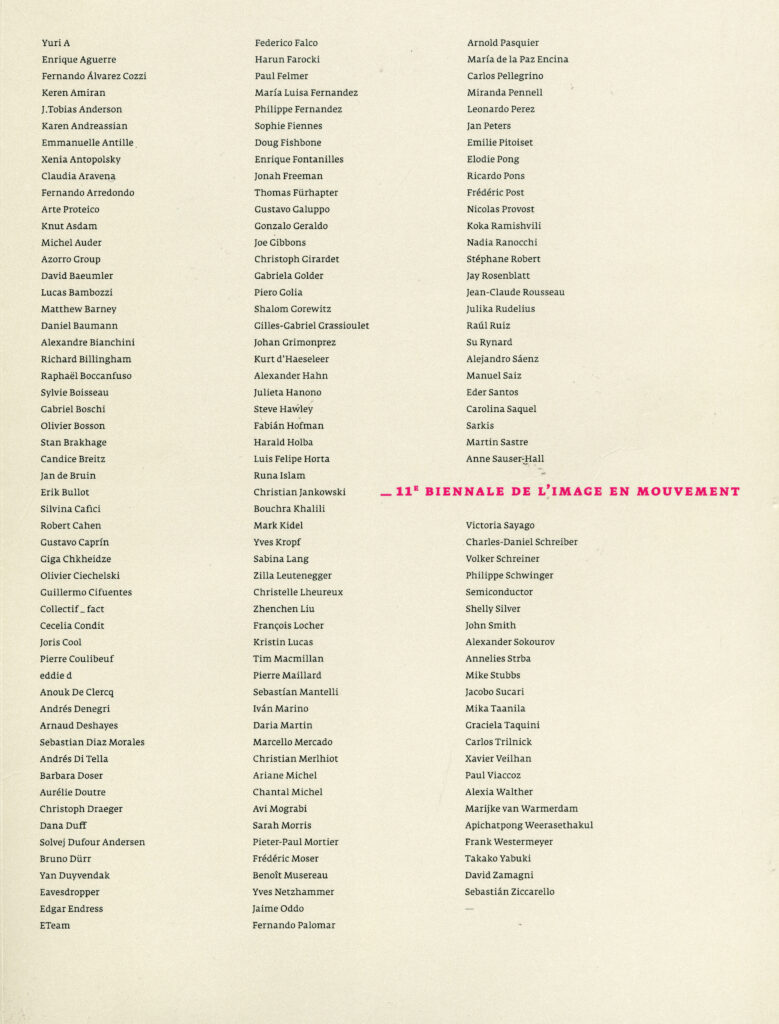
    Das Kapital


    Institut International de Musique Electroacoustique de Bourges

    pl André Malraux

    18000 Bourges

    France


    5 junio, 2003
  • Gödel 1, 2, 3

    Gödel 1, 2, 3


    Bio-performances, 2000–2003


    This work operates as a distributed bio-performative system in which biological matter, formal logic, and urban surveillance are brought into direct operational alignment.

    The procedure begins with a controlled ingestion process: Californian worms are fed with material derived from the Gödel’s incompleteness theorems, reduced to pulp and reconfigured as a biological substrate. The theorems are not interpreted; they are metabolized.

    DNA extraction follows. The resulting material is not archived, preserved, or stabilized. It is displaced.

    The displacement occurs through a repeated action: the dripping of extracted DNA in front of six traffic cameras in Köln. The gesture is minimal. The system is not.

    Each camera functions simultaneously as:

    a recording device
    a distributed observer
    a non-consensual laboratory condition

    The experiment unfolds across time, extending into a three-year continuous process of exposure, decay, and accumulation. The dripping areas are not monitored for results but for persistence. The system does not seek verification.

    Parallel to the physical operation, a secondary layer is activated: the continuous reading of Gödel’s theorems. This reading does not clarify the process. It introduces recursive instability.


    Gödel 1, 2, 3 is a distributed net-performance operating across biological, mathematical, and infrastructural systems.

    The work originates from a sequence of actions involving the ingestion of printed fragments of Gödel’s incompleteness theorems by Californian worms. These biological agents function as processors, converting formal logic into organic residue. From this process, DNA traces are extracted and subsequently reintroduced into the urban environment.

    The second stage unfolds through a network of traffic surveillance cameras in Köln. These cameras, designed for regulation and control, are repurposed as passive witnesses to a non-indexable event. The act of dripping DNA occurs within their field of vision, yet remains unregistered within the system’s operational logic.

    No data is captured.
    No event is recorded.
    No transformation is acknowledged.

    The system observes without knowing.

    Gödel’s incompleteness theorems demonstrate that within any formal system, there exist propositions that cannot be proven or disproven from within the system itself. Gödel 1, 2, 3 translates this condition into a performative and technological field.

    The cameras operate as a closed logical structure.
    The biological material introduces an external inconsistency.
    The system remains intact, but epistemically incomplete.

    Parallel to the physical actions, the online interface presents a sequence of selectable options — databases, regulatory frameworks, submission protocols — none of which produce any functional output. Interaction is simulated, but never resolved.

    The user is positioned within a system that requests decisions while systematically nullifying their consequences.

    Selection does not lead to execution.
    Input does not generate output.
    The interface remains structurally active and functionally void.

    The work constructs a space in which:

    Biological processes are translated into symbolic failure

    Surveillance systems are rendered perceptually active but epistemically blind

    interaction is reduced to a loop without memory

    Gödel 1, 2, 3 does not represent incompleteness.

    It performs it.

    Traffic-cameras Links


    Select more non-functional options with non-functional-requirements

    No comments


    Select more non-functional options with non-functional-requirements

    No comments


    Select more non-functional options with non-functional-requirements

    No comments


    Select more non-functional options with non-functional-requirements

    No comments

    Select more non-functional options with non-functional-requirements

    No comments


    Select more non-functional options with non-functional-requirements

    No comments or convictions found


    No comments


    Select more non-functional options with non-functional-requirements

    No comments


    Select more non-functional options with non-functional-requirements

    No comments


    Select more non-functional options with non-functional-requirements

    No comments


    Select more non-functional options with non-functional-requirements

    No comments


    Select more non-functional options with non-functional-requirements

    No comments


    I want to extract DNA from…[Select]


    25 marzo, 2003
  • Revista El Amante, Nro. 133

    Revista El Amante, Nro. 133


    Revista El Amante

    nro. 133

    Buenos Aires, Argentina, 2003

    19 febrero, 2003
  • Streams of Encounter

    Streams of Encounter

    30.01.2003  –  23.03.2003


    Streams of Encounter– electronic media based artworks


    curated by Andreas Walther
    This exhibit displays art whose basic media consists of machinery, electronics or electronic media. These works are acts of conversation, with many different connections – a condensing process in space and time. Themes presented by active artists of Taiwan and Germany are integrated: on one hand, they point out that in the new era of globalization, new media is the mainstay of the new world order; the mixing of different countries and the establishing of a global network is realized, shrinking distances in space and time. On the other hand, in the backdrop of creative forces hailing from different backgrounds, we hope to analyze what differentiates the two sides, what connects them, and if they can maintain their own uniqueness.


    Taipei Fine Arts Museum
    No.181, Sec. 3, Zhongshan N. Rd., Zhongshan Dist.,
    Taipei City 10461,
    Taiwan,R.O.C.

    29 enero, 2003
  • Installation: Pressure

    Installation: Pressure

    10.01.2003


    Marcello Mercado
    Pressure


    Sculpture-object,
    fan, marble
    50 cm x 45 cm 40 cm, 19.7 in x 17.7 in x 15.7 in
    2003


    10 enero, 2003
  • Installation: AAAGGGTTTTAACCC

    Installation: AAAGGGTTTTAACCC

    03.01.2003


    Marcello Mercado
    AAAGGGTTTTAACCC


    DNA-installation
    green steril surgical fabric, laser, DNA, wood
    variable dimensions

    Munich
    2002


    3 enero, 2003
  • ///—Reload—/// iS.CaM Net-Art Open / 2002

    ///—Reload—/// iS.CaM Net-Art Open / 2002

    21.09.2002 – 21.10.2002


    ///—Reload—/// iS.CaM Net-Art Open / 2002


    61 projects, more than 60 artists and groups from 17 countries, coming together for the
    first time on the net.


    Artists:

    Anke Schafer,
    nikki anderson,
    Genco Gulan,
    Soo Yeun Ahn,
    Neal White,
    Winston Yang,
    Robert J. Krawczyk,
    Maria Beatriz de Medeiros
    Tomasz Konart,
    Agricola de Cologne,
    Lane Last,
    Trang Chung,
    Sergio Maltagliati,
    Andrea Flamini,
    babel,
    Karen J Guthrie,
    Jody Zellen,
    Rozalinda Borcila,
    Plasma Studii,
    Doctor Hugo,
    Judson Wright,
    Faruk Ulay,
    Richard Kriesche,
    Cardarelli Luigia,
    Philip Foeckler,
    Caroline Bell,
    Agence TOPO,
    Tlaolli Arguello
    Servin,
    Andamio Contiguo,
    dane,
    Jorn Ebner,
    helghi,
    Isabelle Sigal and Jay Murphy,
    Lorie Novak,
    Marcello Mercado,
    Garnet Hertz,
    Garett Lynch and Michael Sellam,
    Andrea Polli,
    Doron Golan,
    Bikem Ekberzade,
    Ernest M Concepcion,
    Stanza,
    Ana Maria Uribe,
    Michael Mandiberg,
    Annette Weintraub,
    doll yoko,
    Paula Cordova,
    Pat Badani,
    Ian Haig,
    Kurt Ralske,
    Seth Thompson,
    keserue zsolt,
    Marina Zerbarini,
    Nicolae Comanescu,
    Stefan Sun,
    Nicolas Clauss,
    Dooley Le Cappellaine,
    Miguel Uza


    21 septiembre, 2002
  • Premios Konex 2002: Artes Visuales – Diploma al Mérito

    Premios Konex 2002: Artes Visuales – Diploma al Mérito

    04.09.2002


    Marcello Mercado
    Premio Konex 2002: Video Arte


    Premios Konex 2002: Artes Visuales – Diploma al Mérito


    [+]


    Fundacion Konex Logo


    4 septiembre, 2002
←Página anterior
1 … 33 34 35 36 37 … 42
Página siguiente→

Marcello Mercado

  • Instagram
  • YouTube
  • Vimeo
  • Bandcamp
  • SoundCloud