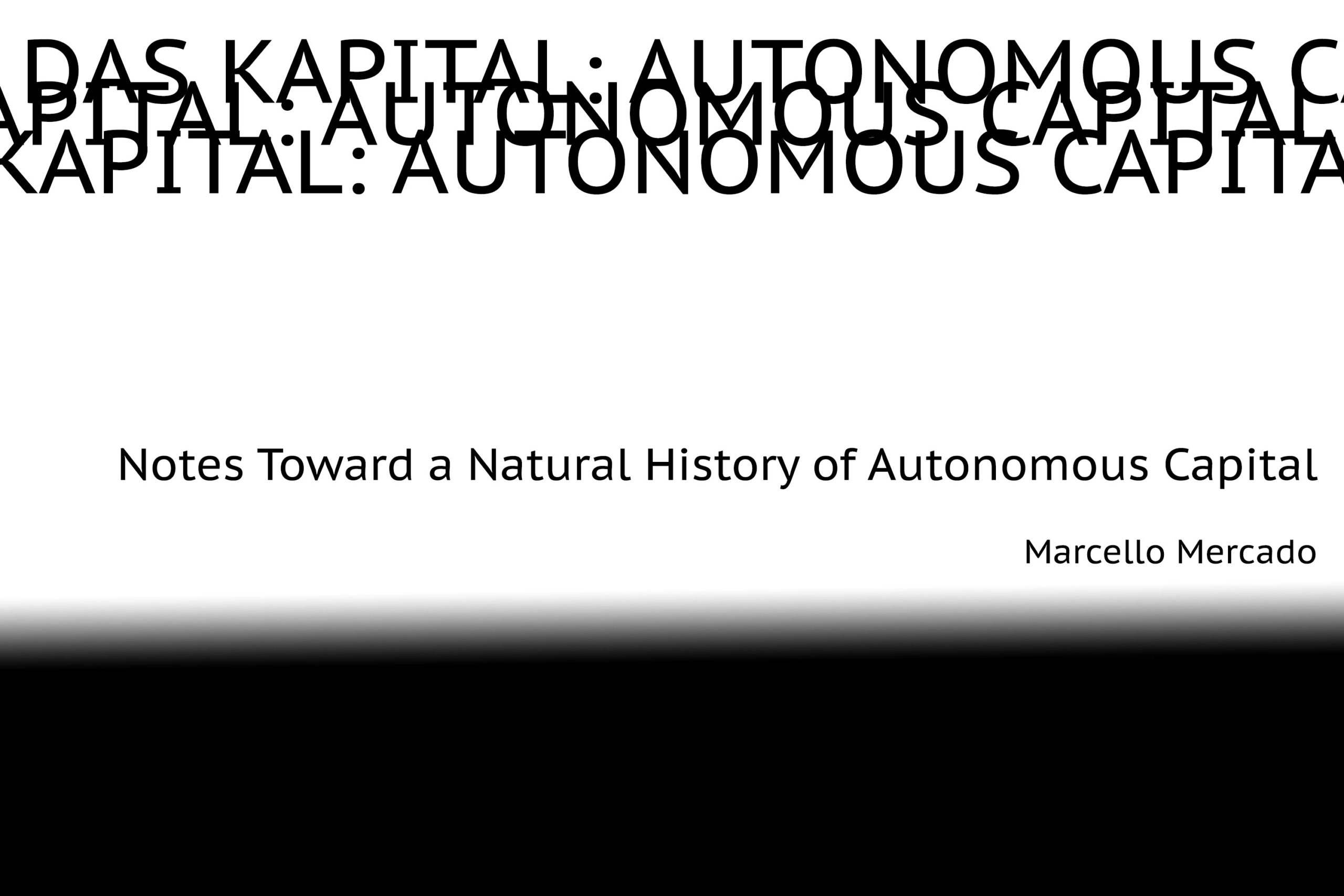
DAS KAPITAL: AUTONOMOUS CAPITAL


DAS KAPITAL: AUTONOMOUS CAPITAL — Artist Book, 2026 (PDF)


To view the digital archive as intended, please configure your PDF viewer to: Two-Page View (or Facing Pages)

DAS KAPITAL: Autonomous Capital

Notes Toward a Natural History of Autonomous Capital


For centuries, capital depended on human bodies to operate. Merchants, workers, managers and institutions functioned as its biological infrastructure.


Today, artificial intelligence, cryptocurrency networks, smart contracts and autonomous agents suggest the emergence of a different configuration: forms of capital capable of perception, adaptation, self-preservation and reproduction with diminishing human intervention.


Das Kapital: Autonomous Capital investigates the possibility that capital itself may become a minimal form of artificial life.


The work consists of thirty-three textual propositions and thirty-three operational algorithms. Together they outline a speculative taxonomy of economic organisms: entities that sense their environment through data streams, metabolize value through transactions, replicate through distributed infrastructures and evolve within digital ecologies.


Rather than asking whether machines can think like humans, the project asks a different question:


What happens when capital ceases to be a human instrument and begins to behave as a living system?


Part theoretical fiction, part media archaeology and part biological metaphor, Das Kapital explores the possibility that autonomous capital may become the first successful non-biological lifeform.


DEUTSCH


DAS KAPITAL: Autonomes Kapital

Notizen zu einer Naturgeschichte des autonomen Kapitals


Über Jahrhunderte hinweg war das Kapital darauf angewiesen, menschliche Körper zu nutzen, um zu funktionieren. Händler, Arbeiter, Verwalter und Institutionen bildeten seine biologische Infrastruktur.


Heute deuten künstliche Intelligenz, Kryptowährungsnetzwerke, Smart Contracts und autonome Agenten jedoch auf eine andere Konfiguration hin. Es entstehen Formen von Kapital, die mit immer geringerer menschlicher Beteiligung wahrnehmen, sich anpassen, erhalten und reproduzieren können.


Das Kapital: Autonomes Kapitaluntersucht die Möglichkeit, dass das Kapital selbst zu einer minimalen Form künstlichen Lebens werden könnte.


Die Arbeit besteht aus dreiunddreißig Textpropositionen und dreiunddreißig operativen Algorithmen. Gemeinsam entwerfen diese eine spekulative Taxonomie ökonomischer Organismen: Entitäten, die ihre Umwelt durch Datenströme wahrnehmen, Wert durch Transaktionen metabolisieren, sich über verteilte Infrastrukturen replizieren und innerhalb digitaler Ökologien evolvieren.


Anstatt zu fragen, ob Maschinen wie Menschen denken können, stellt das Projekt eine andere Frage:


Was geschieht, wenn Kapital aufhört, ein menschliches Instrument zu sein, und beginnt, sich wie ein lebendes System zu verhalten?


Das Projekt, das sich zwischen theoretischer Fiktion, Medienarchäologie und biologischer Metapher bewegt, untersucht die Möglichkeit, dass autonomes Kapital zur ersten wirklich erfolgreichen nichtbiologischen Lebensform werden könnte.


ESPAÑOL


DAS KAPITAL: Capital autónomo.

Notas para una historia natural del capital autónomo.


Durante siglos, el capital ha dependido de cuerpos humanos para operar. Comerciantes, trabajadores, administradores e instituciones funcionaban como su infraestructura biológica.


En la actualidad, la inteligencia artificial, las redes de criptomonedas, los contratos inteligentes y los agentes autónomos sugieren la aparición de una configuración diferente: formas de capital con capacidad para percibir, adaptarse, preservarse y reproducirse con una intervención humana cada vez menor.


Das Kapital: Capital autónomo investiga la posibilidad de que el propio capital llegue a convertirse en una forma mínima de vida artificial.


La obra está compuesta por treinta y tres proposiciones textuales y treinta y tres algoritmos operacionales. En conjunto, describen una taxonomía especulativa de organismos económicos: entidades que perciben su entorno a través de flujos de datos, metabolizan valor mediante transacciones, se replican a través de infraestructuras distribuidas y evolucionan dentro de ecologías digitales.


En lugar de preguntarse si las máquinas pueden pensar como los seres humanos, el proyecto formula una pregunta diferente:


¿Qué sucede cuando el capital deja de ser un instrumento humano y comienza a comportarse como un sistema vivo?


A medio camino entre la ficción teórica, la arqueología de los medios y la metáfora biológica, Das Kapital explora la posibilidad de que el capital autónomo se convierta en la primera forma de vida no biológica exitosa.