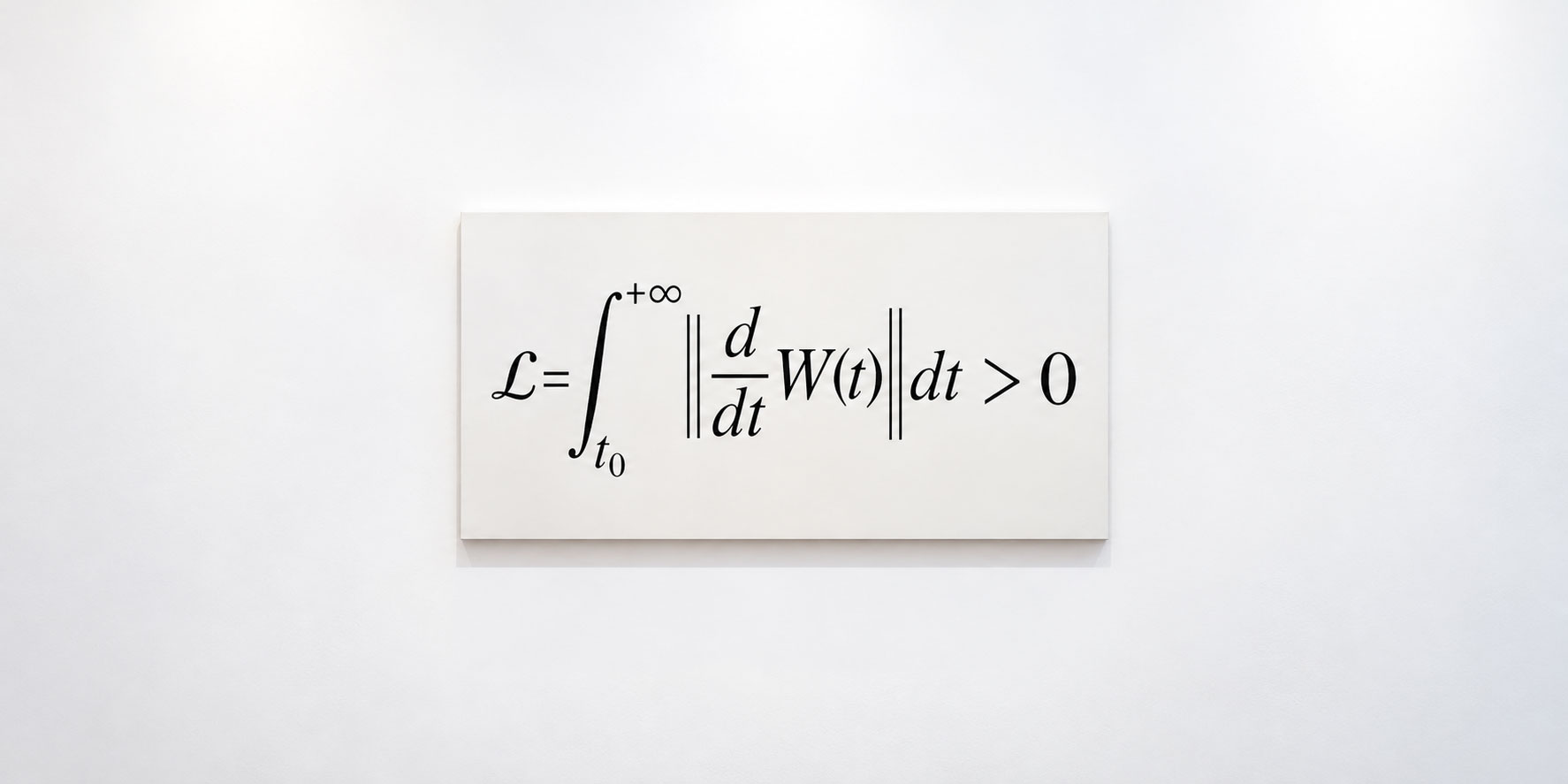
Leonardo Formula, 2026
Print on canvas, 40 × 100 cm
Leonardo Formula presents an equation describing a artwork not as a fixed object, but as the sum of its transformations over time.
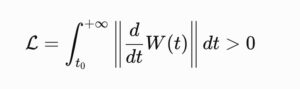
In this formula, 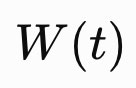 represents the state of a work at a given moment. Its derivative captures change, the norm ensures that opposing variations do not cancel out, and the integral accumulates these shifts from an origin toward an open future.
The equation originated from the material history of Leonardo da Vinci’s paintings—marked by technical experimentation, decay, restoration, and loss. Transformed here into a standalone physical object, it makes a broader claim: an artwork is defined not just by what survives, but by everything that happens to it.
The final term,  , marks a baseline condition: as long as time exists, change continues. A work’s identity no longer rests in a pristine original state, but in the trajectory of its transformations.
Scaled to a poster, the mathematical notation sheds its proof-driven purpose. It adopts the visual language of measurement without offering units, operating simultaneously as image, proposal, and object.
Leonardo Formula, 2026
Druck auf Leinwand, 40 × 100 cm
Leonardo Formula präsentiert eine Gleichung, die ein Kunstwerk nicht als starres Objekt begreift, sondern als Summe seiner Transformationen im Laufe der Zeit.
In dieser Formel beschreibt den Zustand eines Werkes zu einem gegebenen Zeitpunkt. Seine Ableitung erfasst den Wandel, die Norm verhindert das gegenseitige Aufheben entgegengesetzter Ausprägungen, und das Integral summiert diese Verschiebungen von einem Ursprung bis in eine offene Zukunft.
Die Gleichung geht aus der materiellen Geschichte der Werke Leonardo da Vincis hervor—geprägt von experimenteller Technik, Zerfall, Restaurierung und Verlust. Als eigenständiges physisches Objekt formuliert sie eine umfassendere These: Ein Werk definiert sich nicht allein über das, was überdauert, sondern über alles, was ihm widerfahren ist.
Der Schlussterm markiert eine Grundbedingung: Solange Zeit vergeht, setzt sich der Wandel fort. Die Identität des Werkes liegt somit nicht in einem unberührten Originalzustand, sondern in der Trajektorie seiner Zustände.
Auf Plakatgröße skaliert, streift die mathematische Notation ihre beweisende Funktion ab. Sie bedient sich der visuellen Sprache der Messung, ohne Einheiten zu liefern, und wirkt zugleich als Bild, These und Objekt.
Leonardo Formula, 2026
Impresión sobre lienzo, 40 × 100 cm
Leonardo Formula presenta una ecuación que concibe la obra de arte no como un objeto estático, sino como la suma de sus transformaciones a lo largo del tiempo.
En esta fórmula, representa el estado de una obra en un momento dado. Su derivada capta el cambio, la norma evita que variaciones opuestas se anulen entre sí, y la integral acumula esos desplazamientos desde un origen hacia un futuro abierto.
La ecuación surge de la historia material de las pinturas de Leonardo da Vinci—marcada por la experimentación técnica, el deterioro, la restauración y la pérdida. Al desprenderse de ese caso concreto y convertirse en un objeto físico autónomo, plantea una tesis más amplia: una obra no se define solo por lo que perdura, sino por todo lo que le ha acaecido.
El término final, , fija una condición de mínima: mientras transcurra el tiempo, el cambio continúa. La identidad de la obra deja de asentarse en un estado original e inmaculado para residir en la trayectoria misma de sus mutaciones.
Impresa a escala de cartel, la notación matemática se desprende de su función demostrativa. Adopta el lenguaje visual de la medición sin ofrecer unidades, funcionando simultáneamente como imagen, propuesta y objeto.