
COCÓ — Artist Book, 2026 (PDF)
Since the early 1990s, Marcello Mercado’s artistic practice has been characterised by processes of transduction between different systems of representation. Texts, archives, organisms, biological sequences and images are displaced across different media and scales, resulting in configurations that no longer fully resemble their previous states.
Cocó is part of this ongoing investigation.
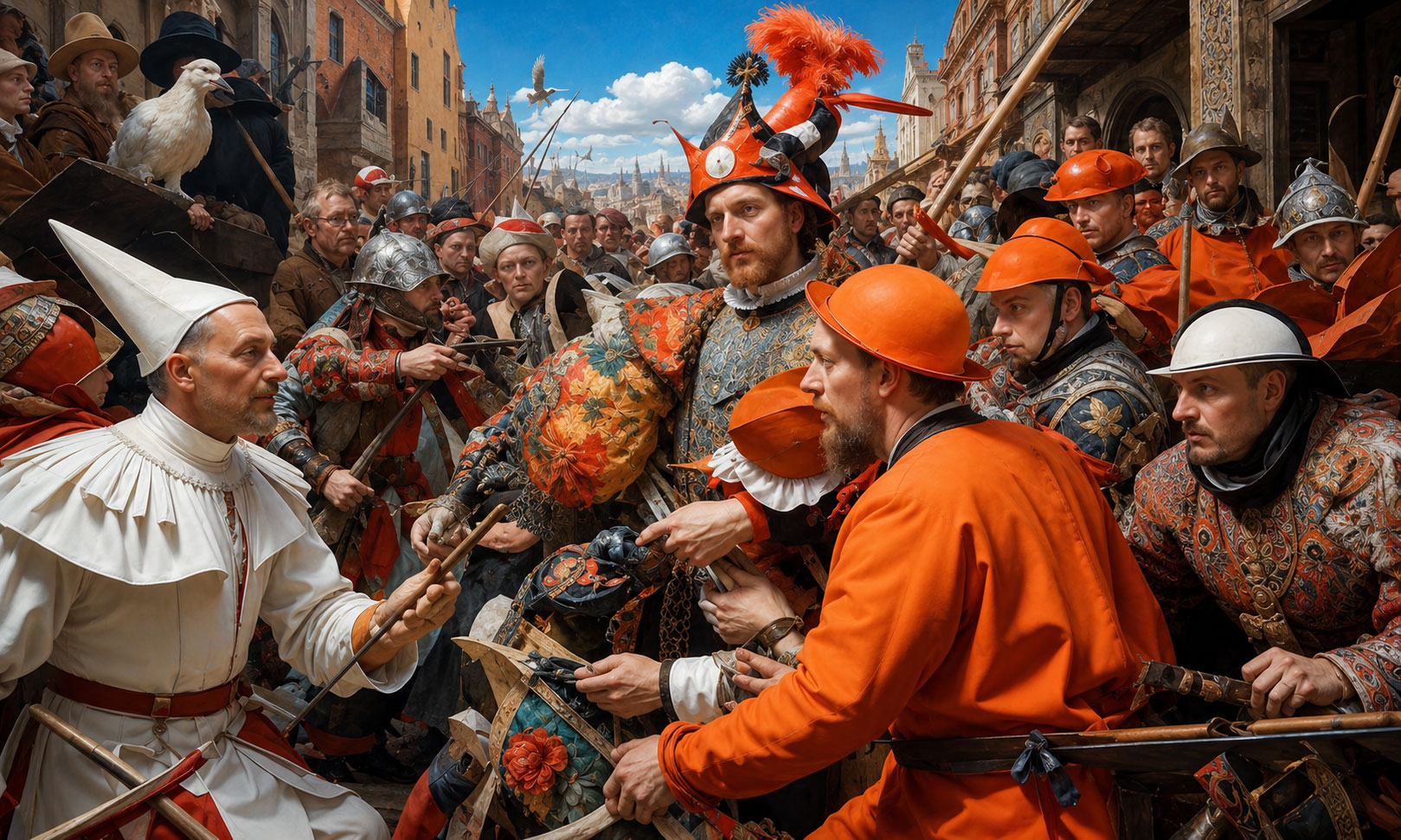
In 2024, following a uterine infection, Cocó — the artist’s dog — underwent surgery involving the removal of her uterus. Photographs of the organ taken after the operation became the starting point for a series of experiments with image synthesis models. Used as source images, they underwent successive transformations through prompts constructed from European pictorial traditions spanning the fifteenth to the seventeenth centuries.
This process confronts visual archives that were originally unrelated: photographs of Cocó’s uterus and a set of pictorial organisations associated with spatial complexity, proliferating figures, collective scenes, dense architectures, and the simultaneity of events that characterise this European visual repertoire.
From this confrontation emerge images in which none of the original materials can be directly identified. There is no recognisable painting. No visible anatomy. No reconstructed historical scene. While the original materials disappear as representations, they continue to operate as organising principles.
The images appear to be structured by biological rather than narrative logic. Figures multiply, bodies expand, and architectures acquire behaviours analogous to organic growth. Space becomes denser through processes of accumulation, branching and proliferation, which displace the traditional hierarchies of historical painting. Cities, processions, battles and ceremonial landscapes emerge as temporary manifestations of a single visual organisation.
Biological organs and pictorial traditions incorporated into the process only survive as relational structures. They no longer function as recognisable representations, but as relations of growth, occupation, expansion and complexity, which persist even after their original forms have disappeared.
Cocó’s images constitute a third entity: a visual form that arises from the confrontation of heterogeneous archives which can no longer be restored to their original states.
This series explores the concept of survival without representation, where images vanish yet the principles that organised them persist.
Deutsch
Seit den frühen 1990er Jahren ist die künstlerische Praxis von Marcello Mercado durch Prozesse der Transduktion zwischen unterschiedlichen Repräsentationssystemen geprägt. Texte, Archive, Organismen, biologische Sequenzen und Bilder werden über verschiedene Medien, Maßstäbe und Kontexte hinweg verschoben und erzeugen Konfigurationen, die ihren ursprünglichen Zuständen nicht mehr vollständig ähneln.
Cocó ist Teil dieser fortlaufenden Untersuchung.
Im Jahr 2024 musste Cocó – die Hündin des Künstlers – infolge einer Gebärmutterinfektion operiert werden. Die nach dem Eingriff aufgenommenen Fotografien des entfernten Organs wurden zum Ausgangspunkt einer Reihe von Experimenten mit Bildsynthesemodellen. Als Ausgangsbilder verwendet, durchliefen sie aufeinanderfolgende Transformationen mittels Prompts, die aus europäischen Bildtraditionen des 15. bis 17. Jahrhunderts entwickelt wurden.
Der Prozess bringt ursprünglich voneinander unabhängige Bildarchive miteinander in Beziehung: Fotografien von Cocós Gebärmutter und bildliche Ordnungen, die durch räumliche Komplexität, die Vervielfachung von Figuren, kollektive Szenen, dichte Architekturen und die Gleichzeitigkeit von Ereignissen geprägt sind.
Aus dieser Konfrontation entstehen Bilder, in denen keines der Ausgangsmaterialien direkt identifizierbar bleibt. Es gibt keine erkennbare Malerei. Keine sichtbare Anatomie. Keine rekonstruierte historische Szene. Während die ursprünglichen Materialien als Repräsentationen verschwinden, wirken sie weiterhin als organisierende Prinzipien.
Die Bilder scheinen eher einer biologischen als einer narrativen Logik zu folgen. Figuren vervielfachen sich, Körper dehnen sich aus, und Architekturen entwickeln Verhaltensweisen, die organischem Wachstum ähneln. Der Bildraum verdichtet sich durch Prozesse der Akkumulation, Verzweigung und Proliferation, welche die traditionellen Hierarchien der Historienmalerei verschieben. Städte, Prozessionen, Schlachten und zeremonielle Landschaften erscheinen als vorübergehende Manifestationen einer einzigen visuellen Organisation.
Die in den Prozess eingebrachten biologischen Organe und Bildtraditionen überleben ausschließlich als relationale Strukturen. Sie fungieren nicht länger als erkennbare Darstellungen, sondern als Beziehungen von Wachstum, Ausbreitung, Verdichtung und Komplexität, die selbst nach dem Verschwinden ihrer ursprünglichen Formen fortbestehen.
Die Bilder von Cocó bilden eine dritte Entität: eine visuelle Form, die aus der Konfrontation heterogener Archive hervorgeht und nicht mehr in ihre ursprünglichen Zustände zurückgeführt werden kann.
Die Serie untersucht die Möglichkeit eines Überlebens ohne Repräsentation – einen Zustand, in dem die Bilder verschwinden, während die Prinzipien, die sie organisiert haben, weiterwirken.
Español
Desde comienzos de la década de 1990, la práctica artística de Marcello Mercado se ha caracterizado por procesos de transducción entre distintos sistemas de representación. Textos, archivos, organismos, secuencias biológicas e imágenes son desplazados entre medios, escalas y contextos, dando lugar a configuraciones que ya no conservan plenamente la forma de sus estados anteriores.
Cocó forma parte de esta investigación sostenida.
En 2024, tras una infección uterina, Cocó —la perra del artista— fue sometida a una intervención quirúrgica en la que se le extrajo el útero. Las fotografías tomadas después de la operación se convirtieron en el punto de partida de una serie de experimentos con modelos de síntesis de imágenes. Utilizadas como imágenes fuente, fueron transformadas sucesivamente mediante instrucciones construidas a partir de tradiciones pictóricas europeas de los siglos XV al XVII.
El proceso pone en relación archivos visuales originalmente inconexos: fotografías del útero de Cocó y repertorios pictóricos asociados a la complejidad espacial, la proliferación de figuras, las escenas colectivas, las arquitecturas densas y la simultaneidad de acontecimientos que caracterizan buena parte de la tradición visual europea.
De esta confrontación surgen imágenes en las que ninguno de los materiales originales puede identificarse directamente. No hay pintura reconocible. No hay anatomía visible. No hay escena histórica reconstruida. Aunque los materiales iniciales desaparecen como representaciones, continúan operando como principios organizadores.
Las imágenes parecen estructurarse según una lógica biológica más que narrativa. Las figuras se multiplican, los cuerpos se expanden y las arquitecturas adquieren comportamientos análogos al crecimiento orgánico. El espacio se densifica mediante procesos de acumulación, ramificación y proliferación que desplazan las jerarquías tradicionales de la pintura histórica. Ciudades, procesiones, batallas y paisajes ceremoniales emergen como manifestaciones temporales de una única organización visual.
Los órganos biológicos y las tradiciones pictóricas incorporados al proceso sobreviven únicamente como estructuras relacionales. Ya no funcionan como representaciones identificables, sino como relaciones de crecimiento, ocupación, expansión y complejidad que persisten incluso después de la desaparición de sus formas originales.
Las imágenes de Cocó constituyen una tercera entidad: una forma visual que surge de la confrontación entre archivos heterogéneos que ya no pueden ser restituidos a sus estados iniciales.
La serie explora la posibilidad de una supervivencia sin representación: un régimen visual en el que las imágenes desaparecen, pero los principios que las organizaron continúan actuando.