• Procesar Destruir Representar Archivar [Process Destruct Represent Archive]

    Procesar Destruir Representar Archivar [Process Destruct Represent Archive]

    02.07.2020 – 03.09.2020


    Marcello Mercado 2020


    Procesar Destruir Representar Archivar [Process Destruct Represent Archive]


    Monitor 1: Facundo traducido [Translated Facundo], 5’
    Monitor 2: Martín Fierro traducido [Translated Martín Fierro], 5’
    The two milestones of national literature, Facundo by Sarmiento and Martín Fierro by Hernández, are remade through algorithmic processes that empty their content, destroy them and reencounter them.


    The chaos and math contribute to the confrontation: Facundo “weights” digitally and textually 395 kb, and Martín Fierro, 101 kb, while the audio-book versions weigh 427,4 MB and 361,8 MB respectively.

    The first step was to translate the books to a language invented by me, which has no meaning at all. The books may be leafed through, but the meaning is lost, though it seems to be there. Then, I mix/bundle both audio-books as soundtracks. From this mix, I take a fragment and obtain a photograph that shows a graphic representation of the sound of the combined books. The audio that cannot be heard can be seen. The founding ideas are erased. How can we read what’s invented/what we invent?


    Details

    • Title: Procesar Destruir Representar Archivar [Process Destruct Represent Archive]
    • Creator: Marcello Mercado
    • Date Created: 2020
    • Date Published: 2020
    • Location: Roque Sáenz Peña, Chaco
    • Physical Dimensions: 200 x 150 cm
    • Original Language: Español
    • Provenance: 11th Itau Visual Arts Award Selection
    • Type: Video installation
    • Publisher: Itaú Foundation Argentina
    • External Link:

      Link to video of the active work

    • Medium: animation and photograph


    Source: Itaú Cultural Visual Arts Award 2019-2020 Catalogue


    Fundación Itaú Argentina

    Victoria Ocampo 360 – 4th Floor – Puerto Madero.
    C1107DAB Buenos Aires
    Argentina


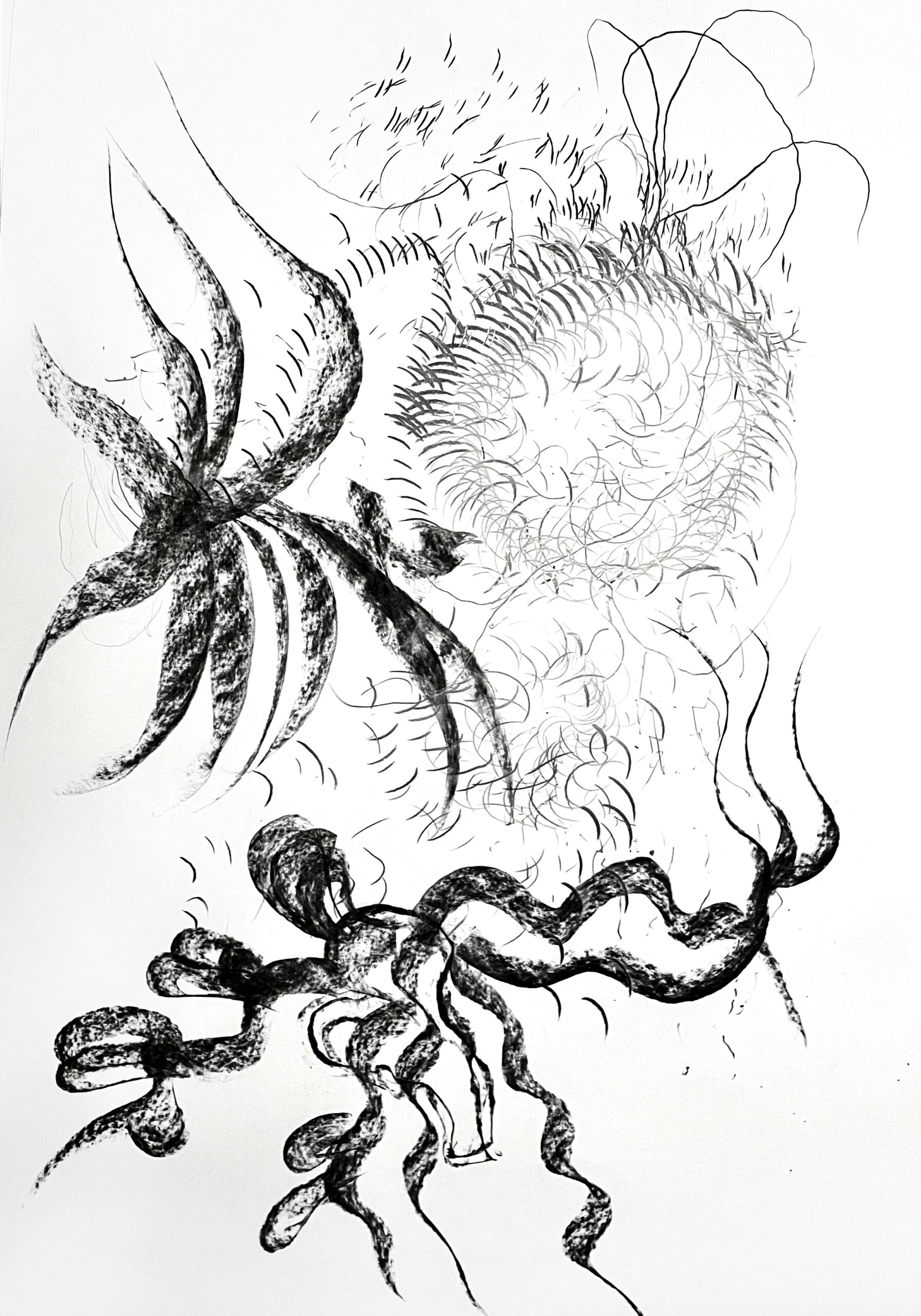
  • Marcello Mercado, drawing, 2020

    Marcello Mercado, drawing, 2020


    Marcello Mercado

    pencil on paper

    2020

  • Netart Performance, Das Kapital Glossolalia, August 9, 1999

    Netart Performance, Das Kapital Glossolalia, August 9, 1999


    Performed from a classroom at the Kunsthochschule für Medien Köln on 9 August 1999, this work belongs to the first generation of artistic experiments that understood the internet not as a site of representation, but as a space of transmission, delay, instability and bodily displacement.

    In the piece, Marcello Mercado streams himself reading fragments from Chapter 7 of Karl Marx’s Das Kapital, but the text does not appear in German, Spanish or any recognizable language. Instead, it is translated live into a private glossolalia: an improvised and unstable idiom situated somewhere between speech, noise, stuttering, trance and machine transmission.

    The choice of Chapter 7 is crucial. Marx describes there the transformation of labor into abstraction, the passage from living activity into measurable, exchangeable labor power. Mercado responds by producing the opposite movement: language is removed from communication and returned to the body. Meaning collapses into breath, repetition, interruption and vocal residue. The voice no longer explains the text; it exposes its material underside.

    Seen today, the work appears remarkably prescient. Produced in 1999, before the normalization of streaming platforms, webcams and networked self-performance, it anticipates many later conditions of digital culture: the mediated body, the unstable online subject, the conversion of presence into data, and the circulation of voices detached from fixed identity.

    But unlike later forms of online self-exposure, this work remains opaque. The performer does not present himself as a stable individual speaking to an audience. He appears instead as a transmitter or channel through which political language becomes fragmented, displaced and estranged. The webcam image is poor, dark and delayed; the body is almost dissolved inside the technical conditions of the network. What reaches the viewer is not a message, but the failure of transparent communication.

    For this reason, the work should not be understood simply as an early web performance. It is also an investigation into translation, labor and the body under conditions of technological mediation. Mercado transforms Marx’s text into an acoustic ruin: a broken language that resists both ideology and information.

    The performance occupies a singular place between net art, sound poetry, conceptual performance and media archaeology. It belongs to a historical moment in which artists were beginning to test how the internet could function not as a tool, but as an unstable aesthetic medium. Here, the network is not used to connect bodies seamlessly across distance. On the contrary: it reveals distance, distortion and disconnection as the true condition of contemporary communication.

    More than twenty-five years later, the work retains an unexpected force. In an age saturated by instantaneous translation, algorithmic voices and permanent online speech, Mercado’s glossolalia appears less as an eccentric gesture than as a radical refusal: the insistence that there are still experiences, bodies and political affects that cannot be fully translated into the language of the network.


  • Magazine des Cultures digitales: Bio-Arts L’essence de la vie

    Magazine des Cultures digitales: Bio-Arts L’essence de la vie

    07.04.2020


    Magazine des Cultures digitales: Bio-Arts L’essence de la vie


    La Nature, la Vie, le Vivant : des concepts philosophiques au cœur de la création artistique, de la poétique et des sciences. Depuis la fin des années 1980-début des années 1990, l’art a quitté le domaine de la représentation pour créer avec la dynamique même du vivant ce que l’on nomma alors le “bio-art”. Quelque vingt-cinq ans plus tard, les techniques et les formes ont évolué et se sont diversifiées, le bio-art s’écrit désormais au pluriel.


    Depuis les années 1990, de nombreux artistes se sont aventurés sur ce terrain (Marta De Menezes, Joe Davis, Jun Takita, Adam Zaretsky, Brandon Ballengée, CriticaI Art Ensemble, Polona Tratnik, Julia Reodica, Marcello Mercado, Niki Sperou pour n’en citer que quelques uns), instaurant une forte collaboration entre l’art et la science. On compte parmi eux le Brésilien Eduardo Kac qui en 2000 a présenté GFP Bunny (Alba), la célèbre lapine albinos à qui l’on avait transplanté une mutation synthétique du gène fluorescent de la méduse Aequorea Victoria. Alba, une lapine transgénique, devenait sous une lumière particulière une chimère fluorescente, et pas seulement du point de vue biologique. Alba est issue d’une expérience somme toute ordinaire menée à l’INRA (l’Institut National de la Recherche Agronomique à Paris) et sans doute dans d’autres structures de ce genre à travers le monde, qu’Eduardo Kac a rendue publique par une sorte de performance médiatique.


    [+] PDF


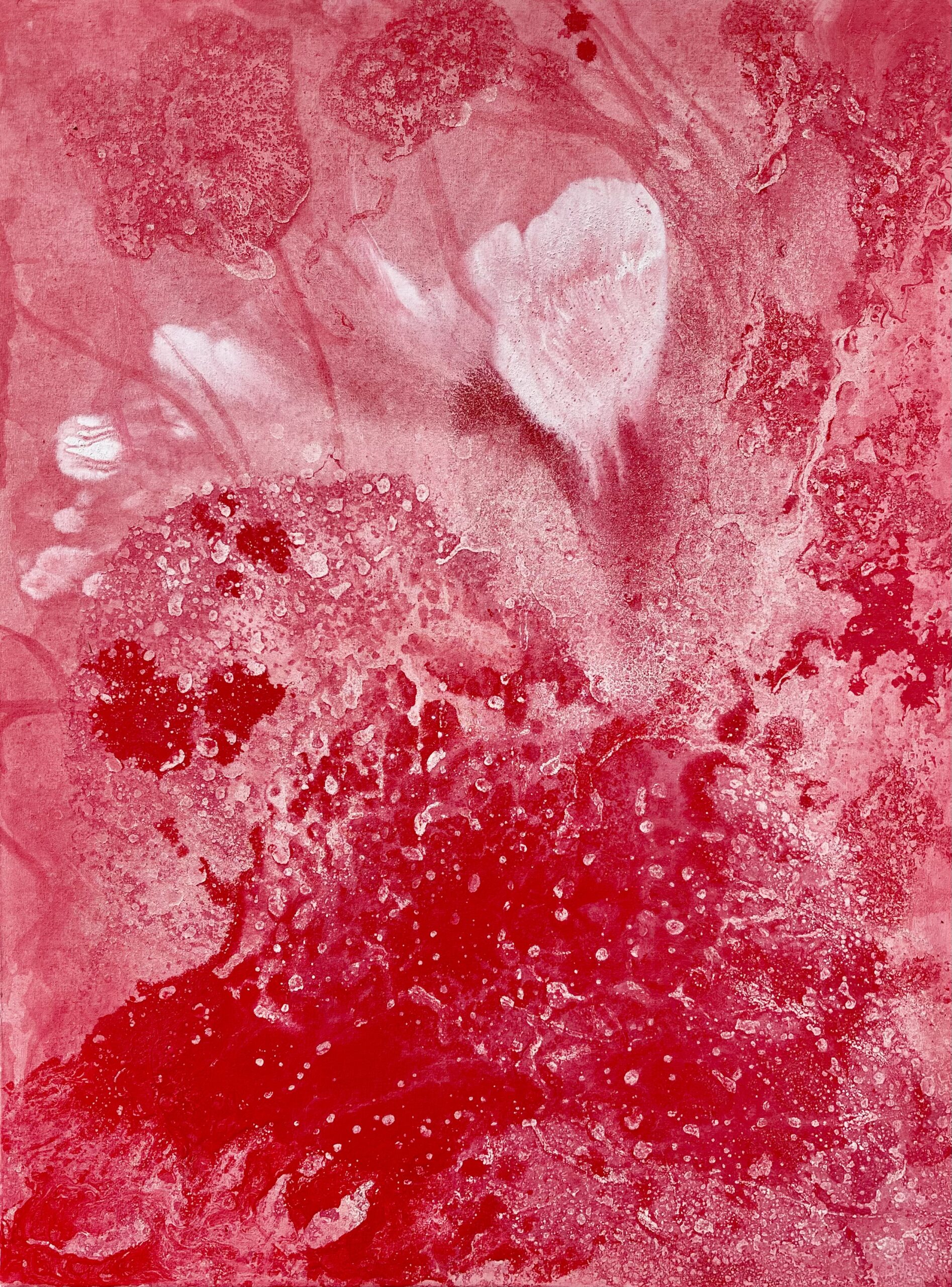
  • Marcello Mercado, origami, 2020

    Marcello Mercado, origami, 2020

    Marcello Mercado

    Cut off

    corona genome´s origami

    2020


  • 73° Salón Nacional de Rosario

    73° Salón Nacional de Rosario

    04.10.2019 – 15.03.2020

    73° Salón Nacional de Rosario


    Artistas: Antonella Agesta, Rodrigo Alcon Quintanilha, Facundo Belén, Vico Bueno, Aurora Castillo, Carla Colombo, Cotelito, Diego de Aduriz, Alfredo Dufour, Clara Esborraz, Elvira Ferrazini, Víctor Florido, Alfredo Frías, Jazmín Giordano, Silvia Gurfein, Mónica Heller, Carlos Huffmann, La quemada – teatro de figuras [Emiliana Arias, Silvia Lenardón, Guillermo Martínez y Soledad Verdún], Martín Legón, Lucrecia Lionti, Valeria Maggi, Matías Malizia, Inés Marcó, Gustavo Marrone, Francisco Medail, Marcello Mercado, Flor Meyer, Clara Miño, Ariel Mora, Malena Pizani, Fabio Risso Pino, Alberto Antonio Romero en colaboración con Susi Villa, Maximiliano Rossini, Rob Verf, Mariela Vita.


    Macro

    Museo de arte contemporáneo de Rosario

    Avenida de la Costa Brig. Estanislao López 2250

    (Bv. Oroño y el río Paraná)

    2000 Rosario
    Argentina


  • Marcello Mercado, drawing, 2019

    Marcello Mercado, drawing, 2019


    Marcello Mercado

    RO_01

    pencil and ink on paper

    100cm x 80cm

    2019


  • Marcello Mercado, drawing, 2019

    Marcello Mercado, drawing, 2019


    Marcello Mercado

    RO_02

    pencil and ink on paper

    100cm x 80cm

    2019

  • Book: Peter Krüll – Bilderschreiben

    Book: Peter Krüll – Bilderschreiben

    10.10.2018


    Book: Peter Krüll – bilderschreiben


    Writing or image? Handwriting as a central, significant and currently very topical stylistic device. Beautiful or outrageous – legible and enigmatic. This book ‘Peter Krüll – bilderschreiben’ presents more than 150 selected exhibits by artists and designers. The collection is fascinating to look at and shows how complex the topic of “handwriting” or the “written” image is.


    “Writing is the painting of words,” Ben Vautier once said. Handwriting has long been, and is once again, a central stylistic device in art and design. Sometimes beautiful, sometimes outrageous – legible as well as enigmatic.

    The book ‘Peter Krüll – bilderschreiben,’ which is in color throughout and of high quality, brings together more than 150 works by artists, designers and students on the subject of the “written” image. The professor of typography and graphic design has compiled a representative selection of works with great skill and extensive knowledge, and in doing so has unearthed treasures by well-known artists, among others, which are not necessarily widely known as famous works of the same.


    Paul Klee, Joseph Beuys, Jean Tinguely or Antoni Tàpies used handwriting as an artistic element in works. Robert Rauschenberg wrote the logo for the “Moderna Museet” in Stockholm; the designer duo Vier5 from Paris surprised us at Documenta 12 with a handwritten signage system. Many posters by the designers Grapus, Niklaus Troxler, Stefan Sagmeister or Fons Hickmann, among others, have become famous through their handwriting. Exceptional and remarkable are also the projects of word drawings or word paintings of “Asemic Writing”. Calligraphy is not only an art with a long and varied tradition worldwide, but is also used in visual poetry or visual music, as the works of Gerhard Rühm or John Cage show. And of course there are plenty of magazines, books, CD’s or record covers that have been uniquely designed using handwritten words.


    Artists:


    Herbert Achternbusch, Akatre, Atelier Formes Vives, Alice Attie, Honoré de Balzac, François-Marie Banier, Peter Bankov, Fiona Banner, Martine Bertrand, Joseph Beuys, Mila Blau, Anthony Braxton, August von Briesen, Nancy Burr, John Cage, Rebecca Chew, Allesandro De Francesco, Mirtha Dermisache, Christian Dotremont, Eva Dranaz, Michael Dumontier, Heinz Edelmann, Gia Edzgveradze, Neil Farber, Ed Fella, Martin Galton, Yvonne Gargano, Pierre Garnier, Marco Giovenale, Anselm Glück, Grapus, Jon Gray, Christoph Grünberger, Florian und Romano Hänni, Patrick Hartl, Romuald Hengstler, Fons Hickmann, Christian Hundertmark C100, Paul Klee, Peter Krüll, L2M3 Ina Bauer & Sascha Lobe, Gabriel Lalonde, Miriam Londoño, Martino&Jaña, Stefan Marx, Marcello Mercado, Saed Meshki, Joan Miró, Maryam Motallebzadeh, Rudolf Mumprecht, John Bunion Murray, Hiroko Nakajima, Emilio Nanni, Nous Travaillons Ensemble, Hans Ulrich Obrist, JonOne, Yoko Ono, Roman Opalka, Dennis Orel, Peng Peng Klaus Fromherz & Martin Geel mit Gelinda Paganini, Pablo Picasso, Olaf Probst, Guillaume Adjutor Provost, Robert Rauschenberg, Nicholas Rougeux, Gerhard Rühm, SagmeisterWalsh, Yuichi Saito, Stefan Sandner, Shoshu, Manita Songserm, Susann Stefanizen, Strichpunkt Design, Antoni Tàpies, Meliha Teparic, Jean Tinguely, Henryk Tomaszewski, Jouri Toreev, Damien Tran, Niklaus Troxler, Cy Twombly, Ben Vautier, James Victore, Vier5, Robert Walser, Andy Warhol, Jan Willem Welzenis, Daniel Wiesmann, Adolf Wölfli, Barbara Wojirsch, Guoqin Zhu, Zwölf Stefan Guzy & Björn


  • BODENLOS. VILÉM FLUSSER AND THE ARTS

    BODENLOS. VILÉM FLUSSER AND THE ARTS

    05.04.2017 –  07.05.2017

    BODENLOS. VILÉM FLUSSER AND THE ARTS


    curated by: Baruch Gottlieb, Pavel Vančát


    exhibition concept: Baruch Gottlieb, Peter Weibel, Siegfried Zielinski

    exhibition architecture: Oldřich Morys

    graphic design: Jan Slabihoudek

    (opening: Tuesday, 4. 4. 2017 at 6 pm)


    The exhibition “Without Firm Ground: Vilém Flusser and the Arts” at GAMU, Prague presents the life and thoughts of one of the most acclaimed Prague-born intellectuals of the 20th century through the combination of rare documents and artistic collaborations and inspirations. It aspires to weave the threads of Flusser’s private and professional life, marked by various migrations, with those of his thinking and writing through dialogues, influences and collaborations. Following presentations at ZKM Karlsruhe, AdK Berlin and West Den Haag, the next stop of this unique project takes place in Flusser’s native city, adapted and enriched with local ties.

    Vilém Flusser was born in the Bubeneč district of Prague in 1920 and was educated in a middle class Jewish intellectual family. In 1939, after the occupation of the Germans, he fled with his wife-to-be, Edith Barth, first to London, and eventually to Sao Paulo Brazil where he would live for over thirty years. Flusser brought his training in the classics, in Enlightenment Humanist philosophy and literature, to bear on his new environment, revelling in the utopian promise of the radically alien modernity into which he was thrown. Fighting through the despair of the extermination of his family and the horror of the Holocaust, Flusser carved out scintillatingly original, uncompromising philosophical insights into a world of scientific progress, automation and migration. During the 1980s he became one of the most respected philosophical guides of the upcoming electronic era. Even though he died only at the dawn of the Internet age his understanding of networks and communication is every bit as insightful to our contemporary condition as it was then. Through his life, Vilém Flusser sought a new utopian form of thinking, emerging from the crushing disappointment of modernity. He called this “synthetic thinking” using “technical images”. The exhibition will feature, beside biographical trajectories, objects from Flusser’s archive, his typoscripts and positions from artists who knew and loved him, some unique artistic collaborations where he would attempt to enact and elaborate the utopian modes of “synthetic thinking” he described. The selection of artists influenced by Flusser includes renowned personalities of Louis Bec, Michael Bielicky, Fred Forest, Harun Farocki, Joan Fontcuberta, Jiří Hanke, Dieter Jung, Martin Kohout, Andreas Müller-Pohle, Lisa Schmitz, Jiří Skála, among others.

    An essential part of this exhibition project, the international symposium “Playing against the apparatus. Vilém Flusser’s media and culture philosophy”, will be held on April 7th – 8th, at Goethe-Institut in Prague and Charles University in Prague (Faculty of Arts). We will rework some of the themes in the exhibition: migration, technological change, the crises of writing, causal thinking and the humanist project.  We explore Flusser’s utopian proposals for new humanisms and new modes of information and communication for our contemporary condition of rapid technological transformation, playing with and against the apparatus. Join us for a rich and invigorating adventure through the life and work of a Czech pioneer of media thinking and philosophy for our networked age! The exhibition is held in collaboration with the Vilém Flusser Archiv/ Universität der Künste Berlin.


    GAMU (Gallery AMU)

    Malostranské náměstí 12

    Praha 1

    Czech Republic

    (entrance from the passage to Tržiště Street)
    open daily except Monday: 1 – 7 pm

  • Marcello Mercado: Fragments of “Das Kapital Teil 1” (1999–2009) | Potential Spaces

    Marcello Mercado: Fragments of “Das Kapital Teil 1” (1999–2009) | Potential Spaces

    16.02.2017 -18.02.2017


    Potential Spaces


    Marcello Mercado: Presentation of fragments of his work “Das Kapital Teil 1” (1999–2009) in conversation with Siegfried Zielinski


    Karlsruhe University of Arts and Design & ZKM | Center for Art and Media 16. – 18. 02. 2017


    Event Organizer: Prof. Dr. Siegfried Zielinski, Daniel Irrgang, Ali Gharib


    Camera/Postproduction: Lukas Rehm, Tilman Rödiger


    www.hfg-karlsruhe.de/