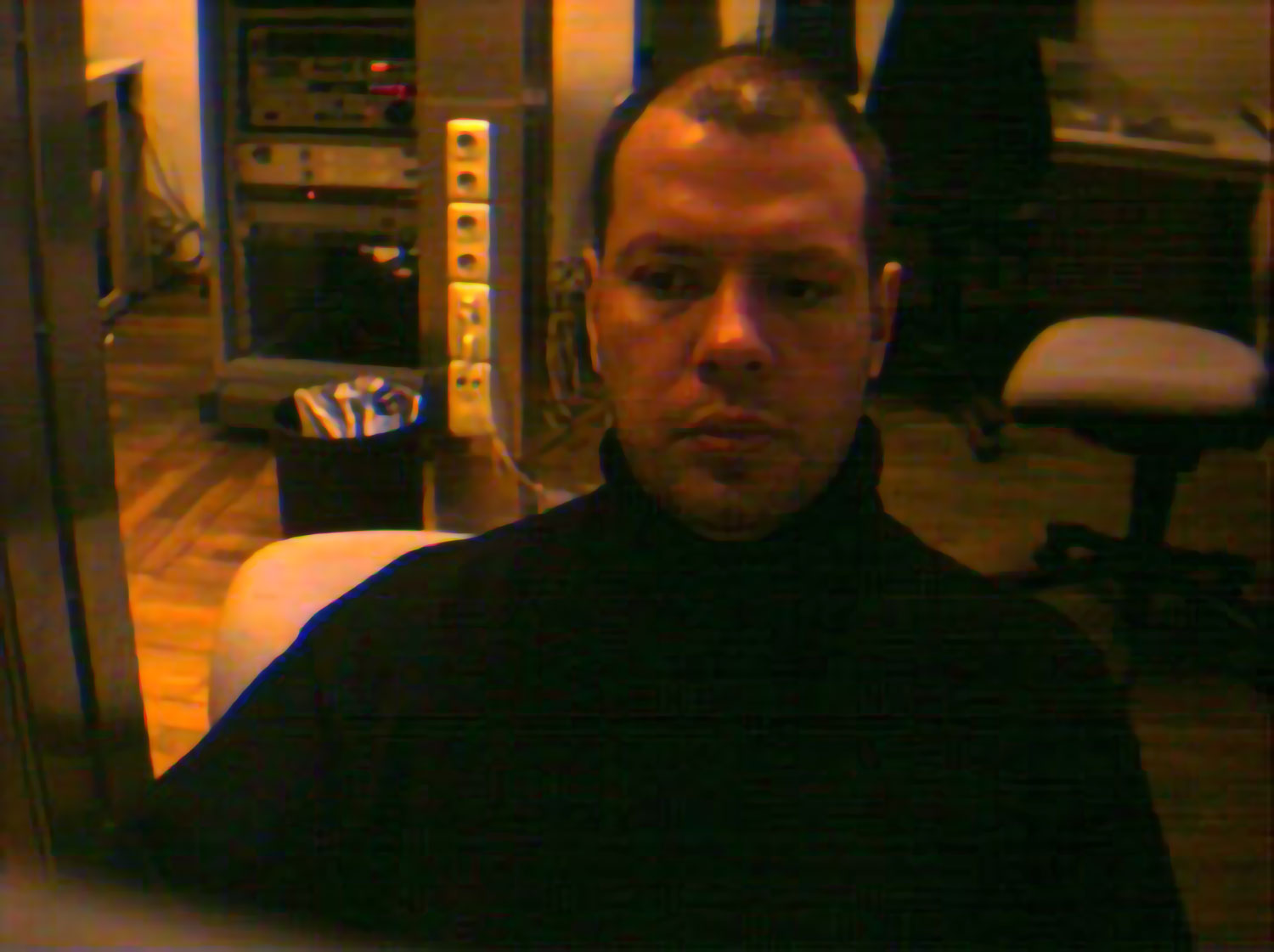

Performed from a classroom at the Kunsthochschule für Medien Köln on 9 August 1999, this work belongs to the first generation of artistic experiments that understood the internet not as a site of representation, but as a space of transmission, delay, instability and bodily displacement.
In the piece, Marcello Mercado streams himself reading fragments from Chapter 7 of Karl Marx’s Das Kapital, but the text does not appear in German, Spanish or any recognizable language. Instead, it is translated live into a private glossolalia: an improvised and unstable idiom situated somewhere between speech, noise, stuttering, trance and machine transmission.
The choice of Chapter 7 is crucial. Marx describes there the transformation of labor into abstraction, the passage from living activity into measurable, exchangeable labor power. Mercado responds by producing the opposite movement: language is removed from communication and returned to the body. Meaning collapses into breath, repetition, interruption and vocal residue. The voice no longer explains the text; it exposes its material underside.
Seen today, the work appears remarkably prescient. Produced in 1999, before the normalization of streaming platforms, webcams and networked self-performance, it anticipates many later conditions of digital culture: the mediated body, the unstable online subject, the conversion of presence into data, and the circulation of voices detached from fixed identity.
But unlike later forms of online self-exposure, this work remains opaque. The performer does not present himself as a stable individual speaking to an audience. He appears instead as a transmitter or channel through which political language becomes fragmented, displaced and estranged. The webcam image is poor, dark and delayed; the body is almost dissolved inside the technical conditions of the network. What reaches the viewer is not a message, but the failure of transparent communication.
For this reason, the work should not be understood simply as an early web performance. It is also an investigation into translation, labor and the body under conditions of technological mediation. Mercado transforms Marx’s text into an acoustic ruin: a broken language that resists both ideology and information.
The performance occupies a singular place between net art, sound poetry, conceptual performance and media archaeology. It belongs to a historical moment in which artists were beginning to test how the internet could function not as a tool, but as an unstable aesthetic medium. Here, the network is not used to connect bodies seamlessly across distance. On the contrary: it reveals distance, distortion and disconnection as the true condition of contemporary communication.
More than twenty-five years later, the work retains an unexpected force. In an age saturated by instantaneous translation, algorithmic voices and permanent online speech, Mercado’s glossolalia appears less as an eccentric gesture than as a radical refusal: the insistence that there are still experiences, bodies and political affects that cannot be fully translated into the language of the network.