

Das Kapital (Restrictions), 2005
Artist’s book
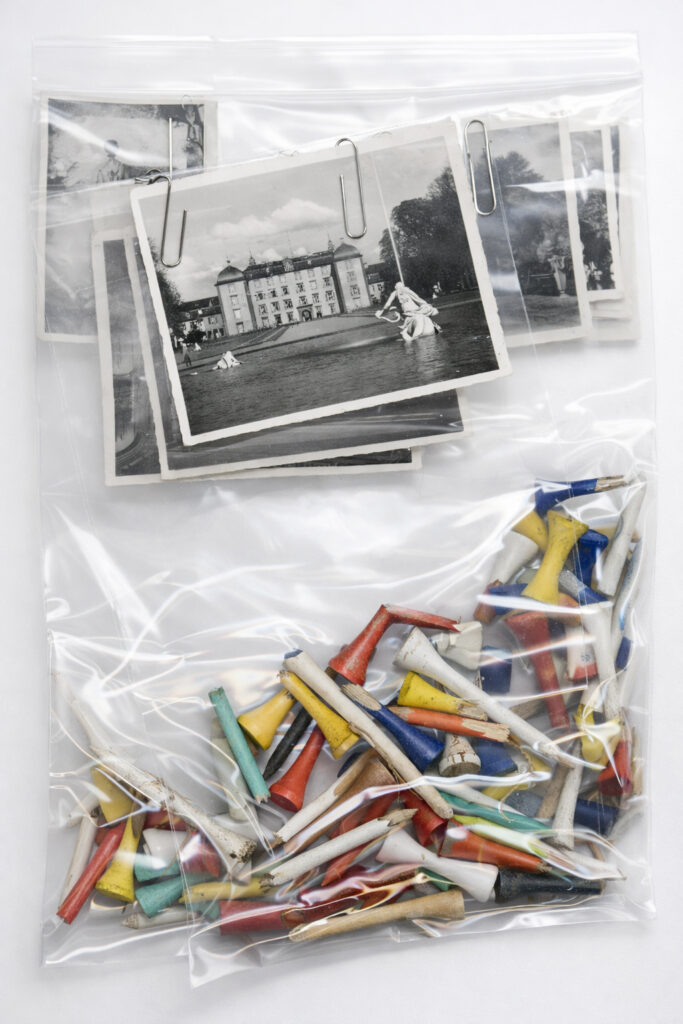
This artist’s book belongs to the series Das Kapital and operates as a material archive of minor gestures, residues, and peripheral economies. Composed of twenty plastic pocket-pages, the book holds broken golf tees collected from golf courses, used golf gloves, and domestic photographs of German houses from the 1950s and 1960s. Its structure does not offer a linear narrative but a system of containment: each bag functions as a unit of storage, separation, and control.
Golf appears here not as sport but as a regime. A game built on repetition, precision, and regulated expenditure of energy, historically embedded in economies of privilege, disciplined leisure, and the territorialization of landscape. The tees—objects designed to be destroyed—condense a logic of programmed consumption: their breaking is not an accident but a condition of use. In this sense, the collected fragments operate as remains of an economy that naturalizes waste under the form of play.
The used gloves introduce a bodily and disciplinary dimension. They are contact surfaces between body and instrument, marked by wear, sweat, and the repetition of a technical gesture. Unlike the tees, which fracture, gloves erode slowly. Both materials register the time of use, but through different temporalities: instant breakage and progressive degradation.
The photographs of German dwellings from the 1950s and 1960s—images originally produced in domestic contexts—add another temporal and political layer. These houses, associated with postwar reconstruction, the normalization of private space, and the stabilization of a welfare economy, are removed from context and reinserted into the book as architecture without inhabitants. They do not function as illustrative historical documents but as silent forms: containers of a promise of order, property, and permanence.
The book thus articulates three systems: play, domesticity, and residue. None is presented spectacularly. The decision to use transparent bags reinforces an aesthetic of provisional archiving, close to museological, forensic, or administrative practices. The object does not seek monumentality but precision: to classify, isolate, and display without hierarchy.
Within Das Kapital, this work shifts the notion of capital from visible accumulation toward its less visible infrastructures: energy expenditure without production, the regulated repetition of leisure, architecture as ideological stabilization, and residue as a form of material truth. Capital appears here not as financial abstraction but as a daily choreography of bodies, objects, and landscapes.
Das Kapital (Restrictions) does not represent power; it measures it in fragments. In remains that do not circulate, in objects that no longer function, in images that persist without a story. The book operates as a device for slow reading, where each pocket-page holds a miniature economy: a relation between use, wear, and control.
More than a documentation book, the work functions as an archival organism: a closed system that exposes, with extreme sobriety, the material conditions of a culture that turns play into industry, the house into model, and residue into norm.
Das Kapital (Restrictions), 2005
Künstlerbuch
Dieses Künstlerbuch gehört zur Serie Das Kapital und konstituiert sich als materielles Archiv kleiner Gesten, von Rückständen und scheinbar randständigen Ökonomien. Das Buch besteht aus zwanzig Blättern, die als transparente Kunststoff-Taschen ausgeführt sind; sie enthalten gebrochene Golf-Tees, die auf Golfplätzen gesammelt wurden, gebrauchte Golfhandschuhe sowie private Fotografien deutscher Häuser aus den 1950er und 1960er Jahren. Die Struktur bietet keine lineare Erzählung, sondern ein System der Verwahrung: Jede Tasche funktioniert als Einheit von Speicherung, Trennung und Kontrolle.
Golf erscheint hier nicht als Sport, sondern als Regime. Als ein Spiel, das auf Wiederholung, Präzision und reguliertem Energieaufwand beruht und historisch in Ökonomien von Privileg, diszipliniertem Freizeitverhalten und der Territorialisierung von Landschaft verankert ist. Die Tees — Objekte, die für ihre Zerstörung entworfen sind — verdichten eine Logik programmierter Konsumption: Ihr Bruch ist kein Unfall, sondern eine Bedingung ihrer Nutzung. In diesem Sinn wirken die gesammelten Fragmente als Reste einer Ökonomie, die Verschleiß und Abfall in der Form des Spiels naturalisiert.
Die gebrauchten Handschuhe führen eine körperliche und disziplinäre Dimension ein. Sie sind Kontaktflächen zwischen Körper und Instrument, geprägt von Abrieb, Schweiß und der Wiederholung eines technischen Gestus. Im Unterschied zu den Tees, die brechen, erodieren Handschuhe langsam. Beide Materialien registrieren Nutzungszeit, jedoch in unterschiedlichen Temporalitäten: plötzliche Fraktur und fortschreitende Abnutzung.
Die Fotografien deutscher Wohnhäuser der 1950er und 1960er Jahre — ursprünglich in privaten Zusammenhängen entstanden — fügen eine weitere zeitliche und politische Schicht hinzu. Diese Häuser, verbunden mit dem Wiederaufbau der Nachkriegszeit, der Normalisierung des Privatraums und der Stabilisierung einer Wohlstandsökonomie, werden aus ihrem Kontext gelöst und als Architektur ohne Bewohner in das Buch re-eingeschrieben. Sie fungieren nicht als illustrative historische Dokumente, sondern als stille Formen: Behälter eines Versprechens von Ordnung, Eigentum und Dauer.
Das Buch verknüpft so drei Systeme: Spiel, Domesticität und Rückstand. Keines davon wird spektakulär inszeniert. Die Entscheidung für transparente Taschen verstärkt eine Ästhetik des provisorischen Archivierens, nahe an museologischen, forensischen oder administrativen Verfahren. Das Objekt zielt nicht auf Monumentalität, sondern auf Präzision: klassifizieren, isolieren, zeigen — ohne zu hierarchisieren.
Innerhalb von Das Kapital verschiebt diese Arbeit den Begriff des Kapitals von der sichtbaren Akkumulation hin zu ihren weniger sichtbaren Infrastrukturen: Energieaufwand ohne Produktion, die regulierte Wiederholung von Freizeit, Architektur als ideologische Stabilisierung und der Rückstand als Form materieller Wahrheit. Kapital erscheint hier nicht als finanzielle Abstraktion, sondern als alltägliche Choreografie von Körpern, Objekten und Landschaften.
Das Kapital (Restrictions) repräsentiert Macht nicht; es misst sie in Fragmenten. In Resten, die nicht zirkulieren, in Objekten, die nicht mehr funktionieren, in Bildern, die ohne Erzählung fortbestehen. Das Buch wird zu einem Instrument langsamer Lektüre, in dem jede Taschen-Seite eine Miniatur-Ökonomie enthält: eine Beziehung zwischen Gebrauch, Verschleiß und Kontrolle.
Mehr als ein Dokumentationsbuch funktioniert die Arbeit als archivischer Organismus: ein geschlossenes System, das mit äußerster Nüchternheit die materiellen Bedingungen einer Kultur freilegt, die das Spiel zur Industrie macht, das Haus zum Modell und den Rückstand zur Norm.
Das Kapital (Restrictions), 2005
Libro de artista