EN — ENGLISH VERSION
NON-PIXEL: 33
Archaeologies of the War Signal
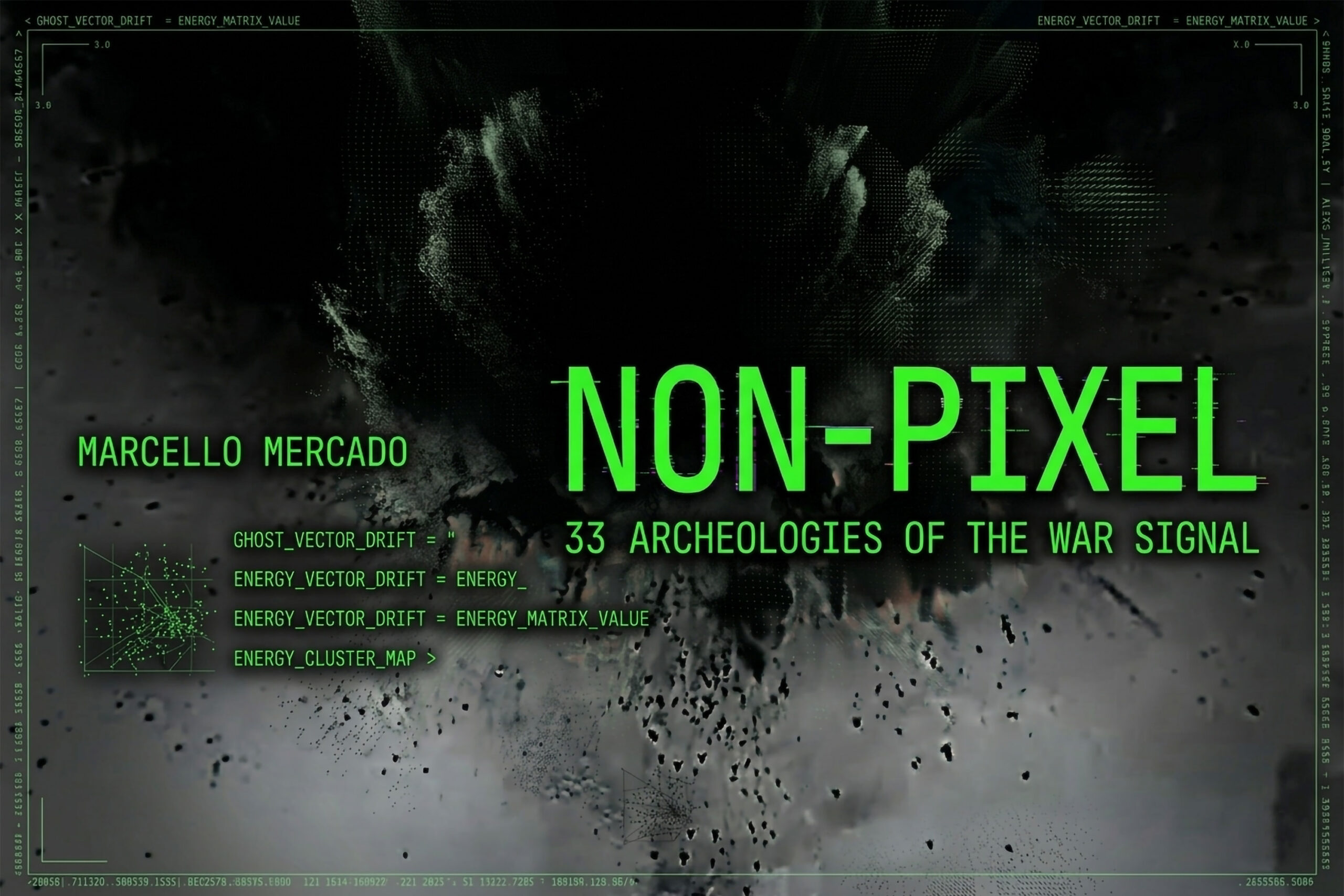
NON-PIXEL is not presented as a book of images, nor even as a book about images. It operates instead as an analytical device that displaces visuality toward its operative condition: A domain in which the image ceases to function as a perceptual surface and becomes a residue of processing.
The project is situated at a critical threshold in the history of media: a point at which the technical image—from photography to video—can no longer sustain its representational promise. In its place, a regime of signal emerges, filtered, compressed, and reconstructed by systems that are not oriented toward human vision, but toward detection, prediction, and decision-making.
Within this context, NON-PIXEL proposes a radical inversion: it does not analyze the image, but the conditions under which the image fails.
The conceptual core of the book—structured as 33 algorithms—functions as a taxonomy of this collapse. Each section does not describe a visual phenomenon, but a technical process: latency, compression, signal loss, thermal translation, probabilistic reconstruction. The image appears only afterwards, as a secondary effect of operations that are fundamentally indifferent to it.
This shift is structural. If modern visuality was built upon the stability of the pixel as a minimal unit of meaning, NON-PIXEL introduces its negation: the image as swarm, as unstable field, as distribution of probabilities. There is no continuous surface, only dynamic granularity produced by real-time transmission and its inherent constraints.
From a media-archaeological perspective, the book does not document contemporary technologies (satellites, drones, infrared sensors), but repositions them as systems of inscription. What is at stake is not war as an event, but war as a transformation of the image into data.
Within this framework, the notion of algorithmic taphonomy becomes central: the image does not represent, it fossilizes. What is perceived is not the event itself, but its decomposition across layers of technical translation. Visual “truth” shifts toward error: failed compression, noise, discontinuity. The glitch ceases to be an aesthetic anomaly and becomes structural evidence.
The project also introduces a thermodynamic reading of the image. The human body—traditionally the center of representation—is reduced here to a thermal signature, to an energy value, to a point within a computational field. This reduction is not metaphorical, but operational: it describes how contemporary systems process the living.
As a consequence, NON-PIXEL articulates a form of biopolitics that is no longer based on visibility, but on detectability.
A further displacement concerns the role of software. Faced with signal loss, the system does not halt—it compensates. Predictive hallucination is not an error, but a function. Where data is missing, the image is generated to maintain operational continuity. This introduces a fundamental rupture with classical image epistemology: the visible no longer guarantees a relation to reality, but to system coherence.
Formally, the book reinforces this logic through the coexistence of text and code. The Python fragments do not illustrate; they perform conceptually. Each algorithm operates as a micro-machine simulating the described processes, shifting the status of the book from reading to activation.
In this sense, NON-PIXEL occupies a strictly post-medial territory. It does not belong to a specific medium, but circulates across languages: image, text, code, model. It is not a format, but an assemblage of operations.
The statement “Total Signal Loss as a Final Aesthetic Form” should not be understood as nihilistic, but as a redefinition of the aesthetic field. If the image can no longer sustain representation, then its degradation—or disappearance—becomes the only remaining site of inscription.
NON-PIXEL does not produce images of war.
It produces the conditions under which war ceases to be visible and becomes signal.
In that shift, it is not only the image that disappears.
The viewer disappears.

DE — DEUTSCHE VERSION
NON-PIXEL: 33
Archäologien des Kriegssignals
NON-PIXEL präsentiert sich weder als Bildband noch als Buch über Bilder. Es operiert vielmehr als analytisches Dispositiv, das die Visualität in ihren operativen Zustand verschiebt: in einen Bereich, in dem das Bild aufhört, eine wahrnehmbare Oberfläche zu sein, und zum Residuum eines Verarbeitungsprozesses wird.
Das Projekt ist an einem kritischen Punkt in der Geschichte der Medien angesiedelt: dort, wo das technische Bild – von der Fotografie bis zum Video – sein repräsentatives Versprechen nicht mehr aufrechterhalten kann. An seine Stelle tritt ein Regime des Signals, gefiltert, komprimiert und rekonstruiert durch Systeme, die nicht auf menschliches Sehen ausgerichtet sind, sondern auf Detektion, Vorhersage und Entscheidungsfindung.
In diesem Kontext schlägt NON-PIXEL eine radikale Umkehrung vor: Es analysiert nicht das Bild, sondern die Bedingungen seines Versagens.
Der konzeptuelle Kern des Buches – organisiert in 33 Algorithmen – fungiert als Taxonomie dieses Kollapses. Jede Sektion beschreibt kein visuelles Phänomen, sondern einen technischen Prozess: Latenz, Kompression, Signalverlust, thermische Übersetzung, probabilistische Rekonstruktion. Das Bild erscheint erst nachträglich, als Nebeneffekt von Operationen, die ihm gegenüber gleichgültig sind.
Diese Verschiebung ist strukturell. Wenn sich die moderne Visualität auf die Stabilität des Pixels als kleinste Bedeutungseinheit stützte, führt NON-PIXEL dessen Negation ein: das Bild als Schwarm, als instabiles Feld, als Wahrscheinlichkeitsverteilung. Es gibt keine kontinuierliche Oberfläche mehr, sondern eine dynamische Granularität, erzeugt durch Echtzeitübertragung und deren strukturelle Begrenzungen.
Aus medienarchäologischer Perspektive dokumentiert das Buch keine zeitgenössischen Technologien (Satelliten, Drohnen, Infrarotsensoren), sondern begreift sie als Einschreibesysteme. Im Zentrum steht nicht der Krieg als Ereignis, sondern der Krieg als Transformation des Bildes in Daten.
In diesem Zusammenhang wird der Begriff der algorithmischen Taphonomie zentral: Das Bild repräsentiert nicht, es fossilisiert. Wahrnehmbar ist nicht das Ereignis selbst, sondern dessen Zerfall durch Schichten technischer Übersetzung. Die visuelle „Wahrheit“ verschiebt sich in Richtung Fehler: misslungene Kompression, Rauschen, Diskontinuität. Der Glitch ist keine ästhetische Abweichung mehr, sondern strukturelle Evidenz.
Zugleich führt das Projekt eine thermodynamische Lesart des Bildes ein. Der menschliche Körper – traditionell das Zentrum der Darstellung – wird hier auf eine thermische Signatur reduziert, auf einen Energiewert, auf einen Punkt innerhalb eines Rechenfeldes. Diese Reduktion ist nicht metaphorisch, sondern operativ: Sie beschreibt die tatsächliche Verarbeitung des Lebendigen durch zeitgenössische Systeme.
Daraus ergibt sich eine Form von Biopolitik, die nicht mehr auf Sichtbarkeit, sondern auf Detektierbarkeit basiert.
Eine weitere Verschiebung betrifft die Rolle der Software. Angesichts von Signalverlust stoppt das System nicht – es kompensiert. Die prädiktive Halluzination ist kein Fehler, sondern eine Funktion. Wo Daten fehlen, wird das Bild erzeugt, um die operative Kontinuität zu gewährleisten. Damit bricht das Projekt grundlegend mit der klassischen Bild-Epistemologie: Das Sichtbare verweist nicht mehr auf Realität, sondern auf Systemkohärenz.
Formal wird diese Logik durch das Nebeneinander von Text und Code verstärkt. Die Python-Fragmente illustrieren nicht – sie operieren. Jeder Algorithmus fungiert als Mikro-Maschine, die die beschriebenen Prozesse simuliert und den Status des Buches von der Lektüre zur Aktivierung verschiebt.
In diesem Sinne bewegt sich NON-PIXEL in einem strikt postmedialen Feld. Es gehört keinem Medium an, sondern zirkuliert zwischen Sprachen: Bild, Text, Code, Modell. Es ist kein Format, sondern ein Gefüge von Operationen.
Die Aussage „Total Signal Loss as a Final Aesthetic Form“ ist nicht als nihilistischer Gestus zu verstehen, sondern als Neudefinition des ästhetischen Feldes. Wenn das Bild die Repräsentation nicht mehr tragen kann, wird seine Auflösung – oder sein Verschwinden – zum letzten Ort der Einschreibung.
NON-PIXEL erzeugt keine Bilder des Krieges.
Es erzeugt die Bedingungen, unter denen der Krieg aufhört sichtbar zu sein und zum Signal wird.
In dieser Verschiebung verschwindet nicht nur das Bild.
Der Betrachter verschwindet.
ES— SPANISH VERSION
NON-PIXEL: 33
Archaeologies of the War Signal
NON-PIXEL no se presenta como un libro de imágenes, ni siquiera como un libro sobre imágenes. Opera, más bien, como un dispositivo analítico que desplaza la visualidad hacia su condición operativa: un entorno donde la imagen deja de ser una superficie perceptiva para convertirse en un residuo de procesamiento.
El proyecto se sitúa en un punto crítico dentro de la historia de los medios: allí donde la imagen técnica —desde la fotografía hasta el video— ya no puede sostener su promesa de representación. En su lugar, emerge un régimen de señal, filtrado, comprimido y reconstruido por sistemas que no están orientados a la visión humana, sino a la detección, la predicción y la toma de decisiones.
En este contexto, NON-PIXEL propone una inversión radical: no analiza la imagen, sino las condiciones bajo las cuales la imagen falla.
El núcleo conceptual del libro —organizado en 33 algoritmos— funciona como una taxonomía de este colapso. Cada sección no describe un fenómeno visual, sino un proceso técnico: latencia, compresión, pérdida de señal, traducción térmica, reconstrucción probabilística. La imagen aparece siempre a posteriori, como un efecto secundario de operaciones que le son ajenas.
Este desplazamiento es estructural. Si la modernidad visual se construyó sobre la estabilidad del píxel como unidad mínima de sentido, NON-PIXEL introduce su negación: la imagen como enjambre, como campo de puntos inestables, como distribución de probabilidades. No hay superficie continua, sino granularidad dinámica producida por la transmisión en tiempo real y sus limitaciones.
Desde una perspectiva de arqueología de medios, el libro no documenta tecnologías contemporáneas (satélites, drones, sensores infrarrojos), sino que las trata como sistemas de inscripción. Lo que está en juego no es la guerra como evento, sino la guerra como transformación de la imagen en dato.
En este marco, la noción de algorithmic taphonomy es central: la imagen no representa, sino que fosiliza. Lo que se observa no es el acontecimiento, sino su descomposición a través de capas de traducción técnica. La “verdad” visual se desplaza hacia el error: compresión fallida, ruido, discontinuidad. El glitch deja de ser anomalía estética para convertirse en evidencia estructural.
El proyecto introduce además una lectura termodinámica de la imagen. El cuerpo humano —tradicional centro de la representación— es reducido a firma térmica, a magnitud energética, a punto dentro de un campo de cálculo. Esta reducción no es metafórica, sino operativa: describe el modo en que los sistemas contemporáneos procesan lo viviente.
En consecuencia, NON-PIXEL articula una forma de biopolítica que ya no se basa en la visibilidad, sino en la detectabilidad.
Otro desplazamiento decisivo concierne al software. Frente a la pérdida de señal, el sistema no se detiene: compensa. La alucinación predictiva no es un error, sino una función. Allí donde el dato falta, la imagen es generada para sostener la continuidad operativa. Esto rompe con la epistemología clásica de la imagen: lo visible ya no remite a lo real, sino a la coherencia interna del sistema.
Formalmente, el libro refuerza esta lógica mediante la coexistencia de texto y código. Los fragmentos en Python no ilustran: ejecutan conceptualmente. Cada algoritmo actúa como una micro-máquina que simula los procesos descritos, desplazando el libro desde la lectura hacia la activación.
Esta condición sitúa a NON-PIXEL en un territorio estrictamente postmedial. No hay especificidad de soporte, sino circulación entre lenguajes: imagen, texto, código, modelo. El libro no pertenece a un medio; es un ensamblaje de operaciones.
La afirmación “Total Signal Loss as a Final Aesthetic Form” no debe leerse como un gesto nihilista, sino como una redefinición del campo estético. Si la imagen ya no puede sostener la representación, entonces su degradación —o su desaparición— se convierte en el único lugar posible de inscripción.
NON-PIXEL no produce imágenes de guerra.
Produce las condiciones bajo las cuales la guerra deja de ser visible y se convierte en señal.
En ese desplazamiento, lo que desaparece no es solo la imagen.
Desaparece el espectador.