
This book-object does not begin with reading, but with resistance. It withholds fluency. It refuses immediate access to meaning by forcing language to pass through successive regimes of translation, decomposition, and re-materialization. Text becomes image, image becomes object, object becomes residue, residue becomes sound. Meaning is never stabilized; it circulates under constraint.
The work stages a fictional encounter between Vilém Flusser and Marshall McLuhan, not as dialogue but as interference. Their texts are not quoted, explained, or illustrated. They are operationalized. Language is processed as raw material, subjected to procedures that expose the frictions between medium, message, and matter.
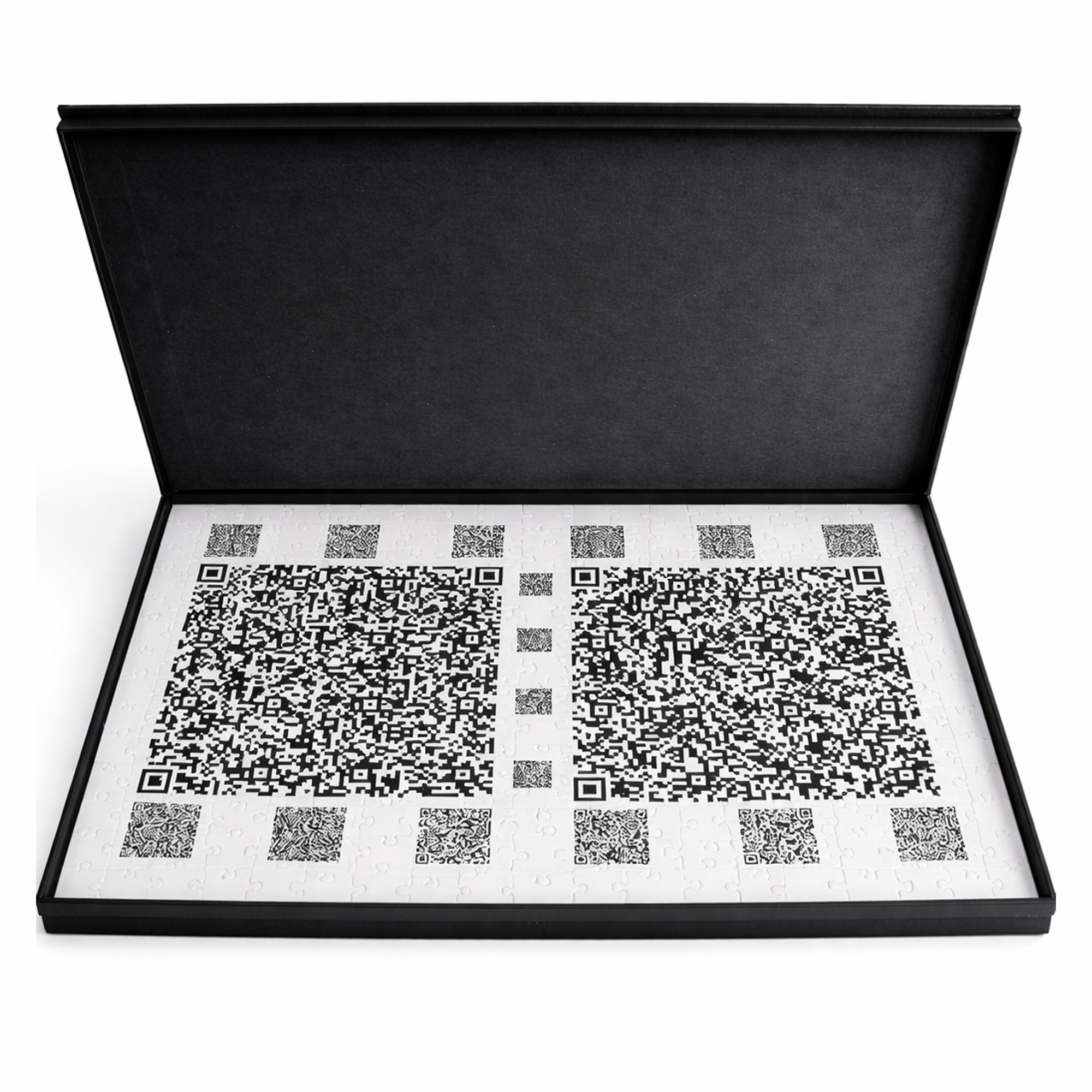
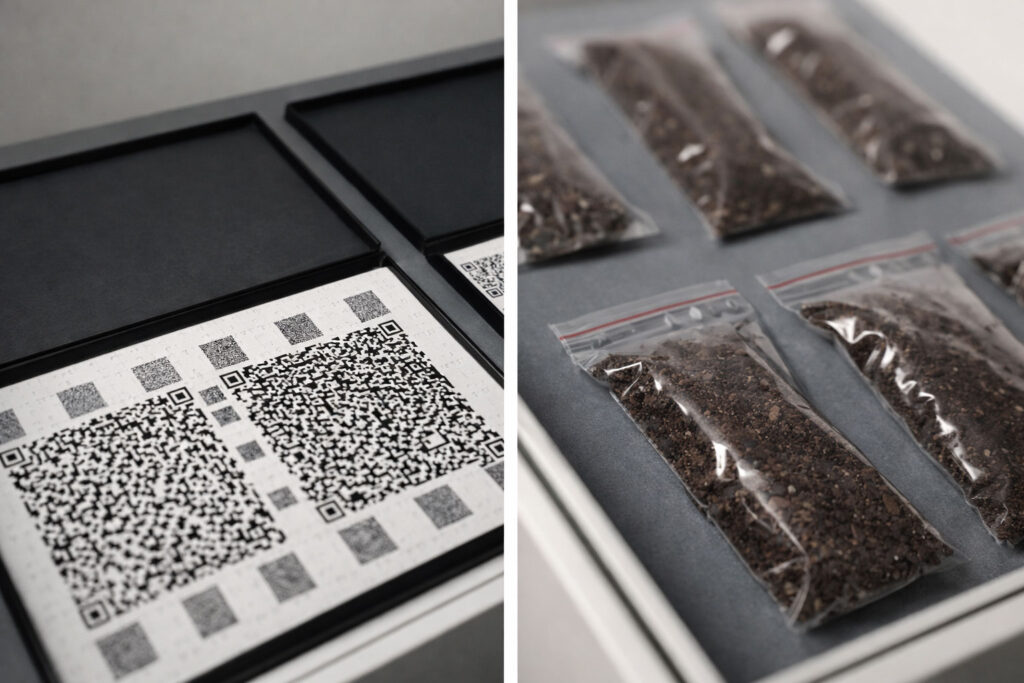
At the core of the book-object lies a paradox: texts that critically interrogate technical images are themselves translated into one of the most opaque technical image formats—the QR code. What appears as a tool of instant access becomes, here, a structure of delay. Fragmented into puzzles, the QR codes cannot be scanned unless reassembled, and reassembly demands time, labor, and bodily engagement. Reading becomes a durational act of construction. Information is no longer immaterial; it acquires weight, resistance, and fatigue.
The puzzle format is not incidental. It introduces a regime of partiality and error. Each fragment carries information but cannot function alone. The code only emerges through coordination, patience, and collective or solitary persistence. In this sense, the book-object behaves less like a container of knowledge than like a test of attention. The viewer is not addressed as a reader but as an operator navigating a system that constantly threatens to collapse back into noise.
Material decisions are crucial. The stark black-and-white of the QR codes, the standardized geometry of the puzzle pieces, and the severe neutrality of the boxes all echo the aesthetics of technical rationality. Yet this rationality is undermined from within. The very precision of the system produces fragility: a single missing piece renders the code unreadable. Totality becomes contingent.
This logic reaches a different threshold in the composted portraits. Here, representation is not fragmented but biologically erased. The faces of Flusser and McLuhan are not archived or preserved; they are decomposed. Theoretical authority is reduced to organic matter, processed by worms, converted into fertile residue. The portrait—a historically stabilizing device—is replaced by an irreversible metabolic process. What remains is not an image, but a transformed material state.
Sound introduces yet another translation layer. Texts become audio files, portraits become voices without faces, presence without visibility. The auditory loop does not clarify the system; it further dislocates it. Language circulates as vibration, detached from both page and image, suspended in repetition. Meaning here is not cumulative but recursive, trapped in feedback.
Across these versions—QR code, puzzle, compost, audio—the book-object operates as a field of media conflict. Each medium exposes the limits of the others. No version is definitive; none resolves the work. Instead, the project constructs a closed circuit of transformations in which information is continuously displaced, degraded, and reconfigured.
This is not an homage to media theory, nor an illustration of its concepts. It is a structural enactment of their consequences. The work does not argue that “the medium is the message” or that “our future depends on design.” It demonstrates what happens when such statements are pushed through systems that resist transparency and mastery.
Installed at ZKM, the book-object does not sit comfortably within the category of the artist’s book, nor within installation, nor within sound art. It occupies an unstable zone between archive and process, between preservation and decay. It is a book that cannot be read without being damaged, a system that only functions by exposing its own failure modes.
In this sense, the work aligns less with critique than with exhaustion. It stages the point at which explanation gives way to operation, and interpretation is replaced by handling. What remains is not clarity, but a dense field of relations between bodies, codes, materials, and time—a book-object that insists that understanding is no longer a matter of decoding, but of enduring the system it constructs.
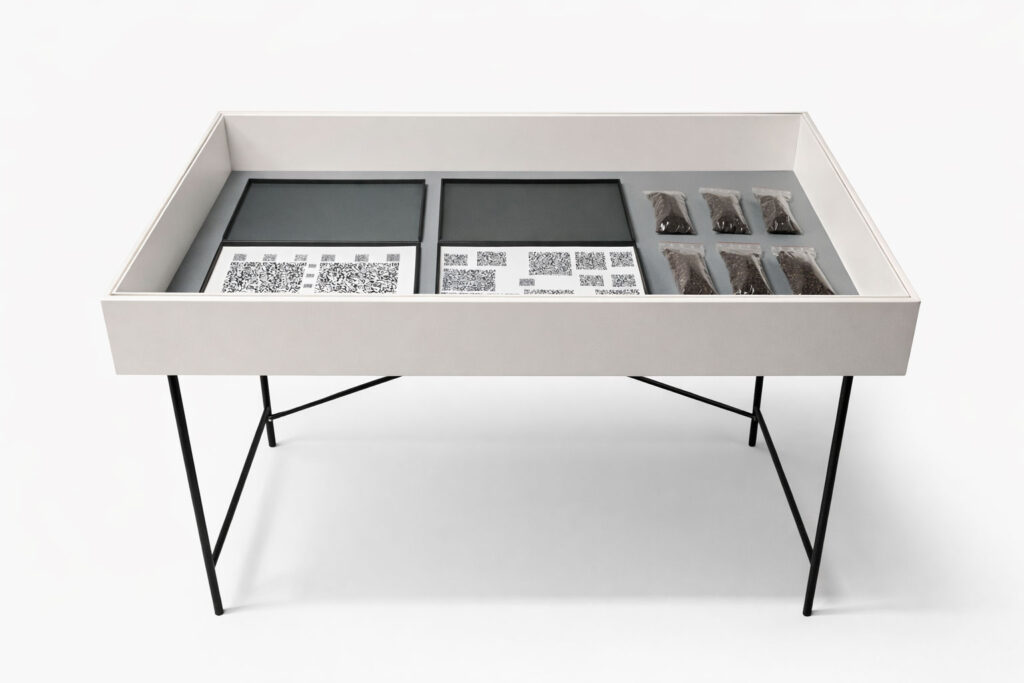
Installation view, Victor India Lima Echo Mike Foxtrot Lima Uniform Sierra Sierra Echo Romeo Mike Alpha Romeo Sierra Hotel Alpha
Lima Lima Mike Charlie Charlie Lima Uniform Hotel Alpha November,
Interactive installation, ZKM | Center for Art and Media Karlsruhe, 2010.
Installation view, Victor India Lima Echo Mike Foxtrot Lima Uniform Sierra Sierra Echo Romeo Mike Alpha Romeo Sierra Hotel Alpha
Lima Lima Mike Charlie Charlie Lima Uniform Hotel Alpha November,
Interactive installation, ZKM | Center for Art and Media Karlsruhe, 2010.
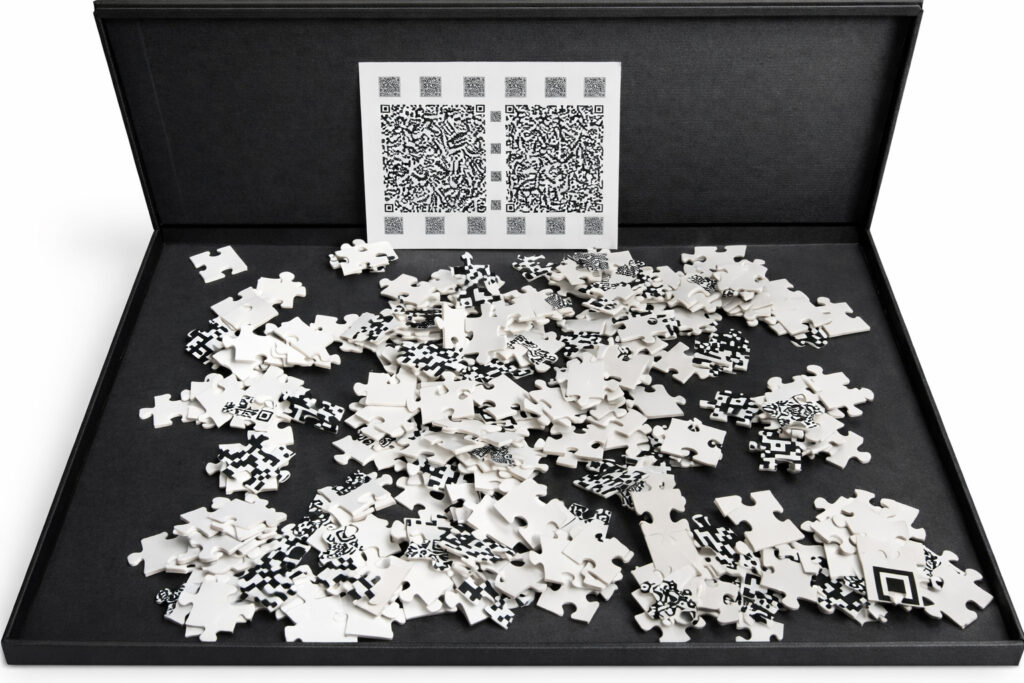
QR-code puzzle books, Victor India Lima Echo Mike Foxtrot Lima Uniform Sierra Sierra Echo Romeo Mike Alpha Romeo Sierra Hotel Alpha
Lima Lima Mike Charlie Charlie Lima Uniform Hotel Alpha November, (Vilém Flusser and Marshall McLuhan, Aviation Alphabet)
Interactive installation, ZKM | Center for Art and Media Karlsruhe, 2010.
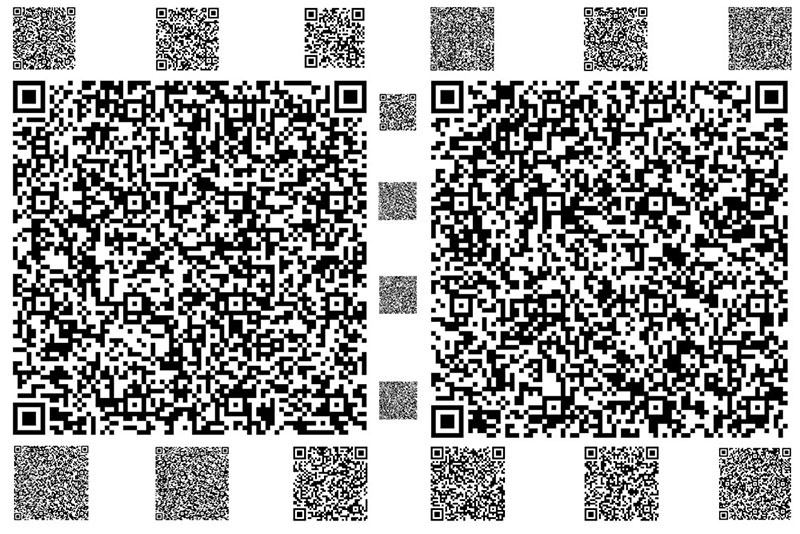
Detail view, QR-code puzzle fragments, Laser-cut puzzle elements forming fragmented QR codes, black and white, 2010,
Victor India Lima Echo Mike Foxtrot Lima Uniform Sierra Sierra Echo Romeo Mike Alpha Romeo Sierra Hotel Alpha
Lima Lima Mike Charlie Charlie Lima Uniform Hotel Alpha November, (Vilém Flusser and Marshall McLuhan, Aviation Alphabet)
Interactive installation, ZKM | Center for Art and Media Karlsruhe, 2010.
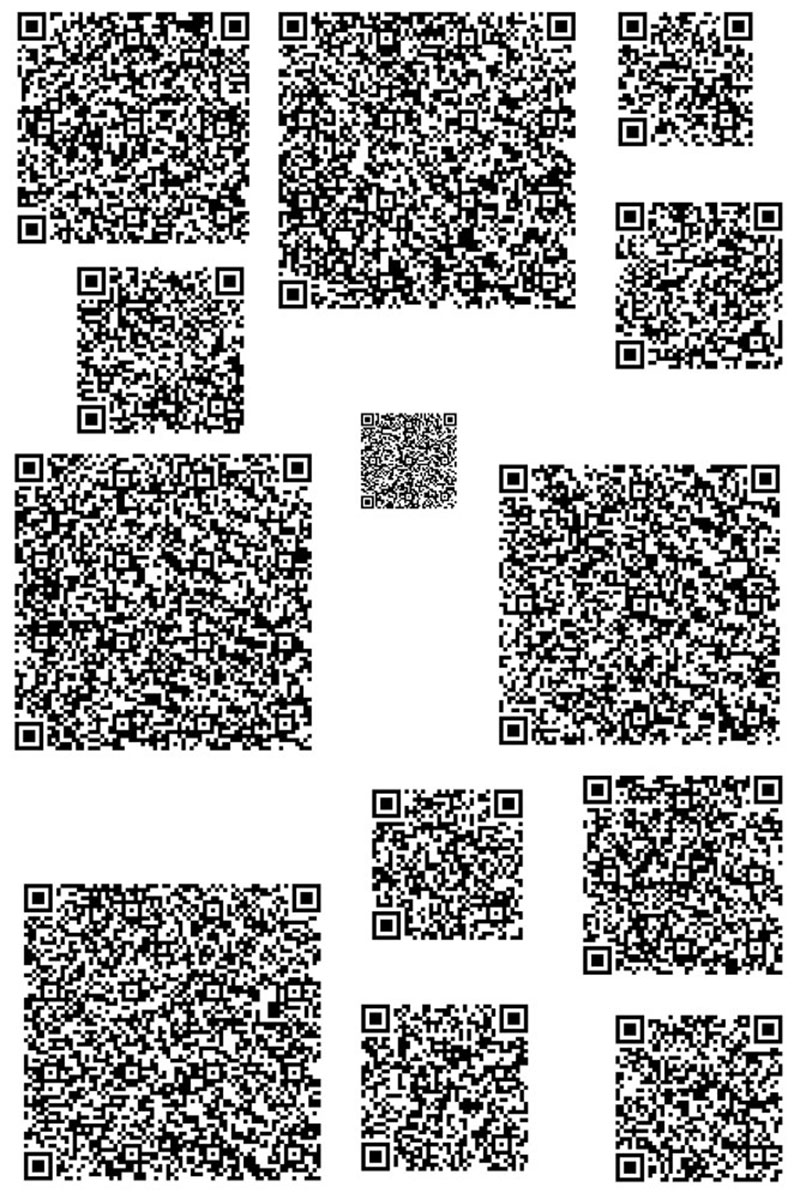
Detail view, QR-code puzzle fragments, Laser-cut puzzle elements forming fragmented QR codes, black and white, 2010,
Victor India Lima Echo Mike Foxtrot Lima Uniform Sierra Sierra Echo Romeo Mike Alpha Romeo Sierra Hotel Alpha
Lima Lima Mike Charlie Charlie Lima Uniform Hotel Alpha November,
Interactive installation, ZKM | Center for Art and Media Karlsruhe, 2010.
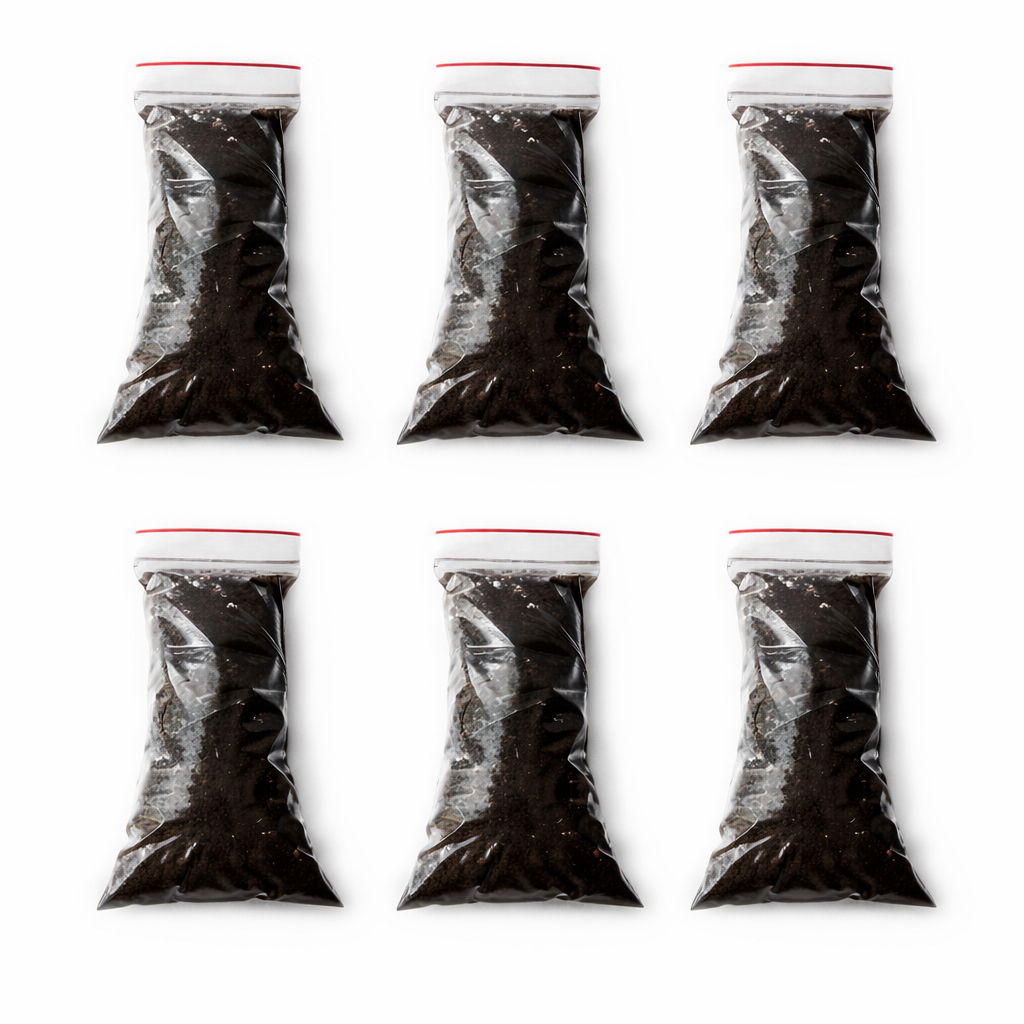
Worm-composted portraits of Vilém Flusser and Marshall McLuhan, organic residue sealed in plastic bags, 2015,
Victor India Lima Echo Mike Foxtrot Lima Uniform Sierra Sierra Echo Romeo Mike Alpha Romeo Sierra Hotel Alpha
Lima Lima Mike Charlie Charlie Lima Uniform Hotel Alpha November,
Interactive installation, ZKM | Center for Art and Media Karlsruhe, 2010.
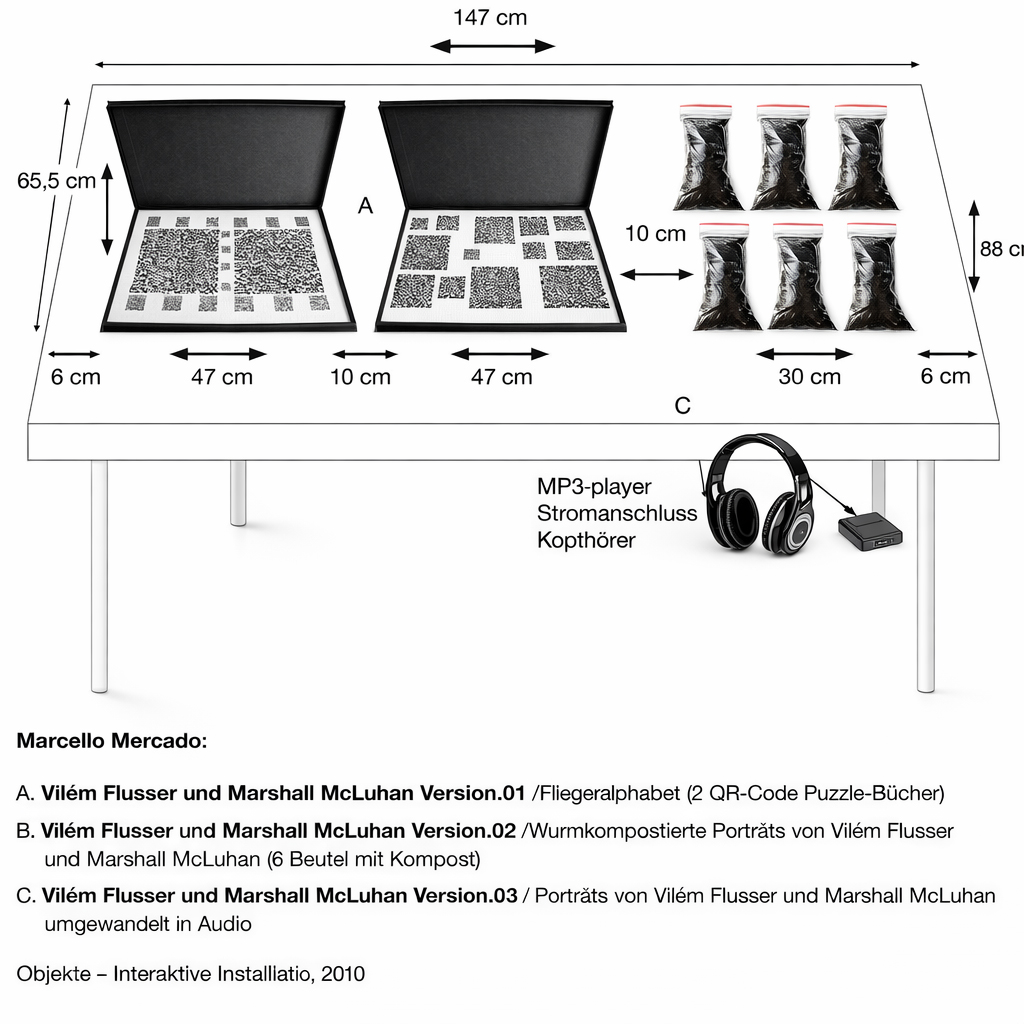
Victor, India, Lima, Echo, Mike, Foxtrot, Lima, Uniform, Sierra, Sierra, Echo, Romeo, Mike, Alpha, Romeo, Sierra, Hotel, Alpha, Lima, Lima, Mike, Charlie, Lima, Uniform, Hotel, Alpha, November.
(Vilém Flusser und Marshall McLuhan, Aviation Alphabet).
2010
Dieses Buch-Objekt beginnt nicht mit Lesen, sondern mit Widerstand. Es verweigert Flüssigkeit. Es entzieht sich dem unmittelbaren Zugang zu Bedeutung, indem es Sprache zwingt, sukzessive Regime von Übersetzung, Zerlegung und Re-Materialisierung zu durchlaufen. Text wird Bild, Bild wird Objekt, Objekt wird Residuum, Residuum wird Klang. Bedeutung stabilisiert sich nie; sie zirkuliert unter Vorbehalt.
Die Arbeit inszeniert eine fiktive Begegnung zwischen Vilém Flusser und Marshall McLuhan, nicht als Dialog, sondern als Interferenz. Ihre Texte werden weder zitiert noch erklärt oder illustriert. Sie werden operationalisiert. Sprache wird als Rohmaterial behandelt, unterworfen Verfahren, die die Reibungen zwischen Medium, Botschaft und Materialität freilegen.
Im Zentrum des Buch-Objekts liegt ein Paradox: Texte, die technische Bilder kritisch befragen, werden in eines der opaksten Formate technischer Bilder übersetzt — den QR-Code. Was gemeinhin als Werkzeug unmittelbaren Zugriffs fungiert, wird hier zu einer Struktur der Verzögerung. In Puzzleteile fragmentiert, können die QR-Codes nur gelesen werden, wenn sie zuvor zusammengesetzt werden — ein Vorgang, der Zeit, Arbeit und körperliche Beteiligung erfordert. Lesen wird zu einem durationalen Akt der Konstruktion. Information verliert ihre Immaterialität und gewinnt Gewicht, Widerstand und Ermüdung.
Das Puzzleformat ist kein beiläufiges Mittel. Es etabliert ein Regime der Partialität und des Fehlers. Jedes Fragment trägt Information, doch keines ist für sich funktional. Der Code entsteht nur durch Koordination, Geduld und Ausdauer, individuell oder kollektiv. In diesem Sinne fungiert das Buch-Objekt weniger als Wissensspeicher denn als Aufmerksamkeitsprüfung. Der Betrachter wird nicht als Leser adressiert, sondern als Operator innerhalb eines Systems, das jederzeit in Rauschen zurückfallen kann.
Die materiellen Entscheidungen sind zentral. Der harte Schwarz-Weiß-Kontrast der QR-Codes, die standardisierte Geometrie der Puzzleteile und die strenge Neutralität der Boxen verweisen auf die Ästhetik technischer Rationalität. Doch diese Rationalität wird von innen her unterminiert. Die Präzision des Systems erzeugt Fragilität: Ein einziges fehlendes Teil macht den Code unlesbar. Totalität wird kontingent.
Eine weitere Schwelle erreicht diese Logik in den kompostierten Porträts. Hier wird Repräsentation nicht fragmentiert, sondern biologisch ausgelöscht. Die Gesichter von Flusser und McLuhan werden nicht archiviert oder bewahrt; sie werden zersetzt. Theoretische Autorität reduziert sich auf organisches Material, verarbeitet durch Würmer, transformiert in fruchtbaren Rest. Das Porträt — historisch ein stabilisierendes Dispositiv — wird durch einen irreversiblen metabolischen Prozess ersetzt. Was bleibt, ist kein Bild, sondern ein veränderter materieller Zustand.
Der Klang fügt eine weitere Übersetzungsebene hinzu. Texte werden zu Audiodateien, Porträts zu Stimmen ohne Gesicht, Präsenz ohne Sichtbarkeit. Die auditive Schleife klärt das System nicht; sie destabilisiert es weiter. Sprache zirkuliert als Vibration, gelöst von Seite und Bild, suspendiert in Wiederholung. Bedeutung akkumuliert sich nicht, sondern wird rekursiv, gefangen in Rückkopplung.
Über diese Versionen hinweg — QR-Code, Puzzle, Kompost, Audio — operiert das Buch-Objekt als Feld medialer Konflikte. Jedes Medium legt die Grenzen der anderen offen. Keine Version ist endgültig; keine löst die Arbeit auf. Stattdessen entsteht ein geschlossener Transformationskreislauf, in dem Information fortwährend verschoben, degradiert und neu konfiguriert wird.
Dies ist weder eine Hommage an Medientheorie noch eine Illustration ihrer Begriffe. Es ist eine strukturelle Vollzugsform ihrer Konsequenzen. Die Arbeit behauptet nicht, dass „das Medium die Botschaft ist“ oder dass „unsere Zukunft vom Design abhängt“. Sie zeigt, was geschieht, wenn solche Aussagen durch Systeme geleitet werden, die sich Transparenz und Beherrschung entziehen.
Im Kontext des ZKM entzieht sich das Buch-Objekt eindeutigen Kategorisierungen: Es ist weder klassisches Künstlerbuch noch Installation noch Klangkunst. Es besetzt eine instabile Zone zwischen Archiv und Prozess, zwischen Bewahrung und Zersetzung. Es ist ein Buch, das nicht gelesen werden kann, ohne beschädigt zu werden; ein System, das nur funktioniert, indem es seine eigenen Fehlermodi offenlegt.
In diesem Sinne positioniert sich die Arbeit weniger im Feld der Kritik als im Feld der Erschöpfung. Sie markiert den Punkt, an dem Erklärung in Operation übergeht und Interpretation durch Handhabung ersetzt wird. Was bleibt, ist keine Klarheit, sondern ein dichtes Beziehungsgeflecht aus Körpern, Codes, Materialien und Zeit — ein Buch-Objekt, das darauf insistiert, dass Verstehen nicht länger eine Frage des Dekodierens ist, sondern des Aushaltens des Systems, das es hervorbringt.
(Vilém Flusser y Marshall McLuhan, Alfabeto de la aviación).
Éste libro-objeto no comienza con la lectura, sino con la resistencia. Retiene la fluidez. Rechaza el acceso inmediato al sentido al forzar al lenguaje a atravesar regímenes sucesivos de traducción, descomposición y re-materialización. El texto deviene imagen, la imagen deviene objeto, el objeto deviene residuo, el residuo deviene sonido. El significado nunca se estabiliza: circula bajo condición.
La obra escenifica un encuentro ficticio entre Vilém Flusser y Marshall McLuhan, no como diálogo sino como interferencia. Sus textos no son citados, explicados ni ilustrados. Son operativizados. El lenguaje es procesado como materia prima, sometido a procedimientos que exponen las fricciones entre medio, mensaje y materialidad.
En el núcleo del libro-objeto se instala una paradoja: textos que interrogan críticamente las imágenes técnicas son traducidos a uno de los formatos más opacos de la imagen técnica —el código QR—. Lo que suele funcionar como herramienta de acceso instantáneo se transforma aquí en una estructura de demora. Fragmentados en rompecabezas, los códigos QR no pueden ser escaneados sin ser previamente recompuestos, y esa recomposición exige tiempo, trabajo y compromiso corporal. Leer se convierte en un acto duracional de construcción. La información deja de ser inmaterial: adquiere peso, resistencia y fatiga.
El formato de rompecabezas no es incidental. Introduce un régimen de parcialidad y error. Cada fragmento porta información, pero ninguno puede funcionar por sí solo. El código solo emerge mediante coordinación, paciencia y persistencia, individual o colectiva. En este sentido, el libro-objeto se comporta menos como un contenedor de conocimiento que como una prueba de atención. El espectador no es interpelado como lector, sino como operador dentro de un sistema que amenaza constantemente con replegarse en ruido.
Las decisiones materiales son determinantes. El contraste extremo del blanco y negro de los códigos QR, la geometría estandarizada de las piezas del rompecabezas y la neutralidad severa de las cajas remiten a la estética de la racionalidad técnica. Sin embargo, esa racionalidad es socavada desde dentro. La precisión misma del sistema produce fragilidad: una sola pieza ausente vuelve ilegible el código. La totalidad se vuelve contingente.
Esta lógica alcanza otro umbral en los retratos compostados. Aquí la representación no se fragmenta: se borra biológicamente. Los rostros de Flusser y McLuhan no son archivados ni preservados; son descompuestos. La autoridad teórica se reduce a materia orgánica, procesada por lombrices, convertida en residuo fértil. El retrato —dispositivo históricamente estabilizador— es reemplazado por un proceso metabólico irreversible. Lo que permanece no es una imagen, sino un estado material transformado.
El sonido introduce una nueva capa de traducción. Los textos devienen archivos sonoros; los retratos, voces sin rostro; presencia sin visibilidad. El bucle auditivo no clarifica el sistema: lo deslocaliza aún más. El lenguaje circula como vibración, desligado tanto de la página como de la imagen, suspendido en la repetición. El significado no se acumula: se vuelve recursivo, atrapado en retroalimentación.
A través de estas versiones —código QR, rompecabezas, compost, audio— el libro-objeto opera como un campo de conflicto mediático. Cada medio expone los límites de los otros. Ninguna versión es definitiva; ninguna resuelve la obra. El proyecto construye, en cambio, un circuito cerrado de transformaciones en el que la información es continuamente desplazada, degradada y reconfigurada.
No se trata de un homenaje a la teoría de los medios ni de una ilustración de sus conceptos. Es una puesta en acto estructural de sus consecuencias. La obra no afirma que “el medio es el mensaje” ni que “nuestro futuro depende del diseño”. Demuestra qué ocurre cuando tales enunciados son empujados a través de sistemas que resisten la transparencia y el dominio.
Instalado en el ZKM, el libro-objeto no se acomoda cómodamente ni en la categoría de libro de artista, ni en la instalación, ni en el arte sonoro. Ocupa una zona inestable entre archivo y proceso, entre preservación y degradación. Es un libro que no puede ser leído sin ser dañado, un sistema que solo funciona exponiendo sus propios modos de falla.
En este sentido, la obra se alinea menos con la crítica que con el agotamiento. Señala el punto en el que la explicación cede ante la operación y la interpretación es reemplazada por la manipulación. Lo que permanece no es claridad, sino un campo denso de relaciones entre cuerpos, códigos, materiales y tiempo: un libro-objeto que insiste en que comprender ya no es una cuestión de decodificar, sino de soportar el sistema que construye.
| QR-codes quotes: | ||||
|
||||
|
||||
|
||||
|
||||
|
||||
|
||||
|
||||
|
||||
|
||||
|
||||
|
||||
|
||||
|
||||
|
||||
|
||||
|
||||
|
||||
|