• Bestiary for the Minds of the 21st Century: Genomic Opera, 2015

    Bestiary for the Minds of the 21st Century: Genomic Opera, 2015


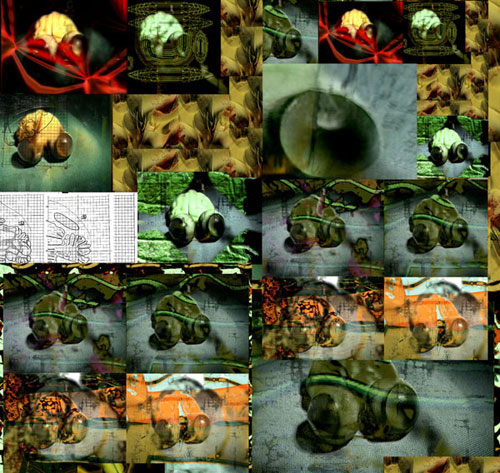
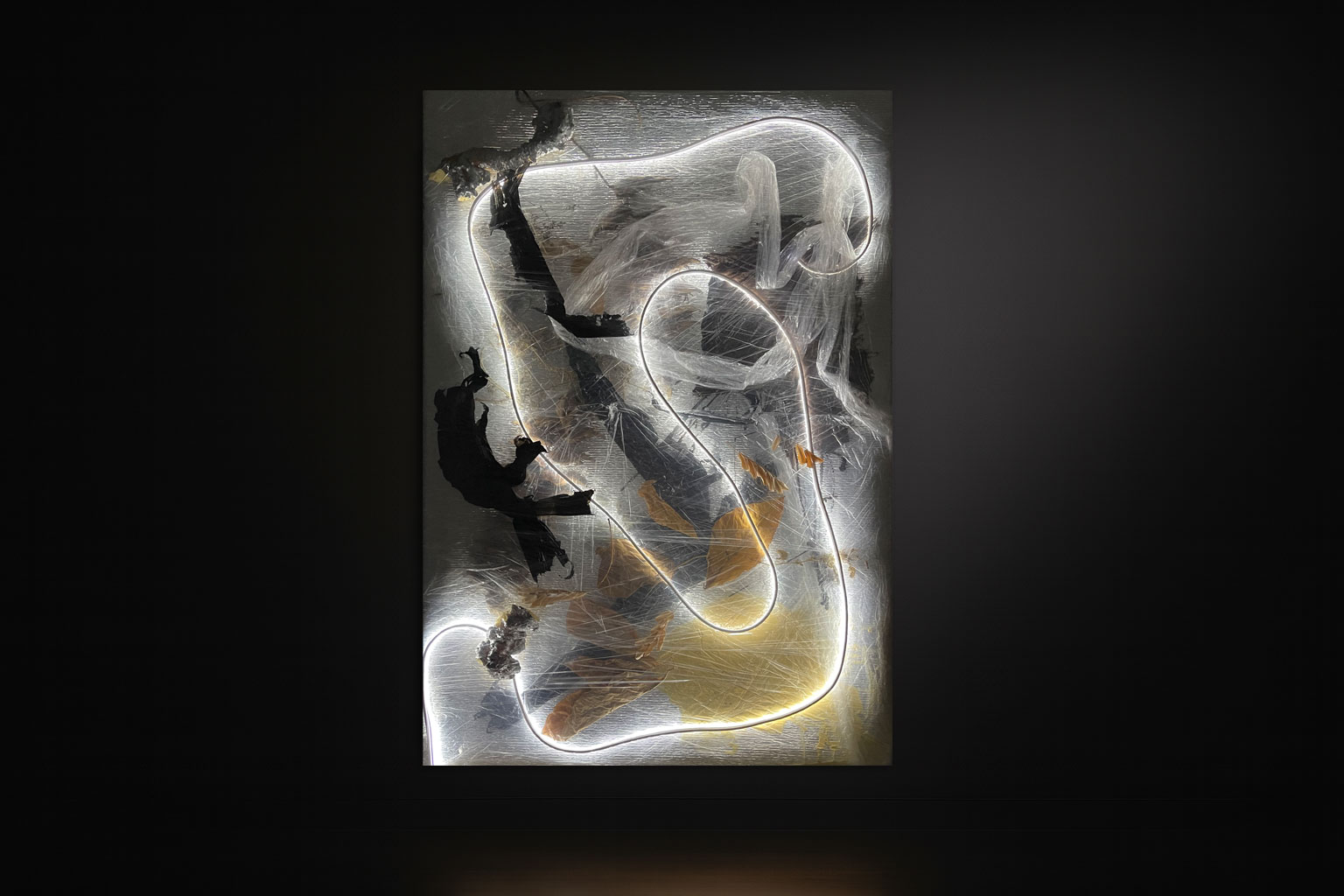
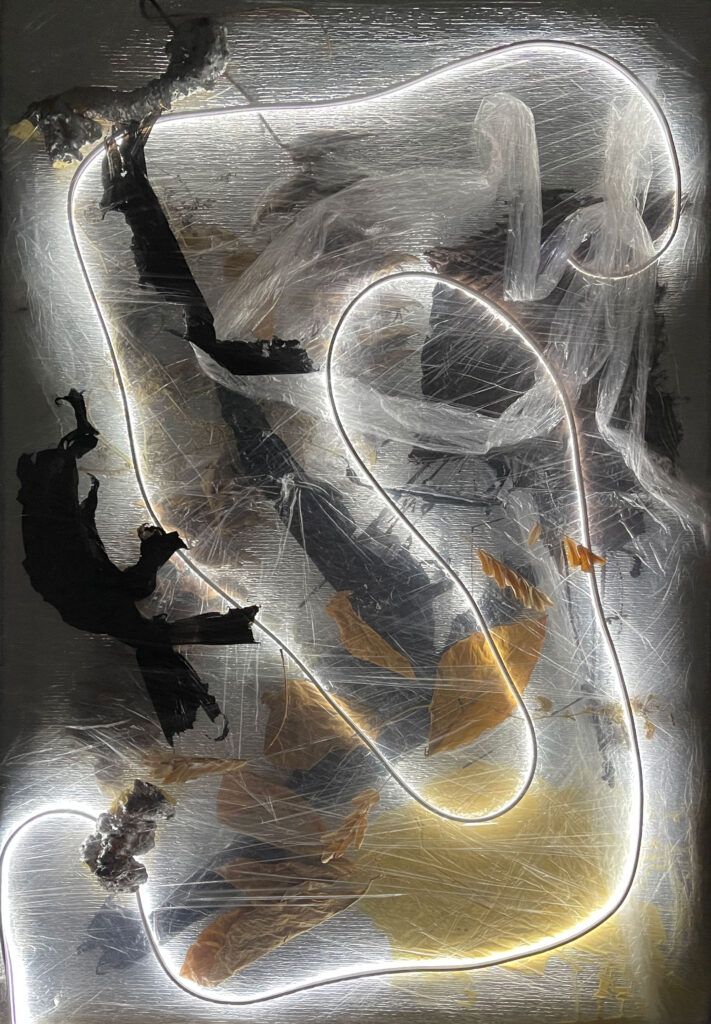
    In Bestiary for the Minds of the 21st Century: Genomic Opera, the book is presented as a physical apparatus in which biological processes, algorithmic operations and sensory translations converge to form a tangible sequence that defies the neutrality of the archive.

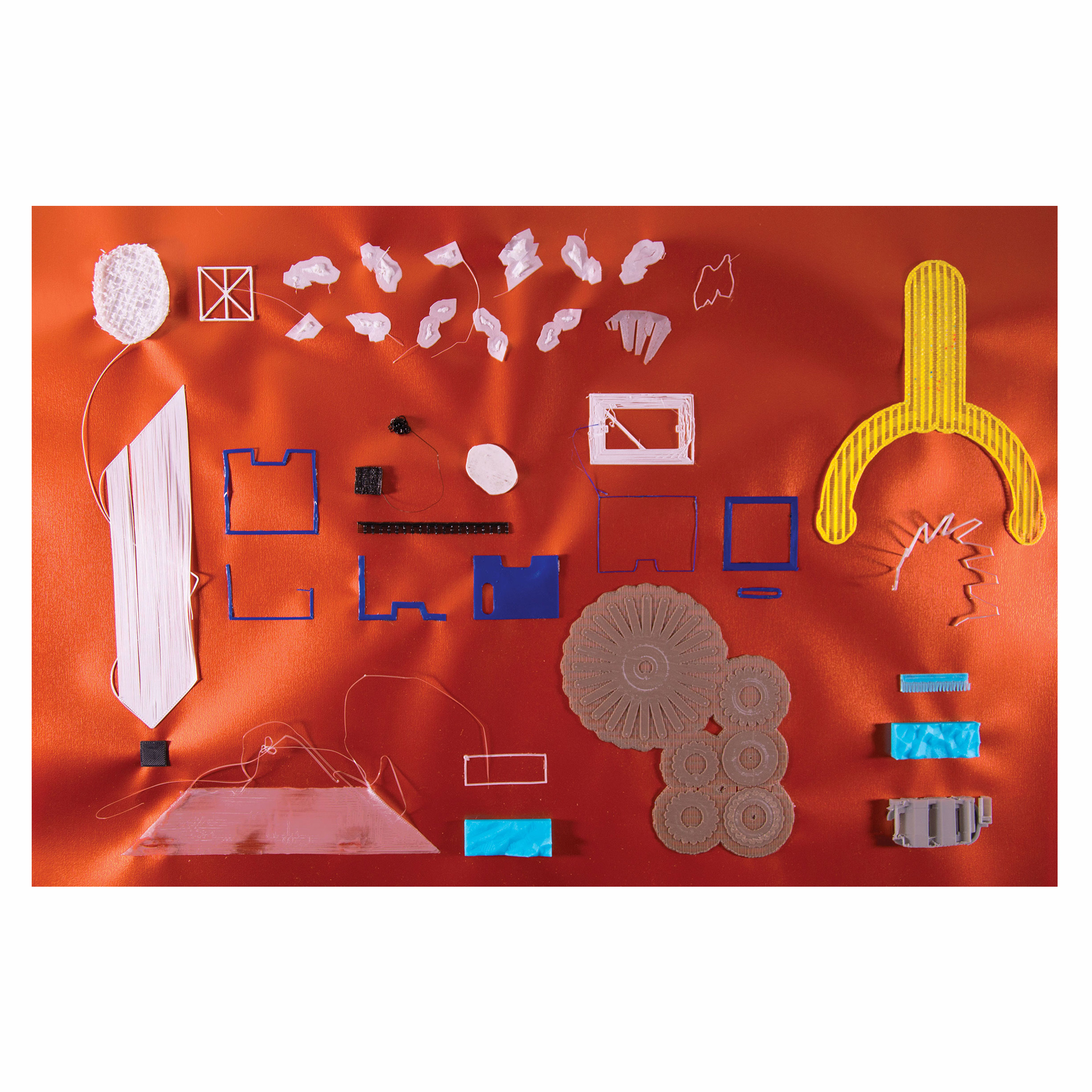
    Each page acts as a threshold between systems of inscription. Genetic sequences are transformed into sound, which is then converted into volume. This volume is fixed in 3D-printed surfaces that adopt the function of musical notation yet are not subject to historical scoring conventions. The book does not merely represent the opera; it embodies it. Appearing as an active archive, it is a stratified body of errors, residues, superimposed layers and unstable materialities.

    Industrial plastics, bioplastics, printing residue, deformations and structural collapse are not collateral effects of the technical process, but constitutive elements of its aesthetic logic. The book documents a production process in which translation between media — genome, audio, object and image — is never clean or transparent. Each conversion introduces noise, failures and deviations — a poetics of friction that shifts the notion of the archive from conservation to mutation.

    The pages function as operative plates — surfaces to be observed, touched, rubbed and activated. By integrating three-dimensional objects attached to printed staves, the book proposes a latent choreography between the hand and the ear, and between gesture and vibration. Reading ceases to be exclusively optical and becomes corporeal. Here, the score is not merely interpreted from afar; rather, it is performed through contact, thereby transforming the readerviewer into a temporary performer within the system.

    The ‘bestial’ nature of the book is not related to figurative iconography, but rather to a system of proliferation consisting of accumulations of forms, crossed genealogies and abstract species generated from biological data and technical mediation. The bestiary does not classify; it overflows. Each double-page spread suggests an unstable ecosystem in which genomic residues, algorithmic structures and manual decisions intertwine without fixed hierarchies.

    As an object, the book has sculptural dimensions. Its size, weight and thickness distinguish it from traditional portable books, necessitating a spatial and physical relationship with the body. Opening the book becomes a performance, and handling it becomes an event. The book exists simultaneously as an archive, a score, a sculpture and a sound-producing machine.

    Within the broader installation, it operates as an operative reservoir a material bank of inscriptions that can be continuously reactivated through microphones, sensors and real-time visualisations. Rather than establishing a definitive version of the work, the book introduces an open temporality in which each interaction generates new layers of information while eroding previous ones.

    Rather than stabilising life as data, Genomic Opera — in its book form — insists on its turbulent condition. Genetics appear not as sovereign code, but as matter subject to imperfect translations, technical manipulation and corporeal encounters. The archive no longer merely preserves; it behaves.

    Thus, the book becomes a platform for post-anthropocentric experimentation, with organisms, machines and humans all participating in the same economy of sensible production. There is no single authorial centre, only a distributed network of agencies comprising molecular sequences, 3D printers, piezoelectric microphones and visitors’ hands.

    This book is more than just a visual compendium; it puts forward a radical redefinition of the artist’s book as a synesthetic interface. It is a space in which information, the body and matter intertwine within an unstable continuum. Here, opera ceases to be a spectacle and becomes an open system of resonances.

    The complete project, including extended documentation, conceptual texts, images and audiovisual materials, is available on the artist’s digital platform.:

    :


    Bestiary for the Minds of the 21st Century: Genomic Opera


    Marcello Mercado
    Bestiary for the Minds of the 21st Century: Genomic Opera, 2015
    artist’s book (within a multi-channel installation)
    data mining and 3D-printed genomic notation
    ABS plastic and polylactic acid (PLA, bioplastic) on polymethyl methacrylate (PMMA)
    copper-coloured 3D-printing errors (glitches) and fabrication remains
    3D objects generated from genomes of mammals, insects, fungi and bacteria
    90 pages
    40 × 60 × 30 cm


    Marcello Mercado
    Bestiary for the Minds of the 21st Century: Genomic Opera, 2015
    artist’s book (within a multi-channel installation)
    data mining and 3D-printed genomic notation
    ABS plastic and polylactic acid (PLA, bioplastic) on polymethyl methacrylate (PMMA)
    copper-coloured 3D-printing errors (glitches) and fabrication remains
    3D objects generated from genomes of mammals, insects, fungi and bacteria
    90 pages
    40 × 60 × 30 cm

    Marcello Mercado
    Bestiary for the Minds of the 21st Century: Genomic Opera, 2015
    artist’s book (within a multi-channel installation)
    data mining and 3D-printed genomic notation
    ABS plastic and polylactic acid (PLA, bioplastic) on polymethyl methacrylate (PMMA)
    copper-coloured 3D-printing errors (glitches) and fabrication remains
    3D objects generated from genomes of mammals, insects, fungi and bacteria
    90 pages
    40 × 60 × 30 cm

    Marcello Mercado
    Bestiary for the Minds of the 21st Century: Genomic Opera, 2015
    artist’s book (within a multi-channel installation)
    data mining and 3D-printed genomic notation
    ABS plastic and polylactic acid (PLA, bioplastic) on polymethyl methacrylate (PMMA)
    copper-coloured 3D-printing errors (glitches) and fabrication remains
    3D objects generated from genomes of mammals, insects, fungi and bacteria
    90 pages
    40 × 60 × 30 cm

    Marcello Mercado
    Bestiary for the Minds of the 21st Century: Genomic Opera, 2015
    artist’s book (within a multi-channel installation)
    data mining and 3D-printed genomic notation
    ABS plastic and polylactic acid (PLA, bioplastic) on polymethyl methacrylate (PMMA)
    copper-coloured 3D-printing errors (glitches) and fabrication remains
    3D objects generated from genomes of mammals, insects, fungi and bacteria
    90 pages
    40 × 60 × 30 cm

    Marcello Mercado
    Bestiary for the Minds of the 21st Century: Genomic Opera, 2015
    artist’s book (within a multi-channel installation)
    data mining and 3D-printed genomic notation
    ABS plastic and polylactic acid (PLA, bioplastic) on polymethyl methacrylate (PMMA)
    copper-coloured 3D-printing errors (glitches) and fabrication remains
    3D objects generated from genomes of mammals, insects, fungi and bacteria
    90 pages
    40 × 60 × 30 cm

    Marcello Mercado
    Bestiary for the Minds of the 21st Century: Genomic Opera, 2015
    artist’s book (within a multi-channel installation)
    data mining and 3D-printed genomic notation
    ABS plastic and polylactic acid (PLA, bioplastic) on polymethyl methacrylate (PMMA)
    copper-coloured 3D-printing errors (glitches) and fabrication remains
    3D objects generated from genomes of mammals, insects, fungi and bacteria
    90 pages
    40 × 60 × 30 cm


    In Bestiarium für die Köpfe des 21. Jahrhunderts: Genomische Oper präsentiert sich das Buch als materielles Dispositiv, in dem biologische Prozesse, algorithmische Operationen und sensorische Übersetzungen zu einer handhabbaren, gewichtigen und taktilen Sequenz verdichtet werden, die sich der Neutralität des Archivs widersetzt.

    Jede Seite fungiert als Schwelle zwischen Systemen der Einschreibung: genetische Sequenzen werden in Klang transformiert, Klang in Volumen überführt, Volumen in 3D-gedruckten Oberflächen fixiert, die die Funktion musikalischer Notation annehmen, ohne sich den historischen Regimen der Partitur zu unterwerfen. Das Buch repräsentiert die Oper nicht; es verkörpert sie. Es erscheint als aktives Archiv, als geschichteter Körper aus Fehlern, Rückständen, Überlagerungen und instabilen Materialitäten.

    Der Einsatz industrieller Kunststoffe und Biokunststoffe, Druckreste, Deformationen und strukturelle Kollapsmomente sind keine Nebeneffekte des technischen Prozesses, sondern konstitutive Elemente seiner ästhetischen Logik. Das Buch dokumentiert ein Produktionsregime, in dem Übersetzungen zwischen Medien—Genom, Audio, Objekt, Bild—niemals sauber oder transparent sind. Jede Konversion bringt Rauschen, Störungen und Abweichungen hervor: eine Poetik der Reibung, die den Archivbegriff von der Bewahrung zur Mutation verschiebt.

    Die Seiten fungieren als operative Platten: Oberflächen, die betrachtet, berührt, gerieben und aktiviert werden können. Durch die Integration dreidimensionaler Objekte auf gedruckten Notensystemen schlägt das Buch eine latente Choreografie zwischen Hand und Ohr, zwischen Geste und Vibration vor. Lesen ist hier kein rein optischer Vorgang mehr, sondern wird zu einer körperlichen Praxis. Die Partitur wird nicht aus Distanz interpretiert; sie wird durch Kontakt ausgeführt und macht den Leser-Betrachter zum vorläufigen Interpreten des Systems.

    Der „bestiale“ Charakter des Buches verweist nicht auf figurative Ikonografie, sondern auf ein Regime der Proliferation: Akkumulationen von Formen, gekreuzte Genealogien, abstrakte Spezies, die aus biologischen Daten und technischer Vermittlung hervorgehen. Das Bestiarium klassifiziert nicht; es überschreitet. Jede Doppelseite evoziert ein instabiles Ökosystem, in dem genomische Rückstände, algorithmische Strukturen und manuelle Entscheidungen ohne feste Hierarchien ineinandergreifen.

    Als Objekt nimmt der Band skulpturale Dimensionen an. Maßstab, Gewicht und Volumen setzen ihn in Spannung zur Tradition des portablen Buches und erzwingen eine räumliche und körperliche Beziehung. Sein Öffnen wird performativ, seine Handhabung zum Ereignis. Das Buch existiert zugleich als Archiv, Partitur, Skulptur und Klangmaschine.

    Im Kontext der größeren Installation fungiert es als operatives Reservoir: als materieller Speicher von Einschreibungen, die durch Mikrofone, Sensoren und Echtzeit-Visualisierungen fortwährend reaktiviert werden können. Anstatt eine definitive Version des Werks zu fixieren, etabliert es eine offene Zeitlichkeit, in der jede Interaktion neue Schichten erzeugt und frühere zugleich erodiert.

    Anstatt Leben als Daten zu stabilisieren, insistiert Genomic Opera—in seiner Buchform—auf dessen turbulenter Verfassung. Genetik erscheint hier nicht als souveräner Code, sondern als Materie, die unvollkommenen Übersetzungen, technischen Eingriffen und körperlichen Begegnungen unterworfen ist. Das Archiv bewahrt nicht mehr; es verhält sich.

    So wird das Buch zu einer Plattform post-anthropozentrischer Experimentation, in der Organismen, Maschinen und Menschen an derselben Ökonomie sensibler Produktion beteiligt sind. Es gibt kein singuläres autoriales Zentrum, sondern ein verteiltes Netzwerk von Handlungsmächten zwischen molekularen Sequenzen, 3D-Druckern, piezoelektrischen Mikrofonen und den Händen der Besucher.

    Mehr als ein visuelles Kompendium schlägt der Band eine radikale Neudefinition des Künstlerbuches als synästhetische Schnittstelle vor: einen Raum, in dem Information, Körper und Materie in einem instabilen Kontinuum verschränkt sind und in dem die Oper aufhört, Spektakel zu sein, um zu einem offenen Resonanzsystem zu werden.

    Das vollständige Projekt—einschließlich erweiterter Dokumentation, konzeptueller Texte, Bildmaterial und audiovisueller Inhalte—ist auf der digitalen Plattform des Künstlers zugänglich:

    Bestiary for the Minds of the 21st Century: Genomic Opera


    En Bestiary for the Minds of the 21st Century: Genomic Opera, el libro se presenta como un dispositivo material en el que procesos biológicos, operaciones algorítmicas y traducciones sensoriales se condensan en una secuencia manipulable, pesada y táctil, resistente a la neutralidad del archivo.

    Cada página opera como un umbral entre sistemas de inscripción: secuencias genéticas transformadas en sonido, sonido convertido en volumen, volumen fijado en superficies impresas en 3D que adoptan la función de notaciones musicales sin someterse a los regímenes históricos de la partitura. El libro no representa la ópera: la encarna. Aparece como un archivo activo, un cuerpo estratificado de errores, residuos, capas superpuestas y materialidades inestables.

    El uso de plásticos industriales y bioplásticos, los restos de impresión, las deformaciones y los colapsos estructurales no son efectos colaterales del proceso técnico, sino elementos constitutivos de su lógica estética. El libro registra un régimen de producción en el que la traducción entre medios —genoma, audio, objeto, imagen— nunca es limpia ni transparente. Cada conversión introduce ruido, fallas y desviaciones: una poética de la fricción que desplaza la noción de archivo desde la conservación hacia la mutación.

    Las páginas funcionan como placas operativas: superficies para ser observadas, tocadas, frotadas y activadas. Al integrar objetos tridimensionales adheridos a pentagramas impresos, el libro propone una coreografía latente entre mano y oído, entre gesto y vibración. La lectura deja de ser exclusivamente óptica y se transforma en un acto corporal. Aquí, la partitura no se interpreta desde la distancia; se ejecuta mediante el contacto, convirtiendo al lector-espectador en intérprete provisional del sistema.

    El carácter “bestial” del libro no remite a una iconografía figurativa, sino a un régimen de proliferación: acumulaciones de formas, genealogías cruzadas, especies abstractas generadas a partir de datos biológicos y mediaciones técnicas. El bestiario no clasifica; desborda. Cada doble página sugiere un ecosistema inestable en el que restos genómicos, estructuras algorítmicas y decisiones manuales se entrelazan sin jerarquías fijas.

    Como objeto, el volumen asume dimensiones escultóricas. Su escala, peso y espesor lo sitúan en tensión con la tradición del libro portátil, exigiendo una relación espacial y física con el cuerpo. Abrirlo se vuelve performativo; manipularlo, un acontecimiento. El libro existe simultáneamente como archivo, partitura, escultura y máquina de producción sonora.

    En el contexto de la instalación mayor, este libro opera como un reservorio operativo: un banco material de inscripciones que pueden reactivarse continuamente mediante micrófonos, sensores y visualizaciones en tiempo real. Lejos de fijar una versión definitiva de la obra, introduce una temporalidad abierta en la que cada interacción genera nuevas capas de información y erosiona las anteriores.

    En lugar de estabilizar la vida como dato, Genomic Opera —en su forma de libro— insiste en su carácter turbulento. La genética aparece no como código soberano sino como materia sometida a traducciones imperfectas, manipulaciones técnicas y encuentros corporales. El archivo ya no conserva: se comporta.

    El libro se convierte así en una plataforma de experimentación post-antropocéntrica, en la que organismos, máquinas y humanos participan de una misma economía de producción sensible. No existe un centro autoral único, sino una red distribuida de agencias entre secuencias moleculares, impresoras 3D, micrófonos piezoeléctricos y las manos de los visitantes.

    Más que un compendio visual, el volumen propone una redefinición radical del libro de artista como interfaz sinestésica: un espacio donde información, cuerpo y materia se entrelazan en un continuo inestable, y donde la ópera deja de ser espectáculo para transformarse en un sistema abierto de resonancias.

    El proyecto completo —incluyendo documentación ampliada, textos conceptuales, imágenes y materiales audiovisuales— se encuentra disponible en la plataforma digital del artista:

    Bestiary for the Minds of the 21st Century: Genomic Opera


  • Meta-Mapping (Metakartierung), 2010

    Meta-Mapping (Metakartierung), 2010


    In Meta-Mapping (Metakartierung), an artist’s book produced in 2010, drawing becomes a speculative cartographic operation. The pages assemble linear tracings, smudged impressions and layered graphite marks that resemble neurological diagrams, seismic records or drifting coastlines, yet ultimately resist stable identification. Rather than mapping an external territory, the book proposes mapping itself as a process—its hesitations, repetitions and failures.

    Each drawing functions as a provisional diagram: gestures accumulate, dissolve and reappear, generating fragile topologies that hover between structure and erosion. The sequence of pages suggests movement through a system rather than across a landscape, as if the viewer were navigating a field of fluctuating coordinates. Lines behave less as contours than as vectors—recording pressure, velocity and interruption.

    In retrospect, Meta-Mapping already registers concerns that would later reappear in the artist’s work, particularly the handling of inscription as a procedural field and the transformation of drawing into an operational trace rather than a descriptive image.

    Marcello Mercado, Meta-Mapping (Metakartierung), 2010, artist’s book. graphite on paper

    Marcello Mercado, Meta-Mapping (Metakartierung), 2010, artist’s book. graphite on paper

    Marcello Mercado, Meta-Mapping (Metakartierung), 2010, artist’s book. graphite on paper


    Marcello Mercado, Meta-Mapping (Metakartierung), 2010, artist’s book. graphite on paper

    Marcello Mercado, Meta-Mapping (Metakartierung), 2010, artist’s book. graphite on paper


    Meta-Mapping (Metakartierung), 2010


    In Metakartierung, einem 2010 entstandenen Künstlerbuch, wird das Zeichnen zu einer spekulativen kartografischen Operation. Die Seiten versammeln lineare Spuren, verwischte Abdrücke und geschichtete Graphitsetzungen, die an neurologische Diagramme, seismische Aufzeichnungen oder driftende Küstenlinien erinnern, sich jedoch jeder stabilen Zuordnung entziehen. Nicht ein äußeres Territorium wird kartiert, sondern das Kartieren selbst—seine Zögerlichkeiten, Wiederholungen und Brüche.

    Jede Zeichnung fungiert als provisorisches Diagramm. Gesten verdichten sich, lösen sich auf und kehren wieder, wodurch fragile Topologien entstehen, die zwischen Struktur und Erosion schweben. Die Abfolge der Seiten evoziert weniger das Durchqueren einer Landschaft als die Bewegung innerhalb eines Systems, als navigiere man durch ein Feld instabiler Koordinaten. Linien agieren nicht als Konturen, sondern als Vektoren, die Druck, Geschwindigkeit und Unterbrechung registrieren.

    Rückblickend lässt sich Metakartierung als eine frühe Artikulation jener Fragestellungen lesen, die später im Werk des Künstlers wiederkehren sollten: die Behandlung von Einschreibung als prozessuales Feld und die Verschiebung der Zeichnung von der Repräsentation hin zu einer operativen Spur.

    Metacartografía (Metakartierung), 2010


    En Metacartografía (Metakartierung), libro de artista realizado en 2010, el dibujo se convierte en una operación cartográfica especulativa. Las páginas reúnen trazos lineales, impresiones difusas y capas de grafito que evocan diagramas neurológicos, registros sísmicos o líneas costeras en deriva, pero que finalmente resisten cualquier identificación estable. No se trata de cartografiar un territorio externo, sino de someter al propio acto de mapear a una exploración reflexiva: sus vacilaciones, reiteraciones y fallas.

    Cada dibujo funciona como un diagrama provisional. Los gestos se acumulan, se disuelven y reaparecen, generando topologías frágiles que oscilan entre estructura y erosión. La secuencia de páginas sugiere un desplazamiento dentro de un sistema más que a través de un paisaje, como si el lector atravesara un campo de coordenadas inestables. Las líneas operan menos como contornos que como vectores, registrando presión, velocidad e interrupción.

    En retrospectiva, Metacartografía puede leerse como una articulación temprana de preocupaciones que reaparecerán más adelante en la práctica del artista: el tratamiento de la inscripción como campo procesual, la condición mutable del archivo y la comprensión de la imagen menos como representación que como traza operativa. El libro propone así al dibujo como una herramienta epistemológica, un modo de poner a prueba cómo se trazan, se desplazan y se reconfiguran los sistemas de conocimiento.

    Aquí la cartografía deja de ofrecer orientación para volverse un dispositivo recursivo, volcado sobre sus propios procedimientos. Más que describir el mundo, estas páginas ensayan modos de registrar su inestabilidad. El mapa ya no antecede al territorio: lo produce, lo tensiona y lo vuelve incierto.

  • Unter Strom – mortS retUrn, 2012

    Unter Strom – mortS retUrn, 2012


    In Unter Strom – mortS retUrn, Marcello Mercado conceives of the artist’s book as a device of intensification.

    Each page operates as an energetic field in which aqueous stains, chromatic filaments, and accumulations of black lines organize into transient states rather than closed compositions.

    Drawing and painting interlace until hierarchies dissolve; the line does not delineate and color does not fill. Both function as agents that traverse the surface, saturating or eroding it.

    The title, with its typographic inversion and implied oscillation between discharge and return, points to an economy of forces rather than narrative development.

    The images depict flows, electrical surges, nodes of condensation, and residues of impact. Some pages are structured around dense, almost organic blotches, while others feature multicolored trajectories cutting through tangled graphite zones. Repetition produces variation, not stability: each new state reconfigures the previous one.

    The sequence of the book establishes an internal temporality. Rather than being a collection of autonomous drawings, the volume behaves as an archive of processes—growth, dispersion, collapse, and recomposition. Forms oscillate between the microscopic and the geological, the corporeal and the abstract, without settling into a recognizable scale. This ambiguity prevents illustrative interpretations and redirects attention toward the material conditions of inscription.

    From a contemporary perspective on drawing, Unter Strom – mortS retUrn aligns with process-based practices that view the sheet as an operational space rather than a representational field. Rather than being used to express a psychological state, gesture is employed to test the support’s capacity to absorb pressure, layering, and excess. Thus, the book becomes a graphic laboratory in which the image remains provisional, the outcome of forces that resist stabilization.

    Here, drawing and painting function as imperfect measuring instruments. Rather than ordering or describing the world, they register its turbulence.


    Marcello Mercado, Unter Strom – mortS retUrn, 2012, artist’s book, drawing and painting on paper, cloth-bound cover

    Marcello Mercado, Unter Strom – mortS retUrn, 2012, artist’s book, drawing and painting on paper, cloth-bound cover

    Marcello Mercado, Unter Strom – mortS retUrn, 2012, artist’s book, drawing and painting on paper, cloth-bound cover

    Marcello Mercado, Unter Strom – mortS retUrn, 2012, artist’s book, drawing and painting on paper, cloth-bound cover

    Marcello Mercado, Unter Strom – mortS retUrn, 2012, artist’s book, drawing and painting on paper, cloth-bound cover


    Marcello Mercado, Unter Strom – mortS retUrn, 2012, artist’s book, drawing and painting on paper, cloth-bound cover

    Marcello Mercado, Unter Strom – mortS retUrn, 2012, artist’s book, drawing and painting on paper, cloth-bound cover


    Unter Strom – mortS retUrn, 2012

    In Unter Strom – mortS retUrn begreift Marcello Mercado das Künstlerbuch als ein Instrument der Intensivierung. Jede Seite fungiert als energetisches Feld, in dem wässrige Flecken, chromatische Filamente und Verdichtungen schwarzer Linien sich zu vorläufigen Zuständen formieren, anstatt abgeschlossene Kompositionen zu bilden. Zeichnung und Malerei verschränken sich, bis Hierarchien verschwinden: Die Linie grenzt nicht ab, die Farbe füllt nicht aus; beide wirken als Kräfte, die die Oberfläche durchqueren, sie sättigen oder unterwandern.

    Der Titel—mit seiner typografischen Inversion und der impliziten Bewegung zwischen Entladung und Rückkehr—verweist auf eine Ökonomie von Energien statt auf eine erzählerische Entwicklung. Die Bilder registrieren Strömungen, Entladungen, Verdichtungszentren und Spuren von Einschlägen. Manche Seiten konzentrieren sich auf dichte, beinahe organische Flecken; andere entfalten vielfarbige Bahnen, die sich durch verfilzte Graphitzonen schneiden. Wiederholung erzeugt hier keine Stabilität, sondern Variation: Jeder neue Zustand reorganisiert den vorherigen.

    Die Abfolge der Seiten etabliert eine innere Zeitlichkeit. Statt einer Sammlung autonomer Zeichnungen verhält sich der Band wie ein Archiv von Prozessen—Wachstum, Zerstreuung, Kollaps, Rekombination. Die Formen oszillieren zwischen dem Mikroskopischen und dem Geologischen, zwischen Körperhaftem und Abstraktem, ohne sich auf eine lesbare Maßstäblichkeit festzulegen. Diese Ambivalenz verhindert illustrative Lektüren und lenkt den Blick auf die materiellen Bedingungen der Einschreibung.

    Aus einer zeitgenössischen Perspektive auf das Zeichnen positioniert sich Unter Strom – mortS retUrn innerhalb prozessualer Praktiken, die das Blatt nicht als Ort der Repräsentation, sondern als operativen Raum verstehen. Die Geste dient nicht der psychologischen Expression, sondern erprobt die Fähigkeit des Trägers, Druck, Schichtung und Übermaß aufzunehmen. Das Buch wird so zu einem grafischen Labor, in dem das Bild stets vorläufig bleibt—Resultat von Kräften, die sich einer Stabilisierung entziehen.

    Hier fungieren Zeichnung und Malerei als unvollkommene Messinstrumente. Sie ordnen die Welt nicht und beschreiben sie nicht; sie registrieren ihre Turbulenz.


    Unter Strom – mortS retUrn, 2012

    En Unter Strom – mortS retUrn, Marcello Mercado concibe el libro de artista como un dispositivo de intensificación. Cada página funciona como un campo energético en el que manchas acuosas, filamentos cromáticos y acumulaciones de líneas negras se organizan en estados transitorios más que en composiciones cerradas. El dibujo y la pintura se entrelazan hasta perder jerarquías: el trazo no delimita, el color no rellena; ambos actúan como agentes que atraviesan la superficie, la saturan o la erosionan.

    El título —con su inversión tipográfica y su doble temporalidad implícita entre descarga y retorno— remite a una economía de fuerzas antes que a una narrativa. Las imágenes registran flujos, descargas, núcleos de condensación, residuos de impactos. Algunas páginas se estructuran alrededor de manchas densas, casi orgánicas; otras despliegan haces multicolores que atraviesan zonas de grafito enmarañado. La repetición no produce estabilidad, sino variación: cada nuevo estado reconfigura el anterior.

    La secuencia del libro introduce una temporalidad interna. Más que una colección de dibujos autónomos, el volumen se comporta como un archivo de procesos: crecimiento, dispersión, colapso, recomposición. Las formas oscilan entre lo microscópico y lo geológico, entre lo corporal y lo abstracto, sin fijarse en una escala reconocible. Esta ambigüedad impide una lectura ilustrativa y desplaza la atención hacia la materialidad misma de la inscripción.

    Desde una perspectiva contemporánea del dibujo, Unter Strom – mortS retUrn se inscribe en una línea procesual que entiende la hoja como un espacio operativo más que representacional. El gesto no persigue expresar un estado psicológico sino poner a prueba la capacidad del soporte para absorber presión, superposición y exceso. El libro se convierte así en un laboratorio gráfico donde la imagen permanece provisional, resultado de fuerzas que no se estabilizan.

    Aquí el dibujo y la pintura operan como instrumentos de medición imperfectos. No ordenan el mundo ni lo describen; registran su turbulencia.

  • FFFF FFFS FFSS SSSS The pluripotent, 2005

    FFFF FFFS FFSS SSSS The pluripotent, 2005


    https://archive.org/details/FfffFffsFfssSsssThePluripotent


    FFFF FFFS FFSS SSSS The pluripotent, 2005


    electronic music, extreme noises, soundart, microsound, techno, noise, microsound, loop, industrial, game, experimental

    FFFF FFFS FFSS SSSS — The Pluripotent is a digital opera conceived at the moment when biotechnological promise, institutional authority, and data production converged in a state of near-total credulity. Presented here through a six-minute fragment extracted from a four-hour work, the piece engages the temporal, ethical, and epistemic density of one of the most consequential scientific failures of the early twenty-first century: the stem-cell research scandal surrounding Hwang Woo-suk.

    Rather than reconstructing the event as narrative or critique, the work approaches it as a corrupted archive. Scientific data, vocal structures, electronic noise, and algorithmic repetition are organized into a system that mirrors the internal logic of experimental validation—generation, amplification, circulation, collapse. Sound functions not as illustration but as structural analogue: loops simulate reproducibility, microsound articulates fragmentation, and extreme electronic textures mark the point at which verification fails.

    The opera unfolds as a prolonged state of anticipation. Promises of pluripotency—customized stem-cell lines, regenerative futures, technological sovereignty—are translated into sonic pressure and procedural excess. What circulates is not truth but credibility. The work exposes how prestige, national scientific ambition, and institutional acceleration can override mechanisms of scrutiny, allowing fabricated results to stabilize temporarily as fact.

    Electronic music, noise, and electroacoustic abstraction operate here as epistemic tools. Rhythm becomes protocol; distortion registers ethical breach; repetition accumulates authority until it implodes. The piece does not dramatize the scandal; it metabolizes it. Sound behaves like data under stress, revealing how systems designed for knowledge production can generate coherence even in the absence of truth.

    By adopting the form of an extended digital opera, The Pluripotent refuses immediacy. Duration is central: collapse is not instantaneous but procedural. The six-minute fragment functions as a rupture—an audible cross-section of a much larger temporal structure in which validation, belief, and falsification are entangled.

    Positioned between sound art, experimental electronic music, and algorithmic composition, FFFF FFFS FFSS SSSS — The Pluripotent proposes a reading of biotechnological history not as linear progress but as unstable signal. What remains after retraction, conviction, and institutional fallout is not silence, but residue: noise embedded in the archive, repetition without ground, and a system still transmitting long after its truth value has dissolved.

  • PORTFOLIO 2026 (english)


    Marcello Mercado 

    He is an ArgentineGerman contemporary artist whose work includes drawing, painting, photography, installations, and algorithmic systems. Since the 1990s, his work examining the body, archival structures, and technological processes through analog and digital methodologies has been presented internationally.


    Drawings  (pdf)


    Paintings (pdf)


    Photography 01 (pdf)

    Photography 02


    Installations (pdf)


    AI Film


    CV Marcello Mercado  (pdf)


    Marcello Mercado, Untitled, 2015, Acrylic and pencil on paper, 84.1 × 59.4 cm


    Drawing structured through accumulation and displacement, in which line and pigment register pressure, drift and residue.


    Marcello Mercado, Ur_Ur, 2005, acrylic and pigment on canvas 201 × 388 cm


    Large-scale painting conceived as a material system rather than an image. Built through accumulation, abrasion and chromatic pressure, the surface operates as a temporal field in which gesture, chemical interaction and erosion remain visible.


    Marcello Mercado, The next and the stranger, object, 2021


    Sculptural object extending the material investigation into three-dimensional space, articulating structural tension, suspension and surface as a physical archive.


  • PORTFOLIO 2026 (German)


    Marcello Mercado 

    Er ist ein argentinischdeutscher zeitgenössischer Künstler, dessen Praxis Zeichnung, Malerei, Fotografie, Installationen und algorithmische Systeme umfasst. In seinen Arbeiten untersucht er den Körper, archivische Strukturen und technologische Prozesse mittels analoger und digitaler Methoden. Seine Werke wurden seit den 1990er-Jahren international ausgestellt.


    Zeichnungen  (pdf)


    Malerei   (pdf)


    Fotografie 01 (pdf)

    Fotografie 02


    Installationen  (pdf)


    KI Film


    Lebenslauf Marcello Mercado  (pdf)


    Marcello Mercado, Ohne Titel, 2015, Acryl und Bleistift auf Papier, 84,1 × 59,4 cm


    Zeichnung als Einschreibungsfeld konzipiert, in dem grafische und chromatische Schichten als aktives Archiv der Geste fungieren.


    Marcello Mercado, Ur_Ur, 2005, Acryl und Pigment auf Leinwand 201 × 388 cm


    Großformatige Malerei, die als materielles System und nicht als Bild konzipiert ist. Durch Akkumulation, Abrasion und chromatischen Druck aufgebaut, fungiert die Oberfläche als temporales Feld, in dem Geste, chemische Interaktion und Erosion sichtbar bleiben.


    Marcello Mercado, The Next and the Stranger, 2021, Objekt


    Skulpturales Objekt, das die materielle Untersuchung in den dreidimensionalen Raum erweitert und strukturelle Spannung, Suspension und Oberfläche als physisches Archiv artikuliert.


  • PORTFOLIO 2026


    Marcello Mercado 

    Es un artista contemporáneo argentino-alemán cuya práctica abarca dibujo, pintura, fotografía, instalaciones y sistemas algorítmicos. Su obra, que ha sido presentada internacionalmente desde los años noventa, examina el cuerpo, las estructuras archivísticas y los procesos tecnológicos mediante metodologías analógicas y digitales.


    Dibujos    (pdf)


    Pinturas  (pdf)


    Fotografía 01  (pdf)

    Fotografía 02


    Instalaciones  (pdf)


    IA Film


    CV Marcello Mercado  (pdf)


    Marcello Mercado, Sin Título, acrílico, lápiz sobre papel, 84,1 x 59,4 cm, 2015


    Dibujo que investiga la superposición de trazo y pigmento como superficies de registro y transformación.


    Marcello Mercado, Ur_Ur, acrílico y pigmento sobre tela, 210 x 388cm, 2005


    Pintura de gran escala concebida como un sistema material más que como una imagen. Construida mediante acumulación, abrasión y presión cromática, la superficie funciona como un campo temporal donde permanecen visibles el gesto, la interacción química y la erosión.


    Marcello Mercado, The next and the stranger, object, 2021


    Objeto escultórico que extiende la investigación material hacia el espacio tridimensional, articulando tensión estructural, suspensión y superficie como archivo físico.


  • El problema de la obsolescencia programada

    El problema de la obsolescencia programada


    Anabel Patricia Márquez Sanabria


    El presente artículo tiene como propósito analizar, a partir de entrevistas realizadas a cuatro artistas mediáticos latinoamericanos —Marcello Mercado, Carlos Castillo, Andrea Ludovic y Carlosmagno Rodrigues—, el impacto de la obsolescencia programada en sus prácticas artísticas, particularmente en relación con la recuperación y preservación de archivos visuales y sonoros en distintos soportes: teléfonos móviles, discos duros, cinta magnética y material fílmico. La investigación se desarrolla mediante una metodología cualitativa, enmarcada en el campo de las humanidades digitales, y utiliza la entrevista como instrumento central de análisis. Entre los resultados se observa que los artistas estudiados recurren de manera consciente al uso de dispositivos electrónicos obsoletos, los cuales son resignificados estéticamente en función de estándares de calidad específicos para su reproducción en el ámbito del arte mediático. Se concluye que la obsolescencia programada, lejos de constituir únicamente una limitación técnica, puede ser enfrentada mediante programas éticos de preservación, conservación y restauración de equipos electrónicos. Dichas estrategias permiten la generación de obras de arte mediático cuya naturaleza efímera exige la construcción de archivos históricos, en un gesto crítico frente a la tecnocracia y al colonialismo digital asociado al desarrollo contemporáneo de la inteligencia artificial.


  • Capital Part 1 – version 2015

    Capital Part 1 – version 2015


    Marcello Mercado

    Das Kapital Teil 1 – Version 2015


    Marcello Mercado
    Das Kapital Teil 1– Capital Part 1, version 2015
    1 channel video-sound installation,
    15 min. 58″
    stereo 4:3 black/white and colour
    http://vimeo.com/133179369


    Das Kapital unfolds as a long-term investigation into how political-economic critique can be translated into images—how theory becomes visual matter, and how the abstractions of capital return to the body.

    Command lines, programming syntax, coordinate maps and editing instructions generate the seductive illusion of control over the screen and its embedded database. Yet this mastery is always unstable. The viewer—momentarily positioned as operator or overseer—moves in synchrony with the turbulent flow of capital and images, without ever fully confronting the material consequences of that virtual circulation.

    After speculation comes correction; after abstraction comes impact. Chaotic global vectors, algorithms and fluctuating variables do not remain in the realm of the symbolic. They produce outcomes in flesh and blood. Industrial-age theory collides with digital-age technology, and this collision becomes the aesthetic engine of the work.

    Das Kapital asks what kind of images emerge when one attempts to translate political-economic analysis into visual form. What does critique look like when reframed as a sequence of frames, codes, glitches or biological traces? Across its multiple iterations, the project becomes an image-laboratory where the human body, synthetic genetics, software processes and textual structures co-exist and mutate.

    The work spans a wide range of formats—performance, animation, video art, video installation, bioart, software-based works, sound art, poetry and radio broadcasts—each one functioning as a distinct experiment within an expanding visual-theoretical archive.


    «Marcello Mercado’s Capital is neither a finished product nor artware. His Capital is a work-in-progress. It will not be finished until the artist no longer believes in it or when he has given up its given up on its spirit.. Capital is an enterprise. In the sense of its purpose as a work, it has to fail constantly. It exists in a process of permanent re-writing, renewing, self-interpretation. At this level of excess and longevity, that is only feasible with electronic and digital machines. The wastage of material would be endless, if Mercado were to work exclusively in analogue. His factory fits on a table. In the beginning, he still needed hefty machines from Silicon Graphics, which only the laboratories of well-endowed institutions could afford. In recent years, he could deploy and create his bodily economy as that of imagery from off his lap. In this way, Capital recounts the story of digital image-processing over the last ten years too, and how an artist has reacted to it. Marx would have said, with his work Mercado would be expressing the status of the productive forces quite excellently. The artist would be functioning as a seismograph for the state of things.»
    Siegfried Zielinski,
    Marcello Mercado: Das Kapital (Capital) (1999-2009),
    RECORD > AGAIN! 40jahrevideokunst.de – Teil 2


    Edition:
    Jan Arlt, Marcelo Santorelli, Marcello Mercado


    Music:
    Marcello Mercado


    Produced by:
    Kunsthochschule für Medien Köln. Germany
    The John D. and Catherine T. MacArthur Foundation.
    The Rockefeller Foundation and The Lampadia Foundation.
    Centre International du Creation Vidéo Pierre Schaeffer
    Montbéliard Belfort France
    Fundación Antorchas
    Marcello Mercado


    Software and Hardware:

    16mm Footage

    Painted 8mm Footage

    Rotoscoping

    Frame by frame Animation

    2D and 3D Animation

    Flint, Flame, Inferno from Discreet logic on Octane from SiliconGraphics
    http://en.wikipedia.org/wiki/SGI_Octane

    Flint, Flame, Inferno
    http://tinyurl.com/q7l9ukg

    Discreet Logic
    http://en.wikipedia.org/wiki/Autodesk_Media_and_Entertainment

    http://tinyurl.com/3r23y4

    Kunsthochschule für Medien Köln, KHM
    http://tinyurl.com/p4qog4u


    Marcello Mercado

    Das Kapital, Version 82: Exponential Capital

    Artist´s book

    2025

    In Das Kapital, Version 82: Exponential Capital, Marcello Mercado continues his decades-long deconstruction of Karl Marx’s seminal text by replacing its linguistic architecture with a sequence of ungraspable numerical scales. Each chapter and section of Capital, Volume I is stripped of explanatory discourse and reconstituted as a solitary number—expressed in scientific notation or extreme multiplicative form—drawn from the accelerating mathematics of computation.


    Marcello Mercado

    The Economy of Residues: Temporal Assemblages of Capital and Body

    1996 . 2004

    The Economy of Residues: Temporal Assemblages of Capital and Body


    Das Kapital 80, AI: The Political Economy of Algorithmic Moderation


    Das Kapital: Bell, Marx and the cycles of absorption, 2005


    Das Kapital, Version 78, DELETEORIUM


    Das Kapital, Version 76, Algorithms, 2025


    Images become containers; containers become images: A Performance in Seven Movements, 2005


  • New Year 2026

    END_OF_YEAR_PROTOCOL
    BEGIN_PROTOCOL :: END_OF_YEAR
    
    for each person P encountered over time:
        send(P, {peace, health, time, warmth})
        keep(P, {respect, distance_if_needed, care})
    
    commit:
        reduce(noise)
        increase(clarity)
        preserve(what matters)
    
    ROLL_OVER: year = year + 1
    
    END_PROTOCOL
    PROTOCOLO_FIN_DE_AÑO_ES