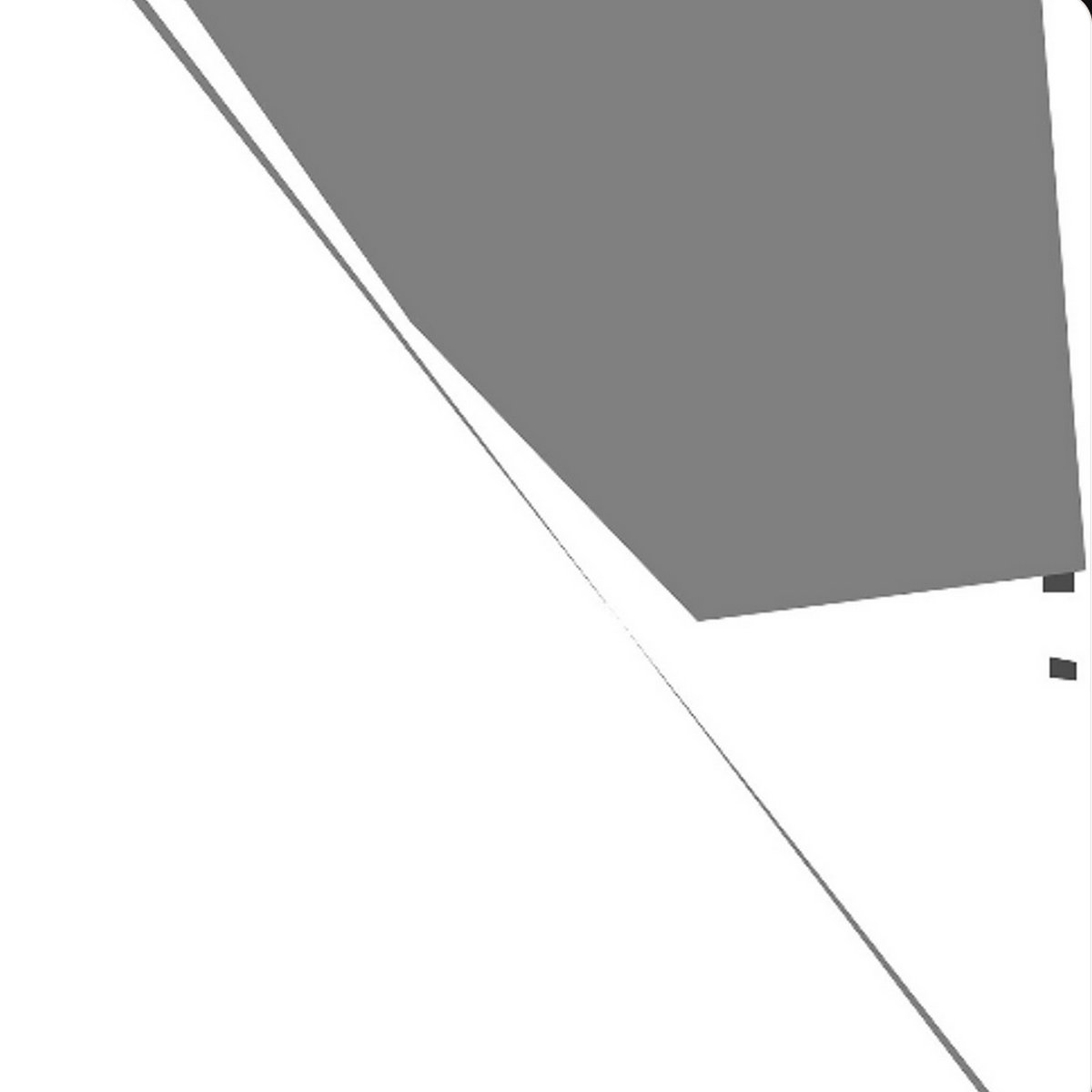
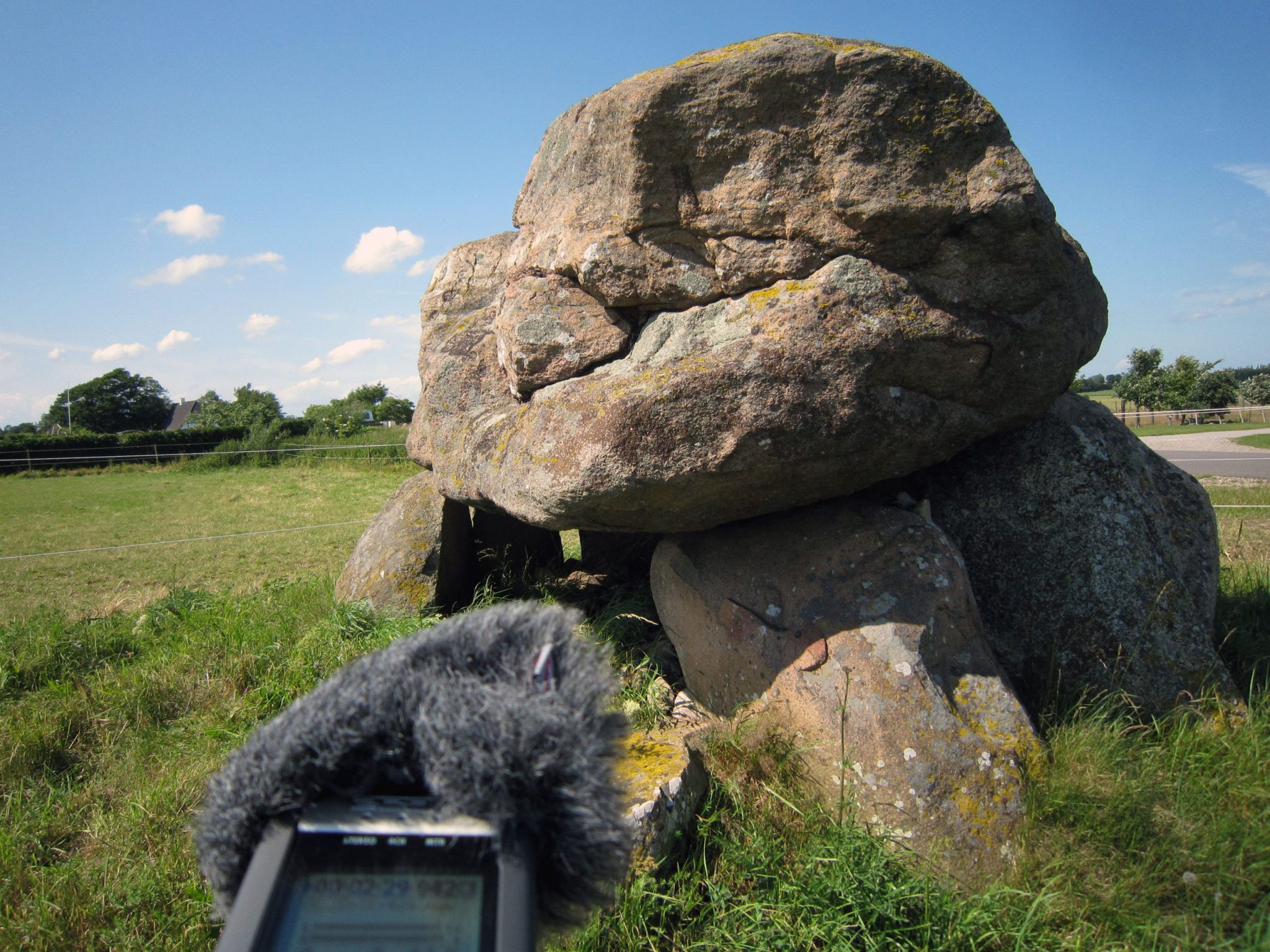
SUMMA – Notations, 2012, HD single channel video, 4min 12sec, stereo, 16:9, black/white
Compression, notation and the impossible archive of music
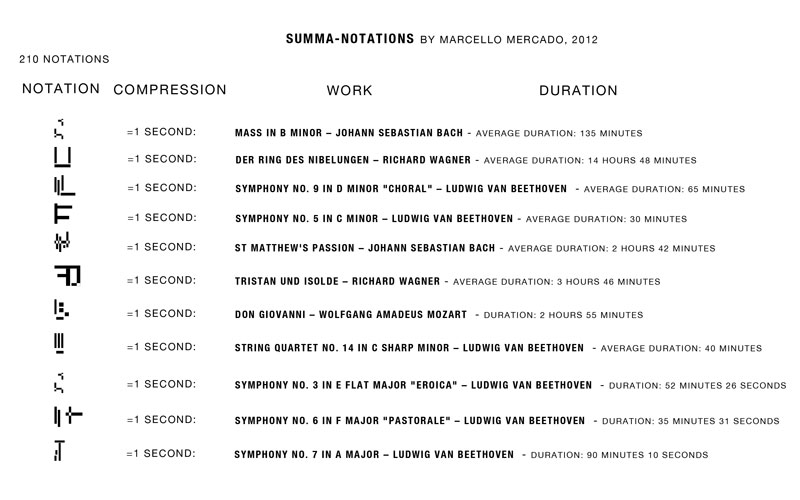
At first sight, SUMMA – Notations appears deceptively simple. A white field, black marks, fragments of text, and the invocation of monumental works from the history of Western music—compositions by figures such as Johann Sebastian Bach or Richard Wagner. Yet what unfolds in the work is not an audiovisual essay about music but the gradual construction of a speculative system: a language designed to encode musical works through radical compression.
The premise of the piece is almost absurdly simple. Musical works whose durations originally span hours are reduced to extremely short temporal fragments. The temporal architecture of a composition collapses into a symbolic instant, and the work is represented by a minimal visual sign—a glyph that functions simultaneously as notation, index, and residue.
In this gesture, time becomes writing.
The operation is at once analytical and poetic. Music, which unfolds through duration and memory, is transformed into a static symbolic field. The musical work no longer exists as sound but as a trace of compression—a mark on a white surface.
From this perspective, the piece does not merely reference musical notation. It proposes something more radical: a hypothetical language capable of encoding the entire archive of music.
Each sign in the work functions as a compressed unit of cultural memory. If a single glyph can represent a composition, then a sufficiently large field of glyphs could theoretically represent the totality of musical history. The work therefore stages a speculative experiment: what would it mean to construct a writing system capable of containing all music?
The dream of a universal language
This question situates the work within a long intellectual lineage.
For centuries, philosophers and scientists attempted to construct symbolic languages capable of representing the entirety of knowledge. In the seventeenth century, thinkers such as Gottfried Wilhelm Leibniz imagined the possibility of a universal symbolic calculus—the characteristica universalis—in which all concepts could be expressed through combinable signs. In such a language, reasoning itself would become a form of calculation.
Other thinkers proposed similar projects. The philosopher John Wilkins designed elaborate taxonomies intended to classify every object in the world through symbolic hierarchies. These systems were driven by the belief that knowledge could be perfectly organised through language.
Centuries later, the semiotician Umberto Eco analysed these projects in his study The Search for the Perfect Language. Eco demonstrated that such systems inevitably collapse under their own ambition. The world resists perfect classification. Every taxonomy produces exceptions, anomalies and proliferating categories until the system becomes unmanageable.
SUMMA can be understood as a contemporary echo of this dream. But instead of attempting to classify the entire world, the work focuses on a more specific domain: the archive of music.
The piece imagines a symbolic system capable of encoding musical compositions as minimal visual units. If such a system were complete, it could theoretically contain the entire musical history of humanity.
Compression and information
Yet the logic of the work extends beyond semiotics into the domain of information theory.
In the mid-twentieth century, the mathematician Claude Shannon formulated the principles that govern the transmission and compression of information. Shannon demonstrated that information systems are constrained by fundamental limits: as information becomes increasingly compressed, the boundary between signal and noise becomes increasingly fragile.
SUMMA visualises this tension with remarkable clarity. As more musical works are encoded, the number of glyphs increases. Signs accumulate across the screen, forming dense constellations. The system that initially appears orderly gradually becomes saturated.
What begins as a clear notation system slowly dissolves into visual noise.
The work thus stages a transformation from order to entropy.
The minimal description of music
Another theoretical framework emerges when the work is examined through the lens of algorithmic complexity.
The mathematician Andrey Kolmogorov proposed that the complexity of an object can be measured by the length of the shortest possible description capable of generating it. In computational terms, this description corresponds to the smallest program that can reproduce the object.
SUMMA implicitly asks whether musical compositions can be reduced to such minimal descriptions.
If a composition can be represented by a single glyph, then that glyph becomes a symbolic expression of its informational complexity. Each sign can be understood as the compressed algorithmic description of a work.
Under this interpretation, the visual field in the piece becomes something extraordinary: a map of musical complexity rendered as writing.
Simple works might produce ordered glyphs, while complex works might generate dense or irregular forms. The visual language of SUMMA thus becomes a speculative representation of the informational structure of music.
Gödel Devices and Epistemic Apparatuses
Incompleteness and the limits of systems
Yet the ambition to encode the entirety of music inevitably encounters deeper logical limits.
In 1931, the logician Kurt Gödel demonstrated that every sufficiently powerful formal system contains truths that cannot be proven within the system itself. Gödel’s incompleteness theorems shattered the hope that mathematics could be reduced to a perfectly complete symbolic structure.
Transposed into the context of SUMMA, this insight suggests something equally unsettling: no symbolic language can fully encode the totality of musical creation.
No matter how extensive the notation system becomes, there will always be musical structures that escape its logic.
The saturation of glyphs in the work may therefore be interpreted as the visual analogue of Gödelian incompleteness. The system attempts to represent everything and gradually collapses under the weight of its own ambition.
Gödel Suite, 2009
The universal machine
A further conceptual resonance emerges with the work of Alan Turing.
Turing demonstrated that a single symbolic device—the universal machine—could simulate any possible computation. In effect, he showed that all computational processes could be represented through symbolic manipulation.
SUMMA can be read as a similar experiment in the field of music. The piece constructs a symbolic machine that attempts to translate musical compositions into a universal language of signs.
But as in Turing’s work, the ambition of universality reveals paradoxes. Certain processes cannot be predicted or resolved within the system itself. Similarly, certain musical structures resist compression or symbolic representation.
The machine can simulate the archive of music, but it cannot fully contain it.
Infinite archives
At this point the work begins to resonate strongly with literary structures imagined by Jorge Luis Borges.
Borges repeatedly constructed fictional archives that sought to contain total knowledge. In The Library of Babel, an infinite library contains every possible book. In The Aleph, a single point reveals the entirety of the universe simultaneously.
Yet these archives do not produce clarity. Instead they generate disorientation and unreadability. When all knowledge is present, the ability to interpret it collapses.
SUMMA evokes a similar condition. The expanding field of glyphs suggests an archive that grows without limit. Each sign contains the compressed residue of a musical work, and together they form a visual library of music.
But as the archive expands, the symbols become increasingly dense. The system approaches a threshold where meaning dissolves into visual noise.
The archive becomes unreadable.
The impossible score
This transformation reveals the most poetic dimension of the work.
The glyphs resemble a musical notation system, yet they do not function as conventional scores. They do not instruct musicians how to perform a composition. Instead they appear as compressed traces of works that have already vanished into abstraction.
SUMMA therefore produces a paradoxical object:
a score for a music that can no longer be played.
The music referenced by the signs has been compressed beyond recoverability. Duration has collapsed into symbol. What remains is a field of inscriptions that refer to musical works but no longer reproduce them.
The piece thus constructs an impossible archive of music.
It imagines a future in which musical culture survives only as compressed symbolic fragments. The works themselves are no longer heard; they persist only as traces within a visual language.
The collapse of the archive
In its final sequences, the visual field becomes saturated with glyphs. Signs accumulate until they form dense constellations that verge on illegibility.
At this moment the work reveals its ultimate conceptual gesture.
The attempt to encode the totality of musical culture does not produce perfect order. Instead it generates excess, saturation and noise.
The archive collapses under its own expansion.
SUMMA therefore stages a profound paradox: the more completely culture is archived, the less readable it becomes.
In this sense the work offers a meditation on the limits of symbolic systems. It reveals the structural impossibility of any language that seeks to contain the entirety of human creation.
The archive grows. The symbols multiply. Meaning disperses.
What remains is a dense constellation of marks—a silent library of music that can no longer be heard.
Addendum II
Navigation, compression and the disappearance of the play
The photographic documentation of Searching for the Short Version of Hamlet introduces a further conceptual layer to the investigation of cultural compression.
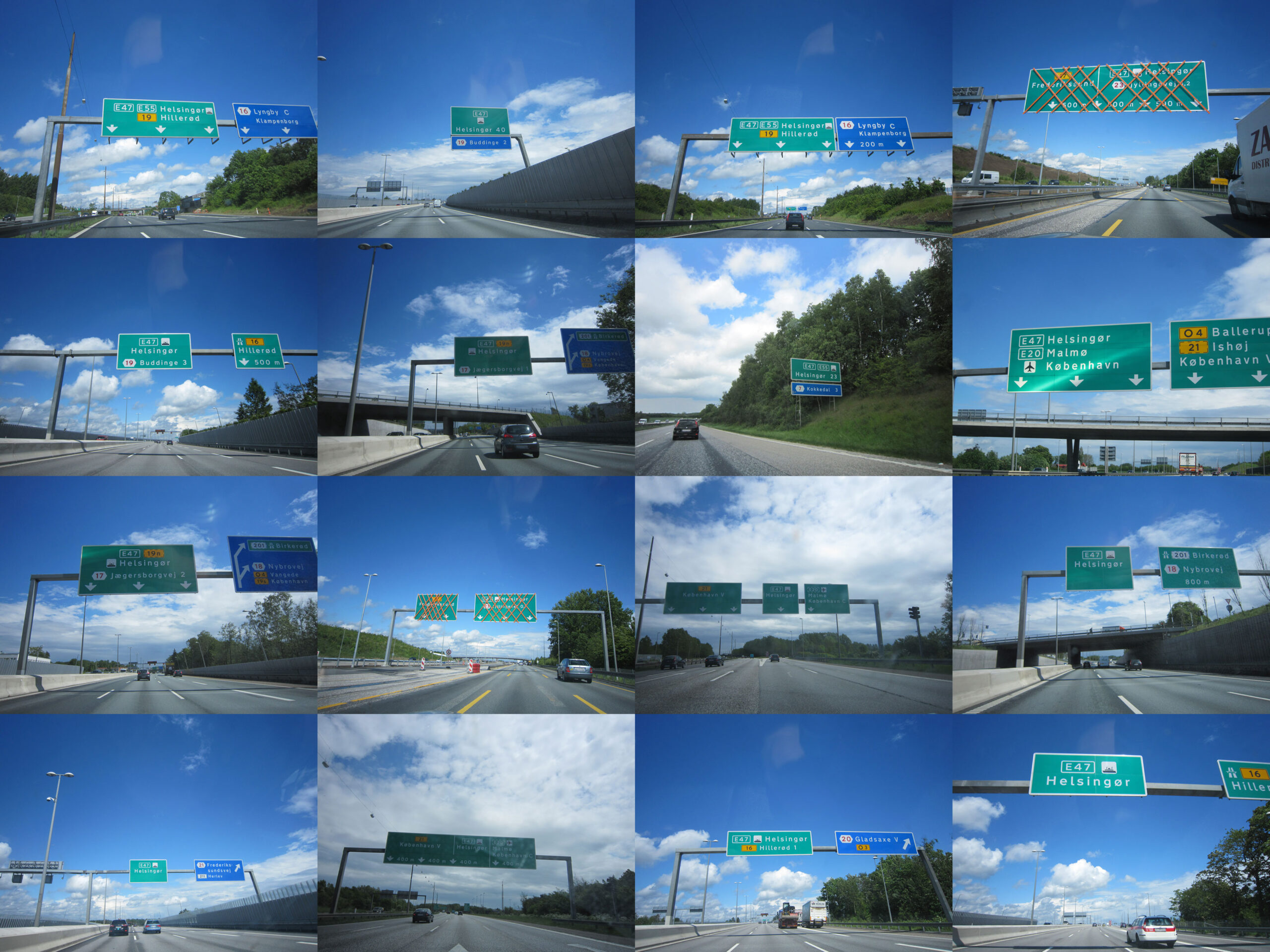
The images show a sequence of highway views taken during the journey toward Elsinore. Road signs indicate directions toward Helsingør, the Danish town associated with the fictional castle of the play.
Here the work reveals an unexpected transformation: the narrative structure of Shakespeare’s tragedy is replaced by a navigation system.
The tragedy of William Shakespeare—a dramatic structure composed of acts, scenes, conflicts and philosophical reflections—is translated into a sequence of directional instructions.
The dramatic universe of Hamlet becomes a route.
The play is no longer performed or narrated. Instead it is approached as a destination within geographic space.
The highway signs that appear repeatedly in the photographs function almost like fragments of a new notation system. Each sign points toward Helsingør, gradually transforming the act of travel into a kind of performative score.
The journey becomes the script.
Theatre as navigation
In classical theatre, narrative unfolds through temporal progression. The audience experiences the story as a sequence of events that develop over time.
In Mercado’s performance this structure collapses.
Instead of temporal duration, the work operates through spatial navigation. The play is replaced by a trajectory across geographic coordinates. The only remaining narrative structure is movement toward a location.
The sequence of photographs therefore functions like a compressed storyboard. Each frame records a step in the approach to the fictional space of the play.
The castle of Hamlet is never staged, never represented dramatically. It appears only as a destination indicated by road signs.
The shortest possible performance
When the artist finally reaches the location, the performance itself is reduced to a minimal gesture:
arrival
exit from the car
immediate return
departure
Using theatrical terminology, the entire dramatic structure of Hamlet is compressed into the most elementary components of stage presence:
an entrance and an exit.
All intermediate dramatic content disappears.
The action functions almost like a mathematical limit case. If a theatrical work can be defined as the appearance of actors in space, then the shortest possible performance would consist of a single moment of presence followed immediately by absence.
Mercado’s gesture therefore represents the minimal duration of theatre.
The role of photography
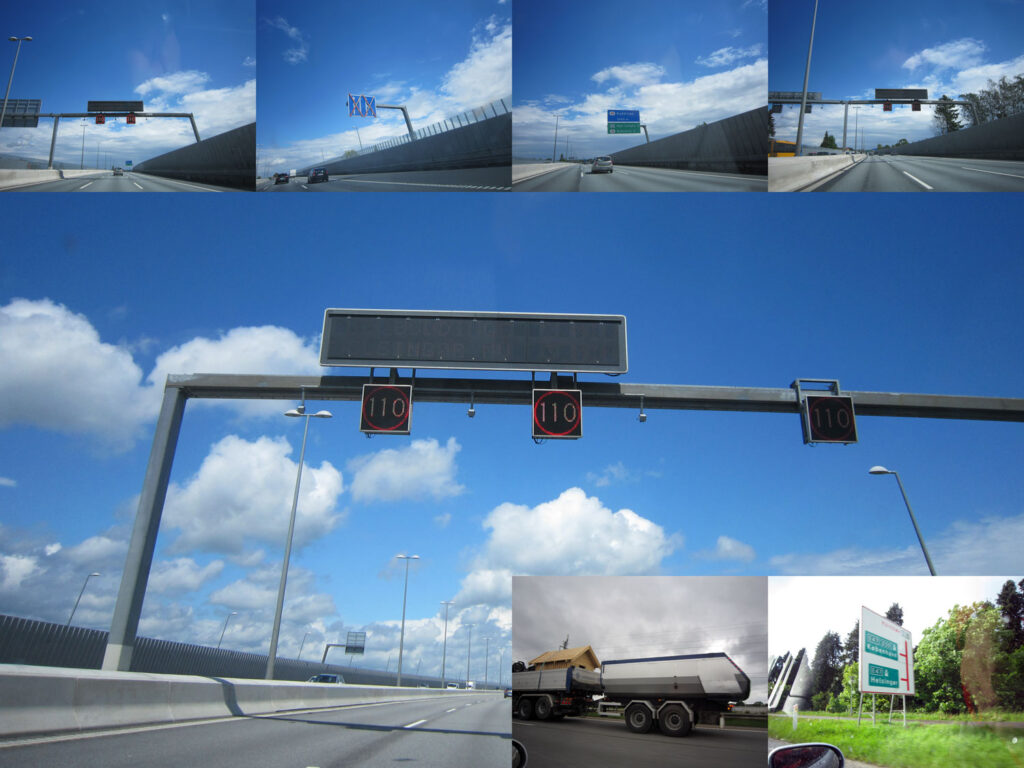
The photographic sequences become essential to the work because they preserve the traces of this navigation process.
The images resemble documentary records of a journey, yet their repetition transforms them into something closer to a visual score. The highway signs appear again and again, pointing toward the same destination.
These signs function as markers within a system of orientation. They transform the journey into a sequence of instructions.
Seen this way, the photographs themselves begin to resemble the glyphs of SUMMA – Notations.
Both projects rely on the transformation of complex cultural structures into minimal visual signs.
Music becomes glyph.
Theatre becomes direction.
Narrative becomes navigation.
From route to archive
This transformation introduces another conceptual shift.
If SUMMA imagines a symbolic archive of music, Searching for the Short Version of Hamlet proposes something slightly different: an archive constructed through movement.
The photographic sequence does not preserve the play itself. Instead it preserves the trajectory toward the place where the play could be imagined.
The archive therefore records the approach to the work rather than the work itself.
The result is a curious inversion of traditional documentation. Instead of recording a theatrical performance, the images record the disappearance of theatre.
The play vanishes into geography.
Cultural objects as coordinates
When viewed together, the elements of the work reveal a deeper structure.
The road signs function like coordinates within a spatial system. They guide the movement of the traveler toward Helsingør, yet they never reveal the fictional world of Hamlet itself.
The cultural object—Shakespeare’s play—exists only as a point of orientation.
This transformation is strikingly similar to the logic of digital networks. On the internet, cultural objects are often accessed through addresses, links and references rather than through continuous experience.
The object becomes a node in a navigational system.
Compression and the disappearance of narrative
The radical compression performed in the piece therefore produces a surprising result.
By reducing the play to a minimal gesture, the work does not merely shorten the narrative. It transforms the entire structure of theatrical representation.
Narrative disappears.
In its place we find a sequence of spatial instructions that guide a journey toward a cultural reference point.
The play becomes a coordinate.
A prefiguration of later works
This transformation anticipates many of the strategies that later appear in Mercado’s long-term project Das Kapital.
In that work, the monumental theoretical structure of Karl Marx is translated into algorithmic procedures, images and symbolic operations.
Just as Hamlet becomes a navigational route in this performance, Das Kapital becomes a system of computational transformations.
Large intellectual structures are translated into operational systems.
The archaeology of compressed culture
Seen in this broader context, Searching for the Short Version of Hamlet occupies a crucial position within Mercado’s practice.
The work demonstrates that cultural objects can be approached not only through interpretation but through structural operations applied to their temporal form.
Compression becomes a methodological tool.
By compressing the duration of the play, the work exposes the minimal conditions under which theatre can still exist. The result is not a simplified version of Hamlet but a conceptual experiment that reveals the structural skeleton of theatrical presence.
The images that remain resemble fragments of a future archive—documents of a cultural work that has been reduced to its coordinates in space.
Preface
Cultural Compression
Over the past decades, culture has entered a new condition. Works of art, literature, music and theory no longer circulate primarily through their original forms of duration and presence. Instead they are translated into compressed structures—files, datasets, symbolic representations and algorithmic systems.
Images become pixels.
Music becomes digital signals.
Texts become databases.
The expansion of digital technologies has produced an unprecedented archive of cultural material. Yet this archive does not simply preserve culture. It transforms it.
Compression alters the structure of cultural objects.
Long narratives become fragments.
Complex works become symbolic traces.
Entire traditions become statistical patterns within machine learning systems.
In this new condition, cultural forms increasingly exist not as continuous experiences but as compressed representations of themselves.
The work of Marcello Mercado can be understood as a sustained artistic investigation into this transformation.
Across performances, bioart experiments, visual systems and algorithmic projects, Mercado repeatedly subjects cultural structures to operations of radical reduction. Musical compositions become glyphs, theatrical narratives become gestures, philosophical texts become biological processes and theoretical systems become computational procedures.
These works do not merely reinterpret cultural objects. They apply pressure to their structural limits.
The resulting transformations reveal a hidden dimension of culture: its susceptibility to compression.
When cultural systems are pushed toward their limits, they begin to change form. Duration collapses into symbol, narrative dissolves into coordinates, theory becomes algorithm and archive becomes data.
What emerges from this process is not simply a body of artworks but a conceptual framework.
Taken together, these investigations outline what might be described as The Theory of Cultural Compression.
This theory proposes that cultural objects possess thresholds beyond which their structures undergo qualitative transformation. When subjected to sufficient reduction, they cease to function in their original form and instead reveal the minimal frameworks that sustain them.
Mercado’s works operate precisely at this threshold.
They examine culture at the moment when it begins to transform into something else.
The Theory of Cultural Compression
Duration, reduction and the transformation of cultural systems in the work of Marcello Mercado
Across more than three decades of work, the artistic practice of Marcello Mercado has repeatedly returned to a fundamental operation: the radical transformation of cultural structures through processes of reduction, translation and compression.
Although these works appear in very different forms—performances, bioart experiments, algorithmic systems, photographic sequences and artificial-intelligence generated images—they share a consistent methodological gesture. Each project takes a complex cultural object and subjects it to operations that push its structure toward the limits of its own legibility.
Music, theatre, logic, philosophy and economic theory become fields in which cultural duration is compressed until only minimal traces remain.
This recurring strategy gradually reveals itself not merely as a set of artistic procedures but as a coherent conceptual framework. Taken together, Mercado’s works outline what might be described as a theory of cultural compression.
Compression as cultural method
Compression is commonly understood as a technical process used in information technology. Digital files are compressed so that large quantities of data can be stored and transmitted efficiently. Images, sounds and texts circulate across networks as encoded structures.
Mercado extends this logic beyond digital technology and applies it directly to culture itself.
In his work, compression becomes a method for examining the internal structures of cultural systems. Rather than preserving works in their original duration, the artist subjects them to operations that drastically reduce their scale, time or symbolic complexity.
The purpose of this reduction is not simplification but revelation. When cultural structures are compressed, their hidden frameworks become visible.
Compression functions as a form of analytical pressure applied to culture.
Logical systems under biological pressure
One of the earliest manifestations of this method appears in Mercado’s performances inspired by the incompleteness theorems of Kurt Gödel.
Gödel demonstrated that any sufficiently complex logical system contains propositions that cannot be proven within the system itself. These theorems revealed the impossibility of constructing a completely closed symbolic structure capable of containing all mathematical truths.
Mercado translated this philosophical insight into a material experiment.
In one performance, the printed text of Gödel’s theorems was placed into environments inhabited by Californian worms. The pages containing the mathematical statements were gradually consumed by the organisms.
The logical structure of the theorem was thus subjected to biological digestion.
What emerges here is a striking inversion of intellectual hierarchy. One of the most abstract achievements of twentieth-century mathematics collapses into a metabolic process.
The conceptual density of the theorem is reduced to organic residue.
This gesture introduces one of the key principles of cultural compression: symbolic structures can be translated into radically different material systems.
Logic becomes biology.
Music reduced to notation
This methodological operation reappears in Mercado’s work SUMMA – Notations, where the focus shifts from logical systems to musical compositions.
Works by composers such as Johann Sebastian Bach or Richard Wagner—musical structures that unfold over long durations—are translated into minimal visual glyphs.
Hours of musical time collapse into symbolic marks.
The musical work no longer exists as sound but as a compressed visual trace.
These glyphs do not function as conventional scores capable of reproducing the music. Instead they act as compressed indices that point toward compositions whose duration has been radically reduced.
Music becomes writing.
Through this transformation, the work asks a provocative question: if an entire composition can be represented by a single symbol, what remains of the musical work itself?
Theatre reduced to gesture
A similar operation appears in the performance Searching for the Short Version of Hamlet.
The play Hamlet, written by William Shakespeare, is one of the longest works in the Western theatrical canon. Traditionally it unfolds over nearly three hours of dramatic narrative.
Mercado approached the play through an act of radical reduction.
The artist traveled to Helsingør—the Danish location associated with the fictional castle of the play. Upon arriving, he briefly stepped out of his car and immediately returned to it before departing.
Using theatrical terminology, the entire dramatic structure of the play is reduced to its minimal structural components:
an entrance and an exit.
Everything else disappears.
The characters, dialogues, conflicts and philosophical reflections of Shakespeare’s tragedy collapse into a brief gesture performed in physical space.
The play becomes a minimal event.
Cultural works as operational systems
Across these works a consistent pattern begins to emerge.
Music becomes glyph.
Theatre becomes gesture.
Logic becomes compost.
Each transformation subjects a cultural system to radical compression while simultaneously translating it into a new material domain.
The cultural object ceases to function in its original form. Instead it becomes an operational system within a new environment.
This methodological strategy reaches a new level of complexity in Mercado’s long-term project Das Kapital.
Theory as algorithm
In this project, Mercado engages with the monumental theoretical work of Karl Marx.
Rather than interpreting Marx’s text through traditional critical analysis, the project performs structural operations on the book itself.
Chapters are translated into algorithmic procedures. Images, computational systems and symbolic structures replace textual exposition.
The theoretical architecture of Das Kapital becomes a field of algorithmic transformations.
Just as SUMMA compresses music into glyphs, the project compresses economic theory into operational systems.
The book becomes code.
Artificial intelligence and the compression of culture
The emergence of artificial intelligence introduces a new dimension to this investigation.
AI systems operate by processing vast datasets composed of compressed representations of images, texts and sounds. Cultural production becomes a statistical field of patterns extracted from enormous archives.
Within this technological context Mercado’s earlier works appear strikingly prophetic.
Experiments that once seemed speculative—compressing music into symbols, reducing theatre to gestures, translating theory into algorithms—now resemble early explorations of the processes through which culture is transformed into data.
Artificial intelligence performs compression on an unprecedented scale.
Entire artistic traditions become training material for computational systems.
The paradox of the archive
This transformation leads to a central paradox.
Modern culture possesses an extraordinary capacity to store and preserve information. Digital archives accumulate enormous quantities of images, texts, recordings and documents.
Yet the expansion of these archives produces a new form of opacity.
The more culture is compressed into digital systems, the more difficult it becomes to interpret and navigate the resulting accumulation of data.
Archives approach saturation.
Mercado’s works repeatedly stage this condition.
The glyphs of SUMMA accumulate until they approach visual noise.
The Hamlet performance reduces theatre to a nearly vanishing gesture.
The Gödel performance transforms logic into biological residue.
Each work reveals a point where cultural systems approach the limits of their own legibility.
Toward an archaeology of compressed culture
Seen across the full trajectory of Mercado’s practice, cultural compression emerges not merely as an artistic strategy but as a philosophical inquiry.
The works examine what remains of culture when its structures are pushed toward their limits.
Duration collapses.
Narrative dissolves.
Symbolic density becomes residue.
What remains are traces—glyphs, gestures, decomposed texts, algorithmic images.
These traces resemble fragments from a future archive, documents of cultural systems that have undergone radical transformation.
Mercado’s work therefore functions as a form of archaeology of compressed culture.
Rather than preserving cultural objects in their original form, it examines the processes through which those objects are translated into new systems of representation.
The works reveal that culture, when subjected to sufficient compression, begins to transform into something else.
Sound becomes symbol.
Narrative becomes coordinate.
Theory becomes algorithm.
Culture becomes data.
And in this transformation, the structures that once defined cultural meaning become visible in their most minimal and fragile form.