
Performance and photographic sequence
Elsinore / Helsingør, Denmark
c. 1999–2000
Searching for the Short Version of Hamlet forms part of a broader investigation into the compression of cultural systems that runs throughout Marcello Mercado’s early work around the turn of the millennium. Developed in temporal proximity to SUMMA – Notationen, the piece explores how complex cultural structures can be reduced to minimal operational gestures.
Where SUMMA compresses musical composition into graphic glyphs, this performance applies the same logic to theatre. Shakespeare’s Hamlet, one of the longest and most structurally complex works in the Western dramatic canon, becomes the subject of a radical experiment in reduction.
The central question posed by the work is deceptively simple:
What is the shortest possible version of Hamlet?
Instead of editing the text or shortening the narrative, Mercado approaches the problem from an entirely different direction. The play is treated not as a script but as a geographical destination.
The performance begins with a journey.
Theatre as Navigation
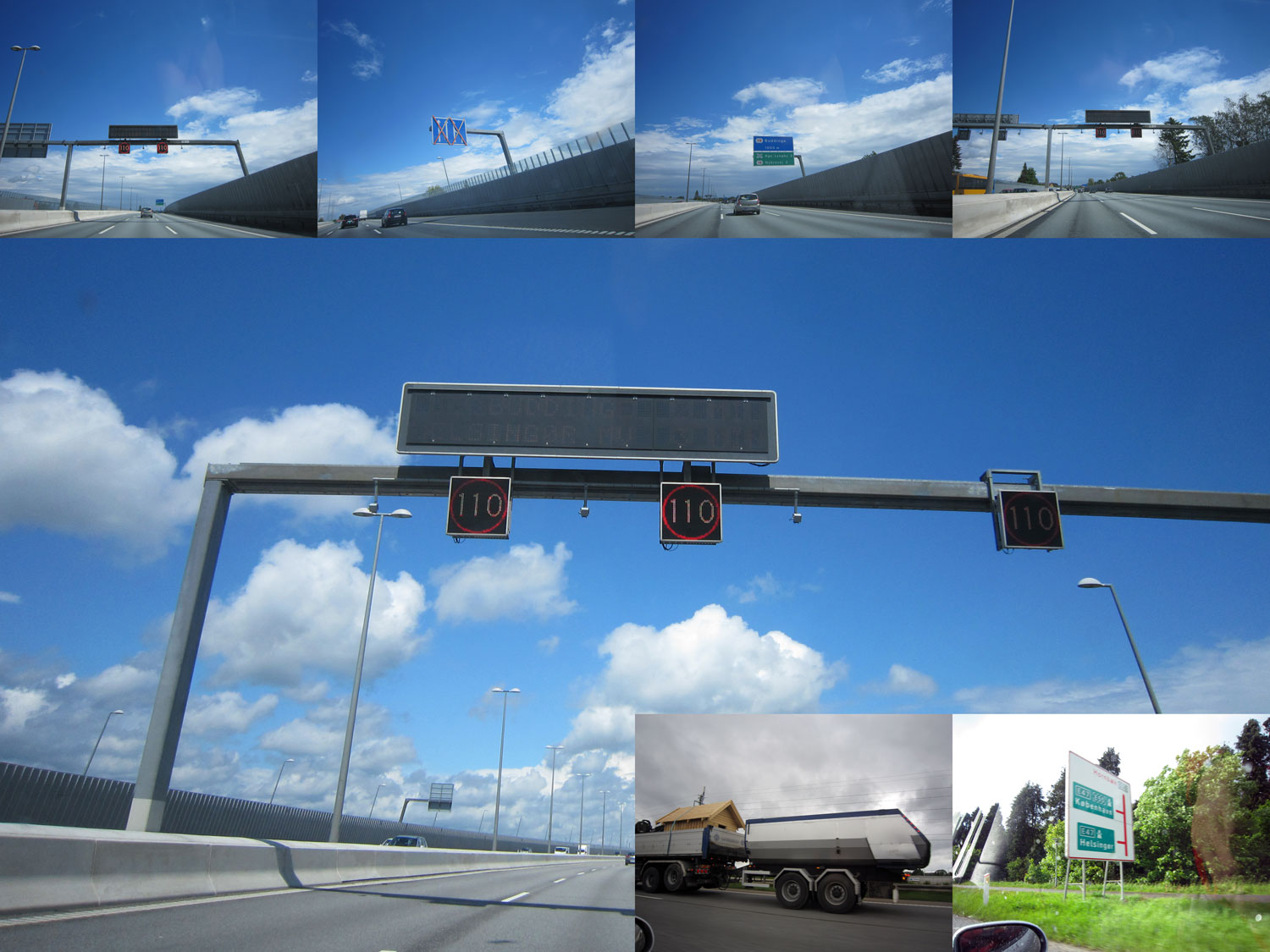
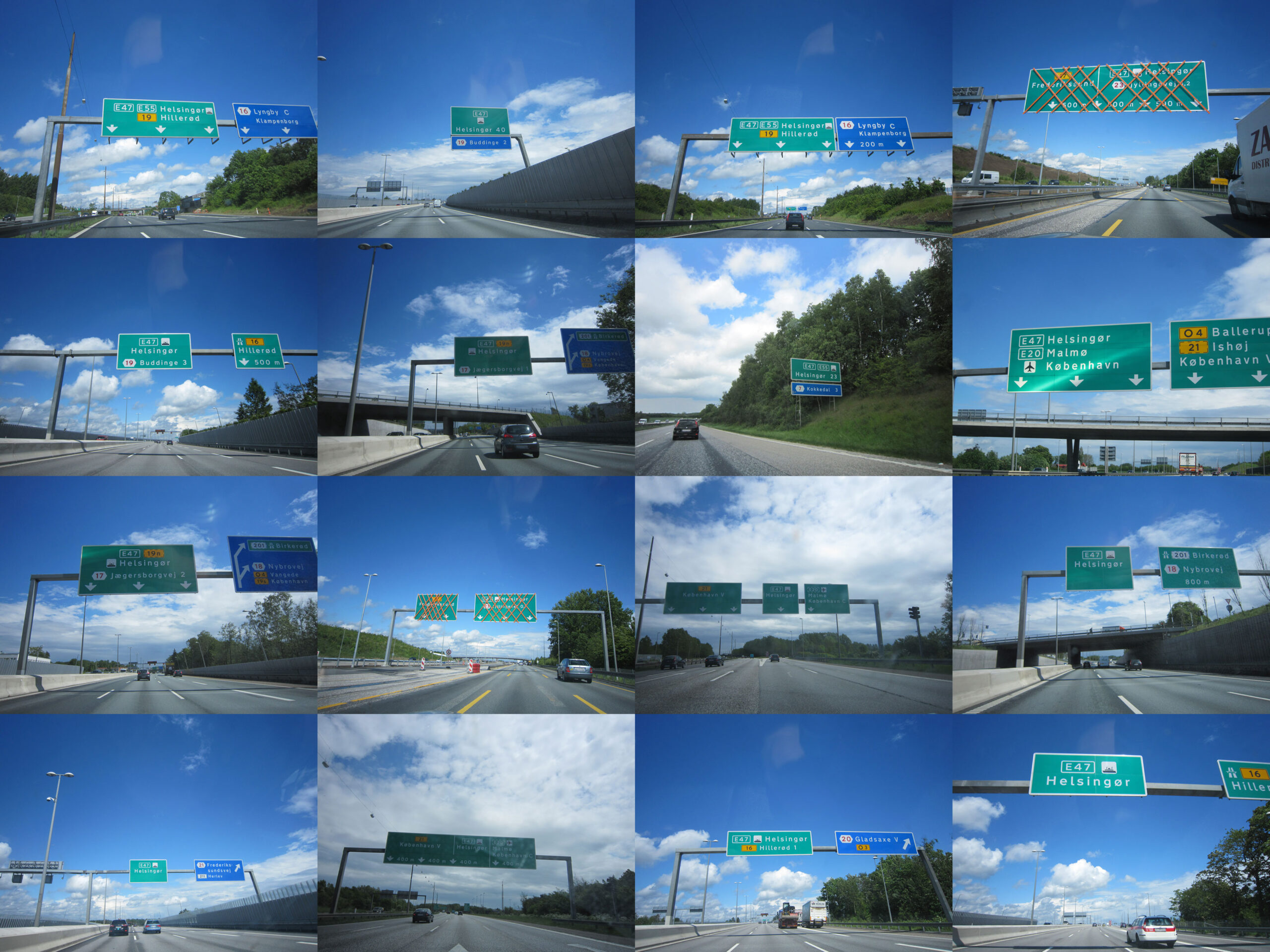
The photographic documentation shows a sequence of highway views taken while driving through the Danish motorway system toward Helsingør, the town historically associated with Elsinore, the fictional location of Hamlet’s castle.
Along the highway, road signs repeatedly appear indicating the direction toward Helsingør.
In these images the theatrical structure of Shakespeare’s tragedy undergoes a conceptual transformation. Acts, scenes, dialogue and dramatic conflict are replaced by a system of navigation markers.
The play becomes a route.
Instead of unfolding in time through dramatic action, the narrative collapses into a sequence of spatial coordinates guiding the performer toward a geographic point.
The journey itself becomes the script.
Each highway sign functions as an element in a new notation system. The repeated indication of “Helsingør” transforms the act of travel into a kind of performative score in which movement replaces narration.
The play is no longer performed.
It is approached.
Geographic Coordinates of the Work
The trajectory documented in the photographs corresponds to the motorway network north of Copenhagen leading toward Helsingør.
Key locations that structure the performative route include:
Kronborg Castle (traditional location of Hamlet’s castle)
These coordinates allow the work to be reconstructed digitally. The performance can therefore be re-enacted conceptually through navigation systems or online mapping platforms, extending the piece into the infrastructure of contemporary spatial media.
The Shortest Possible Performance
When the artist finally reaches Helsingør, the performance itself is reduced to an almost absurdly minimal gesture.
The action consists of four operations:
arrival
exit from the vehicle
immediate return
departure
In theatrical terminology, the entire dramatic structure of Hamlet is compressed into the most elementary components of stage presence:
an entrance and an exit.
All intermediate narrative content disappears.
What remains is a minimal threshold of theatrical existence: the brief appearance of a body in space.
The performance therefore approaches a conceptual limit. If theatre is defined as the presence of a performer in a location, then the shortest possible theatrical event is the moment in which presence immediately becomes absence.
Mercado’s gesture proposes precisely this limit case.
Photography as Score
The photographic images function less as traditional documentation than as a visual score of the journey.
Each frame records a step in the spatial approach toward the fictional world of the play. The repeated appearance of highway signs transforms the images into markers within a navigational system.
The photographs therefore resemble fragments of a cartographic notation.
This visual logic echoes the symbolic structures developed in SUMMA – Notationen, where musical compositions were translated into abstract glyph systems.
In this new context:
music becomes glyph
theatre becomes direction
narrative becomes navigation.
The Disappearance of the Play
A crucial inversion occurs in the work.
Traditional theatre documentation records the performance of a play. In Searching for the Short Version of Hamlet, the documentation records the disappearance of the play itself.
The photographic sequence does not preserve Hamlet as a narrative or dramatic event. Instead it preserves the trajectory toward the place where Hamlet could theoretically occur.
The archive therefore documents the approach to the work rather than the work itself.
This displacement shifts the ontological status of the play.
Shakespeare’s tragedy no longer functions as a dramatic object but as a cultural coordinate within geographic space.
Cultural Objects as Coordinates
Through this operation Mercado anticipates a logic that has become increasingly dominant in digital culture.
In contemporary network systems, cultural objects are often accessed through addresses, links and coordinates rather than through continuous narrative experience.
The object becomes a node in a navigational system.
Searching for the Short Version of Hamlet reveals this transformation with striking clarity. The entire dramatic universe of Shakespeare’s play is reduced to a single point on a map:
Helsingør.
The play exists only as an orientation marker guiding the movement of the traveler.
Narrative disappears.
In its place emerges a spatial instruction embedded within the infrastructure of highways, road signs and geographic coordinates.
Cultural Compression
Seen within the broader trajectory of Mercado’s work, the performance represents an early formulation of a method that would later appear in numerous projects:
the compression of complex cultural systems into minimal operational structures.
In this piece the dramatic universe of Shakespeare collapses into a gesture lasting only a few seconds.
A play that normally unfolds over several hours becomes a performance consisting of a single moment of presence followed by immediate departure.
The result is not merely a shortened version of Hamlet.
It is the vanishing point of theatre itself.