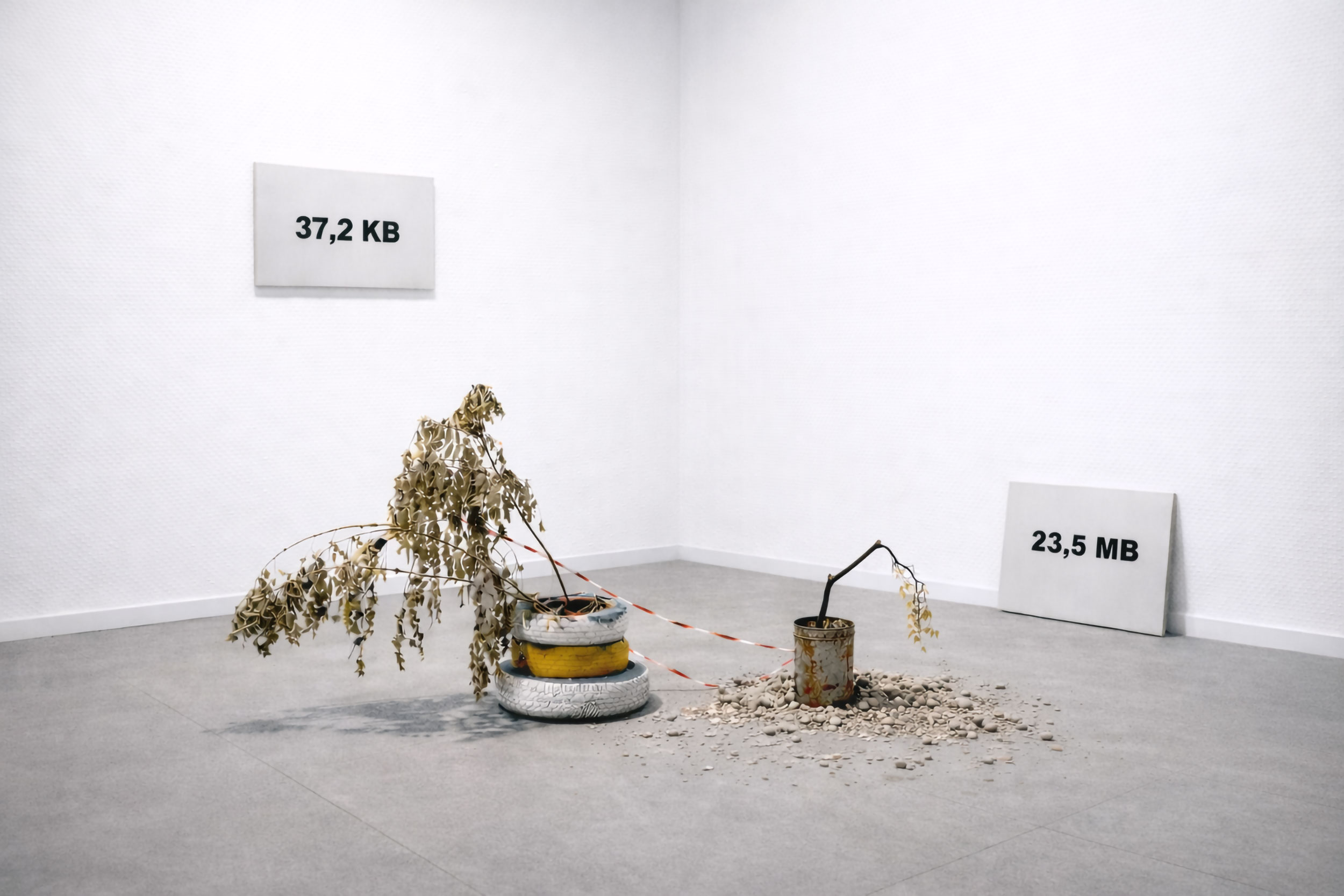

The installation begins with a common form of warning found in many Argentine cities: when there is a pothole, a trench, or a destroyed section of street that blocks access or puts cars at risk, the municipality places dry branches inside tires painted white and yellow. It is a provisional and recognizable solution intended to indicate that something has broken down.
Marcello Mercado transfers this logic into the gallery space, but shifts it from the physical territory to the territory of image and information. Here there is no longer a pothole in the street. What has disappeared is the image itself. The two white surfaces on the wall do not contain the digital weight of any particular photograph, document, or representation. They only display two quantities: “37.2 KB” and “23.5 MB.” These figures function as remains and material indicators of something that was there, or might have been there. Digital weight has taken the place of the image.
The installation does not represent a loss; it turns it into matter. The viewer does not contemplate a missing photograph, but rather the physical conditions of its absence. Instead of an archive, what remains is the digital volume of a file; instead of memory, what remains is its measurement. The work follows a central line in Mercado’s practice: to think of culture not as an infinite accumulation of images, but as a system subject to erosion, compression, transfer, disappearance, and residue.
In The Theory of Cultural Compression and Operational Matter, Mercado argues that the archive ceases to be a repository of memory and becomes an operative, vulnerable, and physically exposed material. In this installation, that operation reaches its most extreme form: the image is no longer there, but its weight persists.
The dry plant supported by tires functions as a warning sculpture. It does not refer to nature or landscape. The installation as a whole functions as a scene after the event: it does not show destruction, but its material consequences. As in many of Mercado’s works — from Open Genome Actions to his recent investigations into the translation from body to system — what matters is not the original event, but the process by which that event is transformed into residue, code, matter, or data.
This precarious form of warning refers to the contemporary erosion of systems of memory, representation, and experience. The work suggests that we live surrounded by images that no longer exist, archives that survive only as quantifiable data, and technological systems capable of preserving the weight of things while losing their content.
The work operates through minimal signs, poor materials, and vernacular procedures. It is as if the space had become occupied by the physical remains of a system that still preserves data, but can no longer sustain what that data once represented.
(Deutsch)
37,2 KB / 23,5 MB
Die Installation geht von einer in vielen argentinischen Städten verbreiteten Form der Markierung aus: Wenn es ein Schlagloch, einen Graben oder einen zerstörten Straßenabschnitt gibt, der die Durchfahrt verhindert oder Autos gefährdet, stellt die Stadtverwaltung trockene Äste in weiß und gelb gestrichene Reifen. Es handelt sich um eine provisorische und leicht erkennbare Lösung, die darauf hinweist, dass etwas beschädigt wurde.
Marcello Mercado überträgt diese Logik in den Galerieraum, verschiebt sie jedoch vom physischen Territorium in das Territorium des Bildes und der Information. Hier gibt es kein Schlagloch mehr auf der Straße. Verschwunden ist das Bild selbst. Die beiden weißen Flächen an der Wand enthalten nicht das digitale Gewicht irgendeiner bestimmten Fotografie, eines Dokuments oder einer Darstellung. Sie zeigen lediglich zwei Werte: „37,2 KB“ und „23,5 MB“. Diese Zahlen fungieren als Reste und materielle Indikatoren von etwas, das einmal vorhanden war oder vorhanden gewesen sein könnte. Das digitale Gewicht hat den Platz des Bildes eingenommen.
Die Installation stellt keinen Verlust dar, sondern verwandelt ihn in Materie. Der Betrachter sieht keine fehlende Fotografie, sondern die physischen Bedingungen ihrer Abwesenheit. Anstelle eines Archivs bleibt das digitale Volumen einer Datei; anstelle von Erinnerung bleibt ihr Maß. Die Arbeit folgt einer zentralen Linie in Mercados Praxis: Kultur nicht als unendliche Ansammlung von Bildern zu begreifen, sondern als ein System, das Verschleiß, Kompression, Übertragung, Verschwinden und Rückständen unterliegt.
In The Theory of Cultural Compression und Operational Matter beschreibt Mercado, wie das Archiv aufhört, ein Speicher der Erinnerung zu sein, und zu einer operativen, verletzlichen und physisch exponierten Materie wird. In dieser Installation erreicht diese Operation ihre extremste Form: Das Bild ist nicht mehr da, aber sein Gewicht bleibt bestehen.
Die trockene Pflanze, die von Reifen getragen wird, funktioniert als Warnskulptur. Sie verweist weder auf Natur noch auf Landschaft. Die gesamte Installation funktioniert wie eine Szene nach dem Ereignis: Sie zeigt nicht die Zerstörung, sondern ihre materiellen Folgen. Wie in vielen Arbeiten Mercados — von Open Genome Actions bis zu seinen jüngsten Untersuchungen über die Übersetzung vom Körper zum System — ist nicht das ursprüngliche Ereignis entscheidend, sondern der Prozess, durch den dieses Ereignis in Rückstand, Code, Materie oder Daten verwandelt wird.
Diese prekäre Form der Markierung verweist auf die gegenwärtige Erosion von Systemen der Erinnerung, der Repräsentation und der Erfahrung. Die Arbeit legt nahe, dass wir von Bildern umgeben sind, die nicht mehr existieren, von Archiven, die nur noch als quantifizierbare Daten weiterleben, und von technologischen Systemen, die das Gewicht der Dinge bewahren können, während sie deren Inhalt verlieren.
Die Arbeit operiert mit minimalen Zeichen, armen Materialien und vernakulären Verfahren. Es ist, als wäre der Raum von den physischen Resten eines Systems besetzt, das zwar noch Daten bewahrt, aber nicht mehr tragen kann, was diese Daten einst repräsentierten.
(Spanish)
37,2 KB / 23,5 MB