

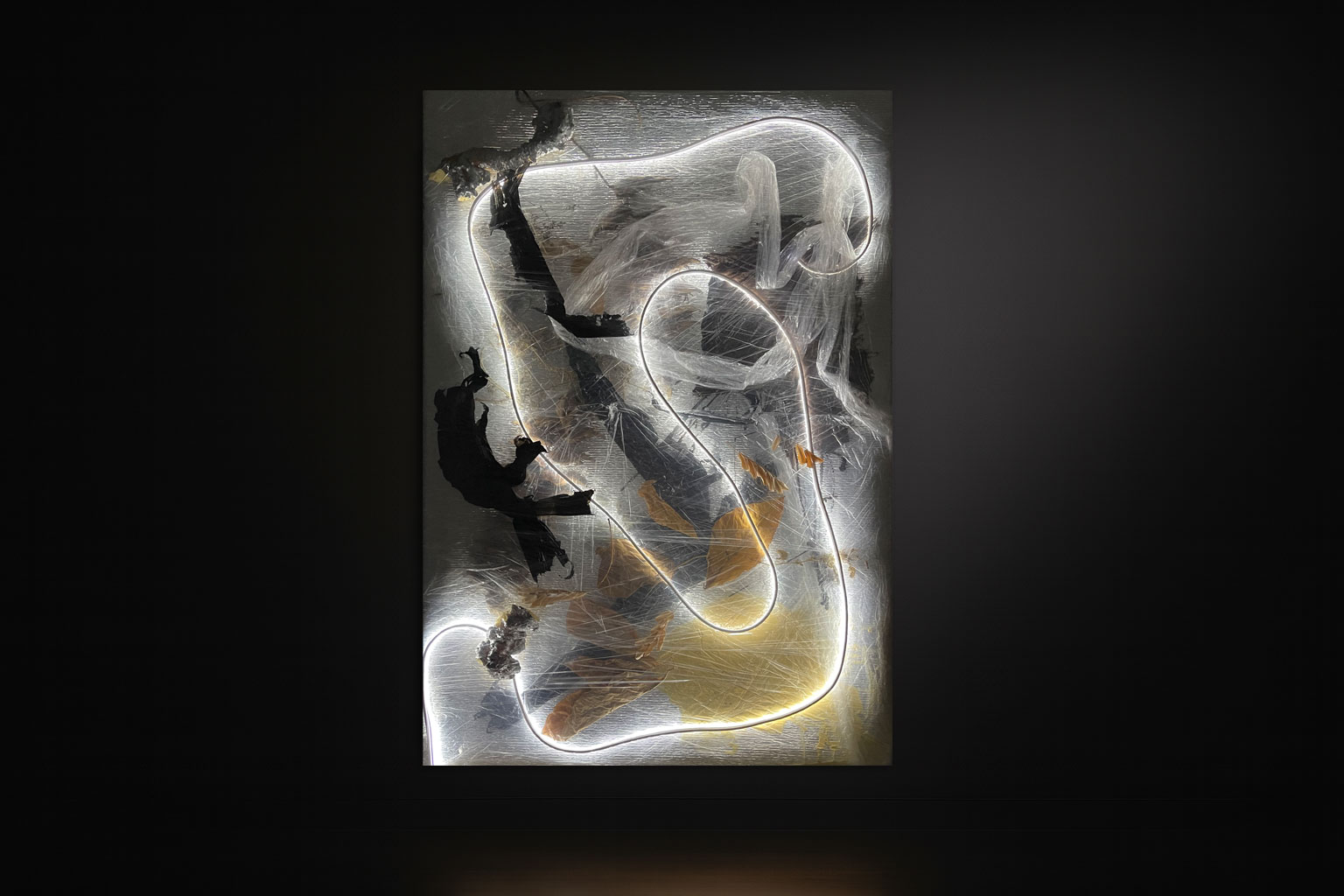
Material Transfer Unit, 2025
Painting-collage
Dried plants, leaves, seeds, vegetal adhesive compounds, putty, metallic insulating foil, plastic foil, neon
100 × 80 cm
At first glance the painting appears wrapped rather than painted. Transparent plastic stretches across the surface in overlapping layers, catching the light unevenly and producing a skin that is at once reflective and opaque. Beneath it, metallic insulation, black passages, dried leaves and small vegetal fragments emerge intermittently. None of these elements occupies a stable foreground. They seem suspended at different depths, as though the work had accumulated through successive acts of covering instead of addition.
The neon tube changes the way the composition is read. It does not sit on top of the image as an accent, nor does it function as an external source of illumination. Its continuous line folds back on itself, slows, accelerates, disappears behind translucent membranes and reappears elsewhere. One follows it instinctively, but it never quite becomes a contour or a frame. It behaves more like a current moving through a dense environment whose resistance constantly alters its path.
Seen closely, the dried leaves lose much of their botanical identity. Their colour survives, but their function has shifted. They are flattened, enclosed, pressed against reflective surfaces or caught beneath plastic film. The same is true of the industrial materials. Foil, putty and insulation are not presented for their technological associations. They become physical conditions within the painting, defining compression, pressure and concealment.
There is an unexpected resemblance to conservation practice. The translucent wrapping recalls the temporary protection used when transporting fragile objects or stabilizing damaged works before restoration. Yet here that provisional condition has become permanent. The painting remains in a state that ordinarily precedes exhibition, as though preservation itself had become a pictorial operation.
This has consequences for the notion of painting. Colour is present, but rarely as pigment spread across a surface. Light reflects from foil, filters through plastic and circulates along the neon tube. The image is built less through chromatic relationships than through changing optical densities. Depending on where the viewer stands, certain areas appear to open while others flatten into a nearly metallic skin.
The title, Material Transfer Unit, suggests movement rather than composition. Nothing in the work feels entirely settled. Materials seem to have arrived from elsewhere carrying visible signs of previous use, then become temporarily fixed within a structure that never quite disguises its own assembly. The painting offers no single point from which its organization can be fully grasped. Its coherence emerges gradually, through sustained looking rather than immediate recognition.
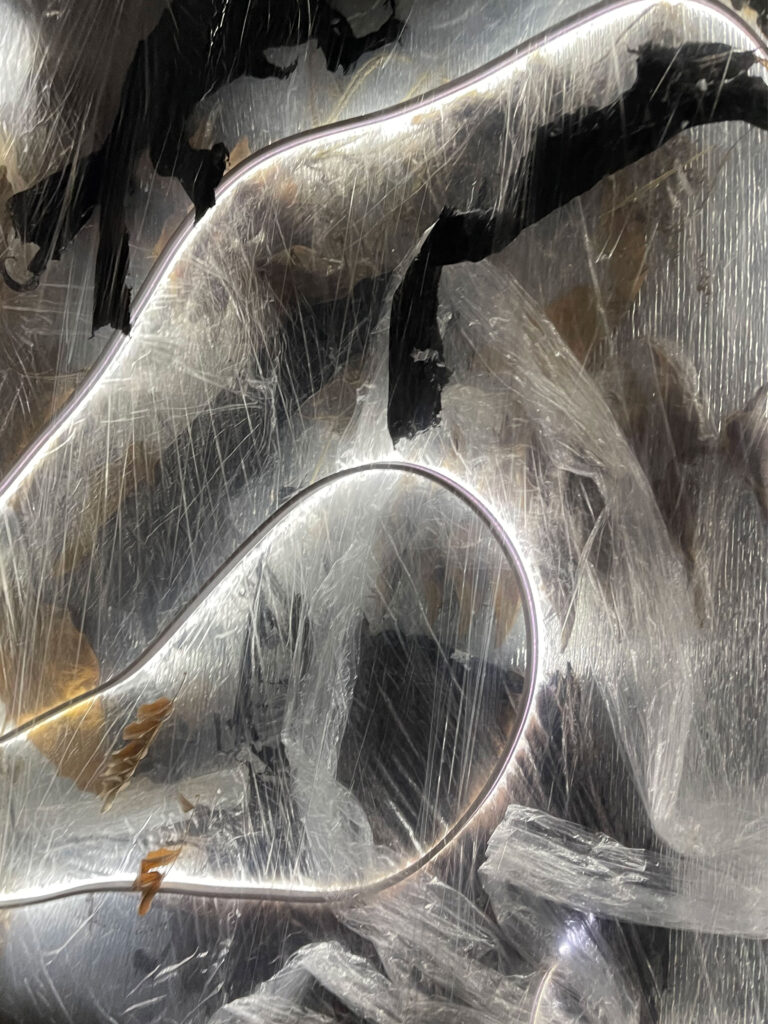
Material Transfer Unit, 2025
Painting-collage
Dried plants, leaves, seeds, vegetal adhesive compounds, putty, metallic insulating foil, plastic foil, neon
100 × 80 cm
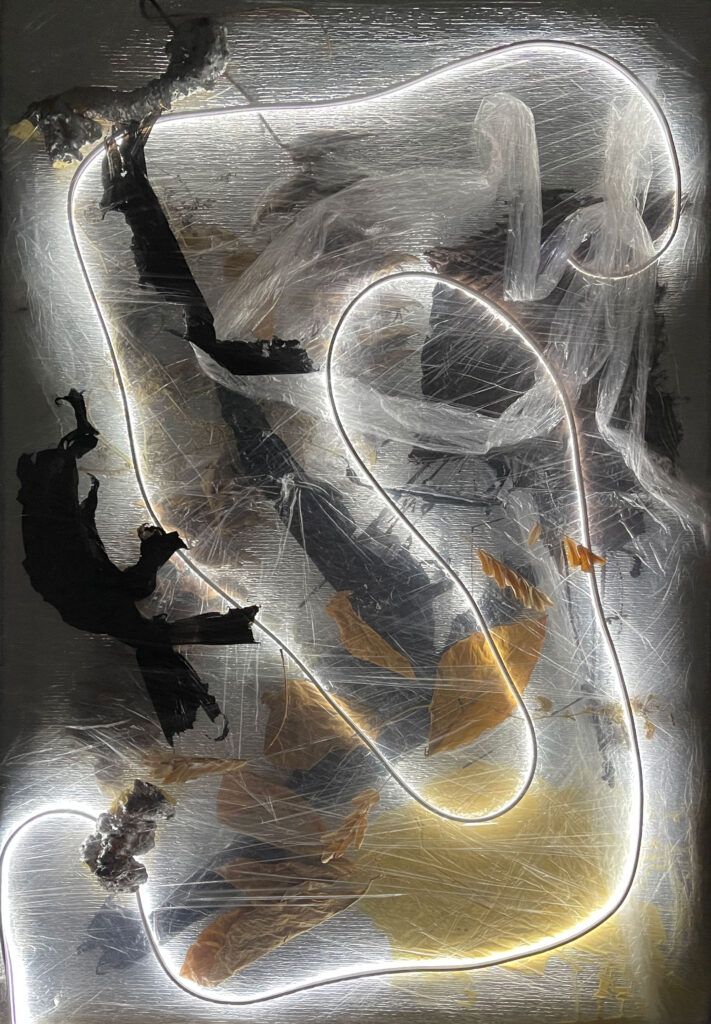
Material Transfer Unit, 2025
Painting-collage
Dried plants, leaves, seeds, vegetal adhesive compounds, putty, metallic insulating foil, plastic foil, neon
100 × 80 cm
DEUTSCH
Auf den ersten Blick wirkt das Bild eher eingehüllt als gemalt. Transparente Kunststofffolien liegen in überlappenden Schichten über der Oberfläche. Sie brechen das Licht ungleichmäßig und bilden eine Haut, die zugleich reflektiert und verdeckt. Darunter treten stellenweise metallische Isolierfolien, dunkle Partien, getrocknete Blätter und kleine pflanzliche Fragmente hervor. Keines dieser Elemente behauptet dauerhaft den Vordergrund. Alles scheint in unterschiedlichen Tiefen eingeschlossen, als wäre die Arbeit weniger durch Addition als durch wiederholtes Überdecken entstanden.
Die Neonlinie verändert die Art, wie sich das Bild lesen lässt. Sie liegt nicht auf der Oberfläche wie ein Akzent und dient auch nicht als äußere Lichtquelle. Ihr Verlauf biegt sich zurück, beschleunigt, verlangsamt sich, verschwindet hinter den transparenten Schichten und taucht an anderer Stelle wieder auf. Das Auge folgt ihr beinahe automatisch, ohne dass sie jemals zur Kontur oder zum Rahmen würde. Eher erinnert sie an einen Strom, der sich durch ein dichtes Material bewegt und dessen Widerstand seinen Verlauf ständig verändert.
Aus der Nähe verlieren die getrockneten Blätter einen Großteil ihrer botanischen Identität. Ihre Farbe bleibt erhalten, ihre ursprüngliche Funktion jedoch nicht. Sie sind gepresst, eingeschlossen oder gegen spiegelnde Flächen gedrückt. Ähnlich verhalten sich die industriellen Materialien. Isolierfolie, Spachtelmasse und Kunststofffolie erscheinen nicht als Zeichen technischer Moderne. Sie bestimmen vielmehr die physischen Bedingungen des Bildes: Druck, Verdichtung und Abschirmung.
Unvermittelt stellt sich eine Verbindung zur Restaurierung her. Die transparente Umhüllung erinnert an den provisorischen Schutz, den empfindliche Werke während eines Transports oder vor einer Konservierung erhalten. Hier bleibt dieser vorläufige Zustand bestehen. Das Bild verharrt in einem Stadium, das gewöhnlich der Ausstellung vorausgeht, als wäre der Akt des Bewahrens selbst zu einem malerischen Verfahren geworden.
Damit verschiebt sich auch das Verständnis von Malerei. Farbe ist vorhanden, doch selten als aufgetragener Farbauftrag. Licht spiegelt sich in den Metallflächen, dringt durch die Folien und bewegt sich entlang der Neonlinie. Die Bildstruktur entsteht weniger aus Farbverhältnissen als aus wechselnden optischen Dichten. Je nach Standort des Betrachters öffnen sich einzelne Bereiche, während andere sich zu einer nahezu metallischen Haut verdichten.
Der Titel Material Transfer Unit verweist eher auf Bewegung als auf Komposition. Die Materialien wirken, als seien sie aus anderen Zusammenhängen übernommen worden und trügen sichtbare Spuren ihres früheren Gebrauchs. Nun sind sie in einer Struktur fixiert, die ihren eigenen Aufbau nie vollständig verbirgt. Das Bild erschließt sich nicht auf einen Blick. Seine Ordnung entsteht langsam, während sich der Blick länger auf seiner Oberfläche hält.
ESPAÑOL
A primera vista, la pintura parece envuelta más que pintada. Láminas de plástico transparente cubren la superficie en capas superpuestas que capturan la luz de manera irregular, formando una piel a la vez reflectante y opaca. Debajo aparecen, por momentos, aislantes metálicos, zonas negras, hojas secas y pequeños fragmentos vegetales. Ninguno de estos elementos ocupa un primer plano estable. Permanecen suspendidos en distintas profundidades, como si la obra hubiera crecido mediante sucesivos actos de recubrimiento antes que por acumulación.
El neón modifica la forma de recorrer la composición. No descansa sobre la imagen como un acento, ni actúa como una fuente de iluminación externa. Su línea continua se repliega, acelera, disminuye el ritmo, desaparece detrás de membranas translúcidas y vuelve a emerger en otro lugar. El ojo la sigue casi involuntariamente, aunque nunca llega a convertirse en contorno ni en marco. Se comporta más bien como una corriente que atraviesa un medio denso cuya resistencia altera continuamente su trayectoria.
Al acercarse, las hojas secas pierden gran parte de su identidad botánica. Conservan el color, pero ya no remiten al paisaje ni a la ilustración naturalista. Están prensadas, encapsuladas o retenidas contra superficies reflectantes. Algo semejante ocurre con los materiales industriales. La lámina aislante, la masilla o el film plástico no aparecen como signos de tecnología. Funcionan como condiciones físicas de la pintura, definiendo presión, compresión y ocultamiento.
Hay una asociación inesperada con las prácticas de conservación. El envoltorio translúcido recuerda los sistemas temporarios utilizados para proteger una obra durante un traslado o estabilizarla antes de una restauración. Aquí, sin embargo, ese estado provisional deja de ser transitorio. La pintura permanece en la condición que normalmente precede a la exhibición, como si la preservación misma se hubiera convertido en un procedimiento pictórico.
Esto modifica la propia idea de pintura. El color existe, aunque rara vez como pigmento aplicado sobre un soporte. La luz rebota en las superficies metálicas, atraviesa el plástico y circula por el recorrido del neón. La imagen se organiza menos por relaciones cromáticas que por variaciones de densidad óptica. Según la posición del espectador, ciertas zonas parecen abrirse mientras otras se comprimen hasta adquirir el aspecto de una piel metálica.
El título, Material Transfer Unit, sugiere desplazamiento antes que composición. Los materiales parecen haber llegado desde otros contextos, conservando señales visibles de usos anteriores, para quedar fijados —quizá sólo de manera provisional— dentro de una estructura que nunca oculta del todo su propio ensamblaje. La organización de la obra no se entrega de inmediato. Se vuelve legible lentamente, a medida que la mirada acepta demorarse sobre ella.