Connections and Gaps between Artists and Institutions
Media art, which frequently involves data, software, or electronic devices, continues to face the challenge of technological obsolescence. In a previous article, this research project reviewed example models and strategies that media artists have personally developed to prevent artworks’ technical failures and to restore artworks on the edge of obsolescence. The preliminary study also touched on why artists may or may not devote themselves to preservation proactively. For example, an artist may have essential assumptions about their artworks’ life span. Or, an artist may recognize personal preservation efforts as a kind of assistance offered to potential collectors, including institutional conservation initiatives. However, given the diversity of media art, my preliminary research on three artists does not sufficiently reveal variations in or similarities between media artists’ understandings of preservation. Since preservation and conservation are fields often dominated by museums and similar organizations, a contrast also exists between personal and institutional practices.
Introduction
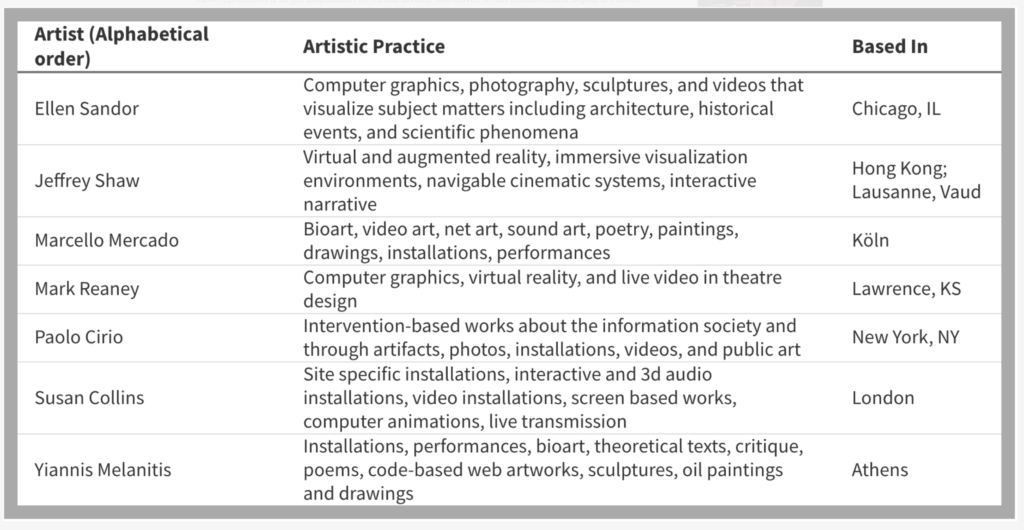
In order to provide more representative data about how media artists view preservation, this research relies on two larger samples. One consists of seven media artists who contribute to this research as interview participants. The firsthand interview data reveals artists’ genuine perceptions of institution-based preservation work. The other sample is a dataset of media artworks donated by artists to the Museum of Modern Art (MoMA). Ultimately, this research aims to answer the following questions: when do artists and institutions interact with each other for media art preservation? Is there potential for museums to develop more artist-oriented policies and services?
Sampling and Data Collection
For this research, I selected interview participants randomly from the THESAURUS database of the Archive of Digital Art (ADA) to include media artists with diverse backgrounds and practices. With the scientific selection of hundreds of international artists from about 5,000 evaluated artists, the ADA represents a larger population of media artists. Moreover, it has documented digital art since 1999 and covered various aesthetics, genres, subjects, and technologies involved in media art. Therefore, sampling from the ADA’s database allowed this research to reflect a comprehensive range of media art-making and preservation practices.