Text as Territory (1998)
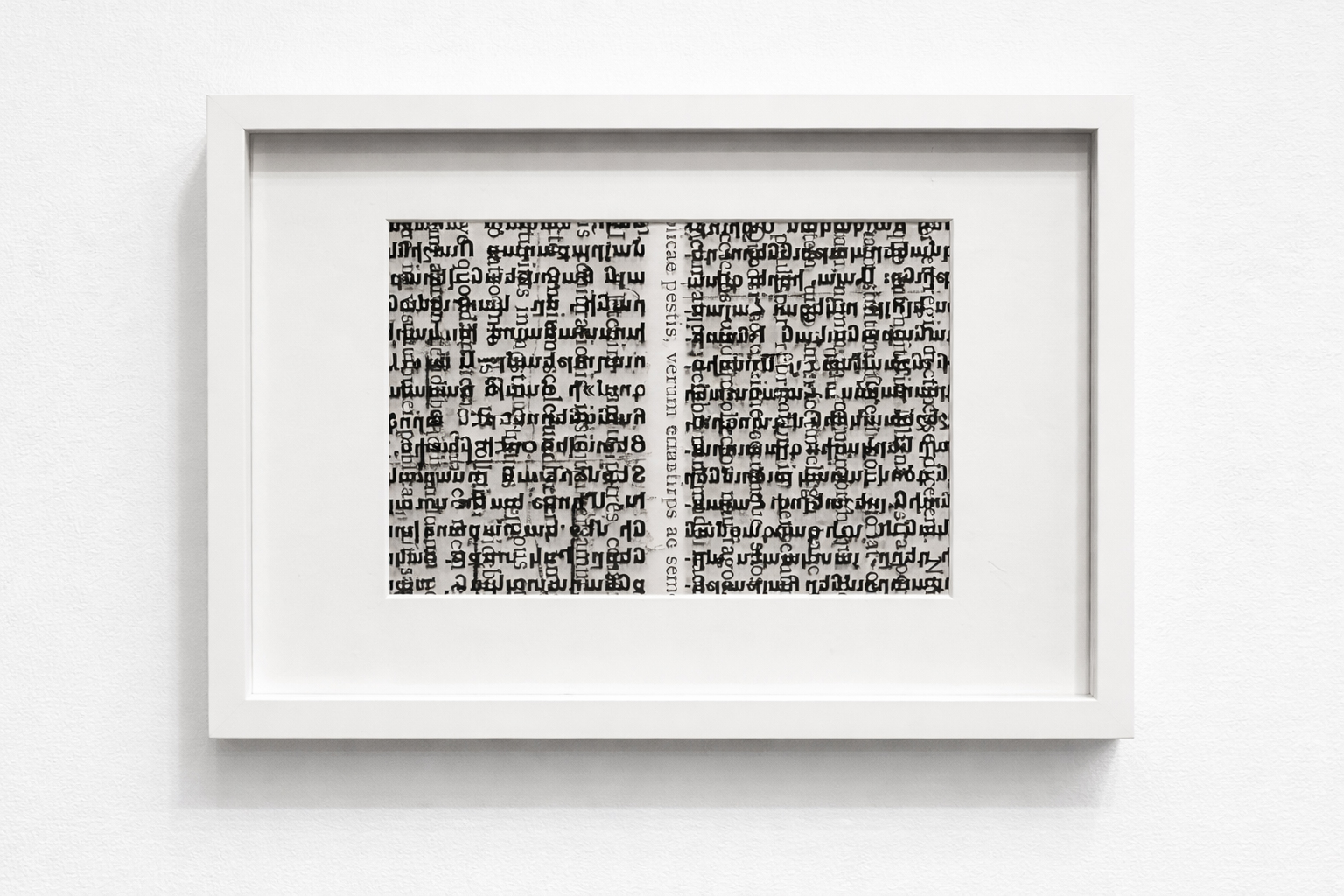
In Text as Territory, a series of graphic works produced in 1998, language ceases to function as a vehicle of transmission and instead becomes a contested spatial field. Fragments in Latin from Cicero’s Catilinarian Orations and newspaper reports drawn from the Georgian press—originating in a territory located at the unstable intersection of Eastern Europe and Western Asia—are printed and overlaid until any stable hierarchy of reading is eroded. Rather than juxtaposing sources, the series generates a zone of friction in which temporalities, rhetorical regimes and geopolitical conditions are compressed onto a single surface.
Here, the page operates as a topography. Textual layers accumulate, interrupt and neutralize one another, producing areas of opacity that shift attention away from semantic content toward the infrastructures through which discourse circulates. Classical rhetoric, associated with the foundations of Western political speech, and the immediacy of post-Soviet news media shaped by territorial reconfigurations appear as equivalent strata within the same inscriptional system.
Seen retrospectively, the series anticipates a line of inquiry that would run through the artist’s later practice: the archive treated as an active material, writing as infrastructure, and the image understood as an operational device rather than a representational one. Produced before the ubiquity of digital culture, Text as Territory can today be read as an early intuition of the contemporary saturation of signs and of language’s transformation into a territory—administered, occupied and continuously reconfigured.

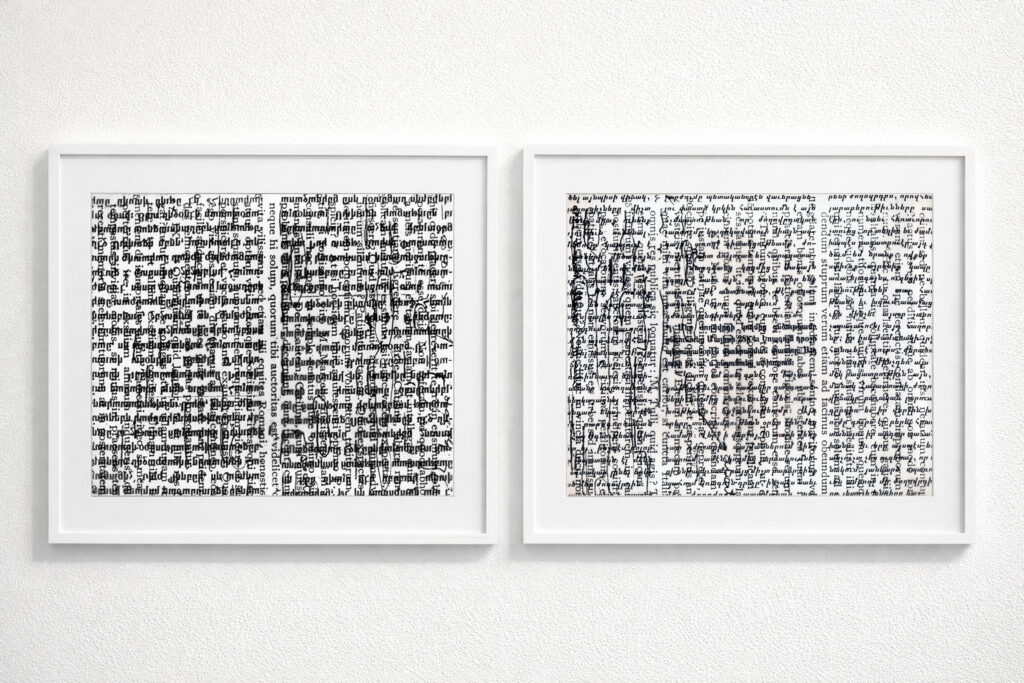
Marcello Mercado, Text as Territory, 1998, mixed media on paper (offset print, typographic overlay), dimensions: 29,7 × 21 cm
Text als Territorium (1998)
In Text als Territorium, einer 1998 entstandenen Serie grafischer Arbeiten, verliert Sprache ihre Funktion als neutrales Übertragungsmedium und wird zu einem umkämpften Raum. Lateinische Fragmente aus Ciceros Catilinarischen Reden und Zeitungsberichte aus der georgischen Presse—stammend aus einem Gebiet an der instabilen Schnittstelle zwischen Osteuropa und Westasien—werden übereinander gedruckt, bis jede stabile Lesehierarchie unterlaufen ist. Die Serie stellt keine Quellen nebeneinander, sondern erzeugt ein Reibungsfeld, in dem Zeitlichkeiten, rhetorische Regime und geopolitische Bedingungen auf einer einzigen Fläche verdichtet werden.
Die Seite fungiert hier als Topografie. Textschichten häufen sich, unterbrechen und neutralisieren einander und erzeugen Zonen der Opazität, die den Blick vom semantischen Inhalt auf die Infrastrukturen der Diskurszirkulation verschieben. Klassische Rhetorik—verbunden mit den Grundlagen westlicher politischer Rede—und die Unmittelbarkeit postsowjetischer Nachrichtenmedien, geprägt von territorialen Neuordnungen, erscheinen als gleichwertige Sedimente innerhalb desselben Einschreibungssystems.
Rückblickend lässt sich die Serie als Vorwegnahme einer Fragestellung lesen, die das spätere Werk des Künstlers durchzieht: das Archiv als aktives Material, Schrift als Infrastruktur und das Bild als operatives Dispositiv statt als bloße Repräsentation. Entstanden vor der allgegenwärtigen digitalen Kultur, kann Text als Territorium heute als frühe Intuition einer zeitgenössischen Zeichenüberflutung verstanden werden—und der Verwandlung von Sprache in ein Territorium, das verwaltet, besetzt und fortwährend neu konfiguriert wird.
Text como territorio (1998)
En Texto como Territorio, una serie de obras gráficas producidas en 1998, el lenguaje deja de funcionar como vehículo de transmisión para convertirse en un espacio en disputa. Fragmentos en latín de las Catilinarias de Cicerón y noticias tomadas de la prensa georgiana —procedentes de un territorio situado en la franja inestable entre Europa oriental y Asia occidental— son impresos y superpuestos hasta erosionar cualquier jerarquía de lectura. Más que yuxtaponer fuentes, la serie produce un campo de fricción donde temporalidades, regímenes retóricos y geografías políticas se comprimen en una misma superficie.
La página opera aquí como una topografía. Los textos se acumulan, se interrumpen y se neutralizan mutuamente, generando zonas de opacidad que desplazan la atención desde el contenido hacia las condiciones mismas de circulación del discurso. La retórica clásica, asociada a la fundación de la política occidental, y la inmediatez informativa de un espacio post-soviético sometido a redefiniciones territoriales, aparecen así como capas equivalentes dentro de un mismo sistema de inscripción.
Vista en retrospectiva, la serie anticipa una línea de investigación que atravesará décadas posteriores de la práctica del artista: el tratamiento del archivo como materia activa, la escritura como infraestructura, la imagen entendida como dispositivo operativo antes que como representación. Realizada en un momento previo a la omnipresencia digital, Text as Territory puede leerse hoy como una intuición temprana sobre la saturación contemporánea de signos y la conversión del lenguaje en un territorio administrado, ocupado y constantemente reconfigurado.