The Fruits of Hercules Mountain (2000–2001)
The Fruits of Hercules Mountain (2000–2001) is a series of seven paintings and drawings produced with pigments extracted from elderberry collected on Cologne’s Herkulesberg—a man-made hill formed from urban rubble left by the Second World War and layers of buried clothing (Klamotten) compressed beneath its vegetated surface—combined with black pencil and wax on paper.
The project begins with a strictly material operation: the elderberry is subjected to processes of boiling, fermentation, controlled putrefaction, filtering, and reduction in order to produce an unstable range of organic tonalities. These vegetal extracts do not function as illustrative colour but as active chemical deposits, sensitive to the paper’s absorption, to oxidation, and to their interaction with wax and graphite. Each sheet records a negotiation between fluidity, sedimentation, and friction.
The Herkulesberg does not appear as an image but as the physical origin of the pictorial material. Beneath its topography persist fragments of destroyed architecture, mineral dust, and compressed domestic residues that form an artificial ground. By extracting pigment from that specific botanical environment, Mercado introduces into the paintings an indirect economy of place: the landscape enters by material transfer rather than representation.
The compositions are constructed through accumulations, drags, circular sweeps, and concentrations of matter that operate as diagrams of deposition rather than closed forms. Drawing intervenes as a force of pressure and deviation; wax regulates absorption; pigment disperses, coagulates, and flows again. The surface functions as a testing field where physical processes and manual decisions intertwine without hierarchy.
The series affirms a conception of painting as a technical system: extraction, transformation, application, and recording. In this early body of work, Mercado establishes a methodology that traverses much of his later production—working with situated materials, subjecting them to chemical operations, and converting them into instruments of visual inscription.
The Fruits of Hercules Mountain presents painting as a practice of material and temporal transfer, in which botany, urban ruin, and compressed domestic residues remain active within the image. The sheet does not represent a landscape: it contains it.

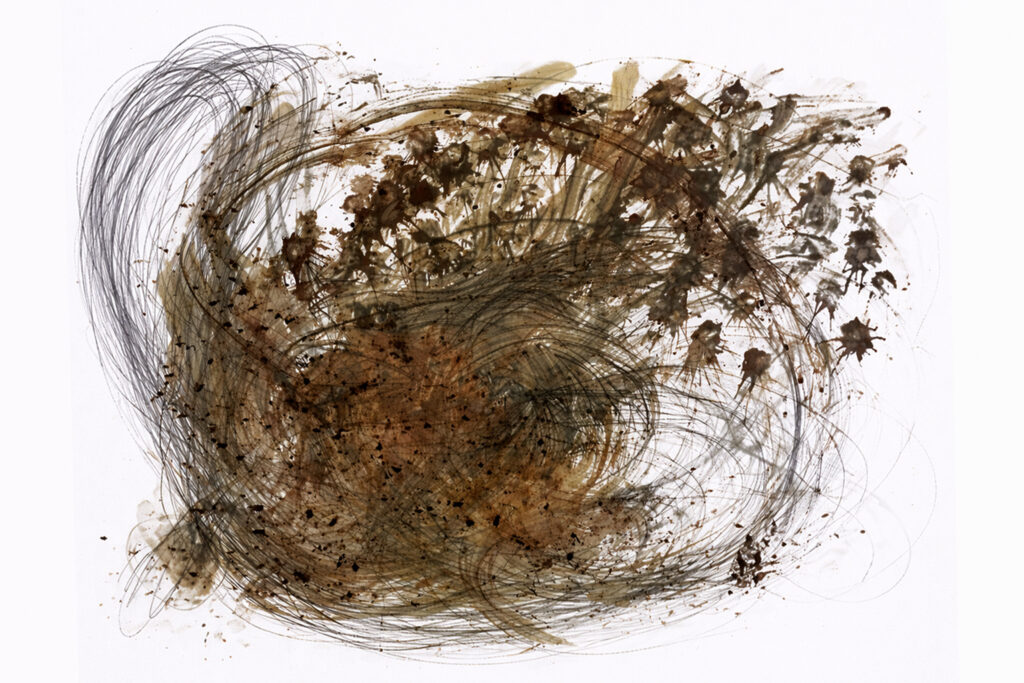
Früchte vom Herkulesberg XVIII, 2001
Elderberry pigment, black pencil and wax on paper
60 × 86 cm
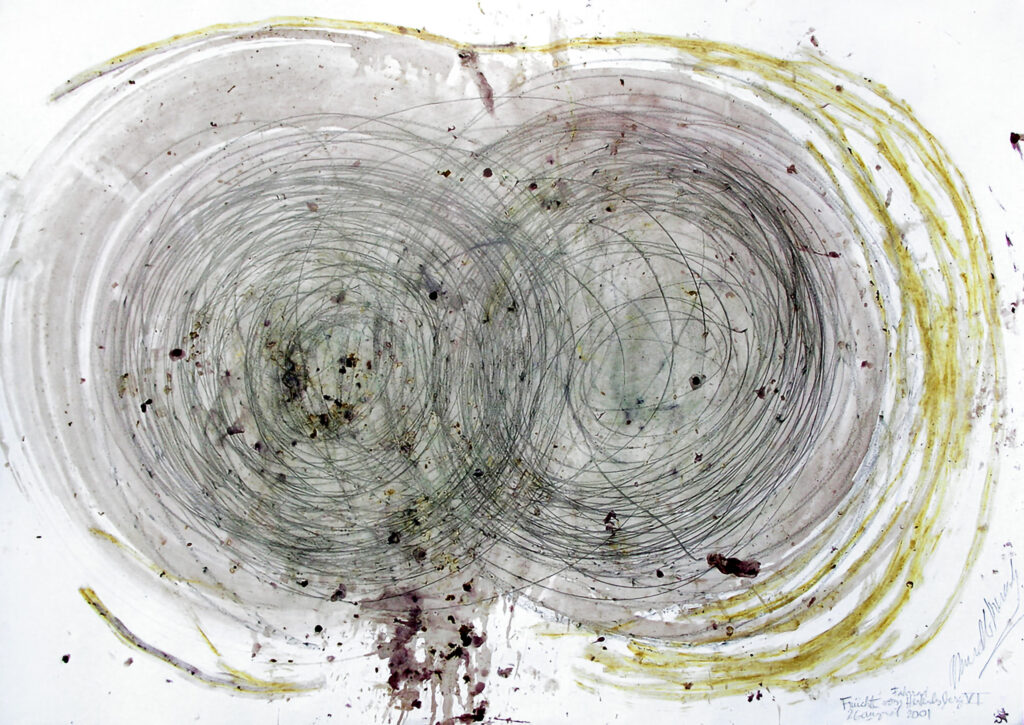
Früchte vom Herkulesberg XVIII, 2001
Elderberry pigment, black pencil and wax on paper
60 × 86 cm
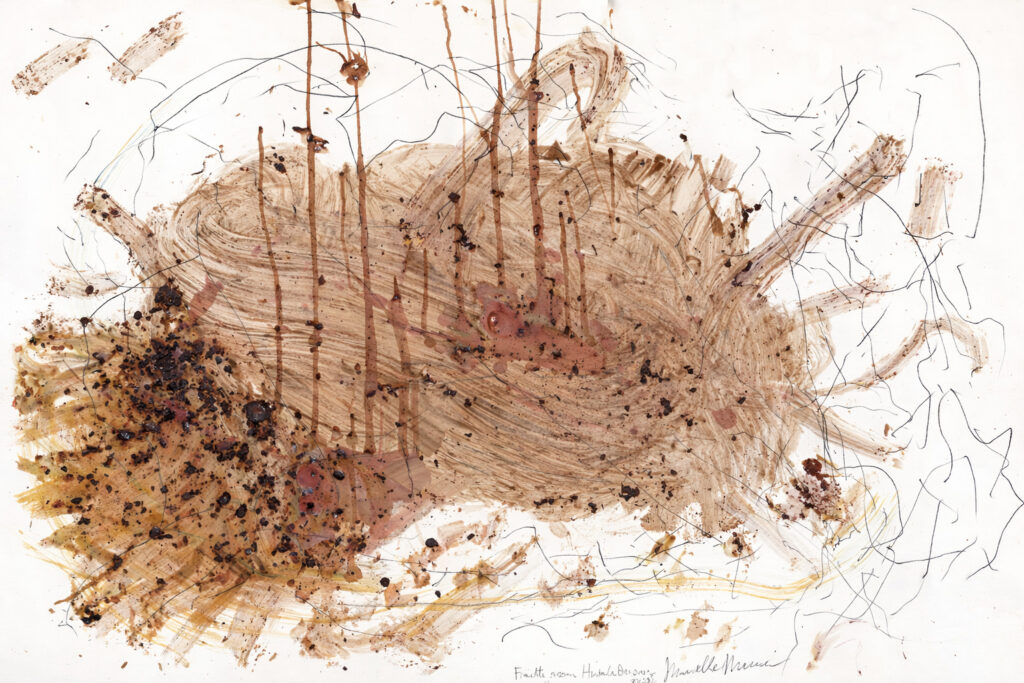
Früchte vom Herkulesberg XVIII, 2001
Elderberry pigment, black pencil and wax on paper
60 × 86 cm
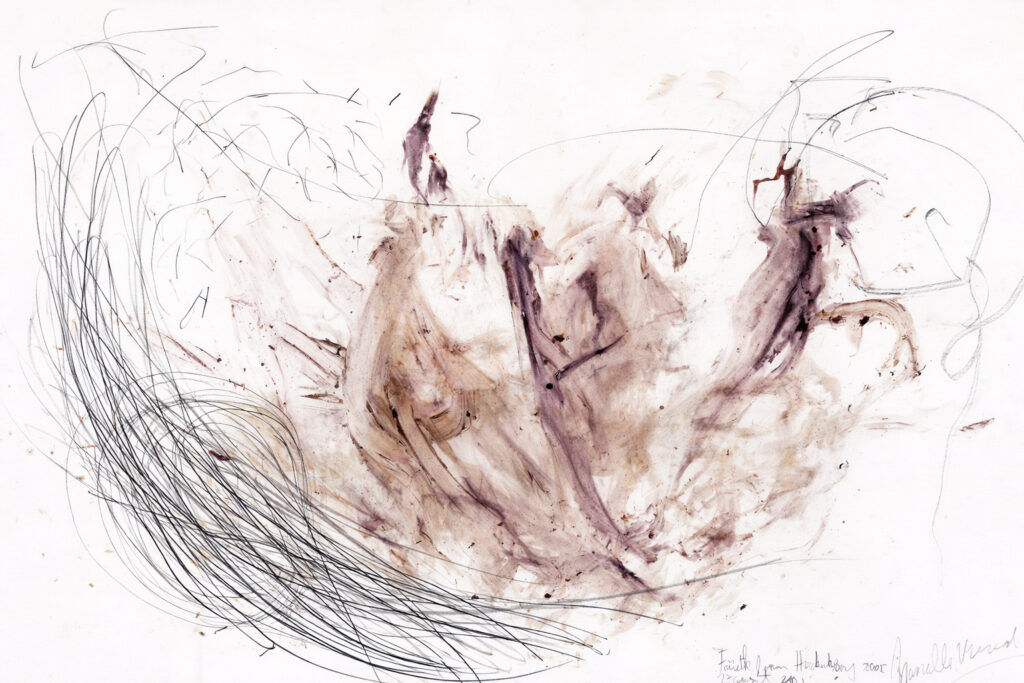
Früchte vom Herkulesberg XVII, 2001
Elderberry pigment, black pencil and wax on paper
60 × 86 cm
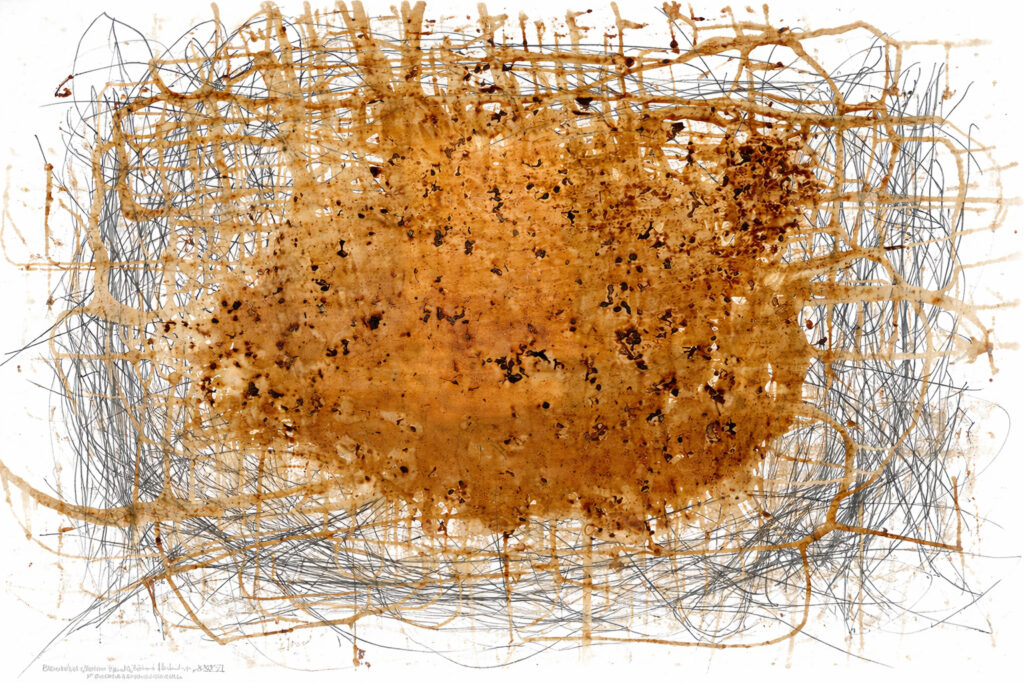
Früchte vom Herkulesberg XVI, 2001
Elderberry pigment, black pencil and wax on paper
60 × 86 cm
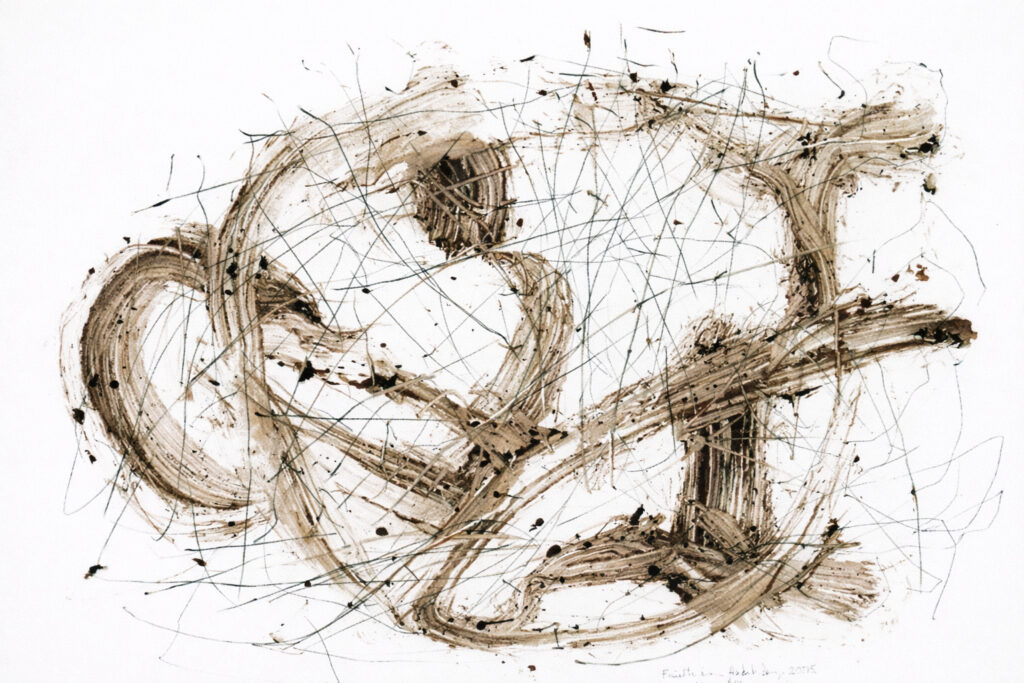
Früchte vom Herkulesberg XV, 2001
Elderberry pigment, black pencil and wax on paper
60 × 86 cm
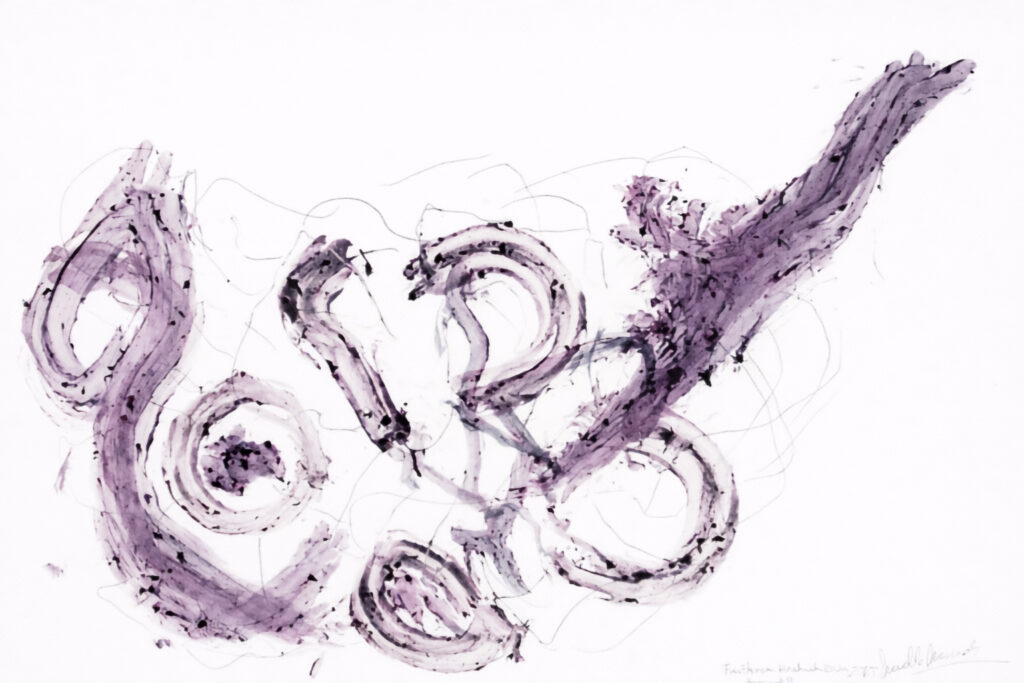
Früchte vom Herkulesberg XIV, 2001
Elderberry pigment, black pencil and wax on paper
60 × 86 cm
Die Früchte des Herkulesbergs (2000–2001)
Die Früchte des Herkulesbergs (2000–2001) ist eine Serie von sieben Malereien und Zeichnungen, die mit Pigmenten aus Holunder ausgeführt wurden, der auf dem Kölner Herkulesberg gesammelt wurde—einer künstlichen Anhöhe, die aus städtischen Trümmern des Zweiten Weltkriegs sowie aus unter der begrünten Oberfläche verdichteten Schichten vergrabener Kleidung (Klamotten) besteht—kombiniert mit schwarzem Bleistift und Wachs auf Papier.
Das Projekt geht von einer strikt materiellen Operation aus: Der Holunder wird Koch-, Fermentations-, kontrollierten Zersetzungs-, Filter- und Reduktionsprozessen unterzogen, um eine instabile Bandbreite organischer Tonwerte zu erzeugen. Diese pflanzlichen Extrakte fungieren nicht als illustrative Farbe, sondern als aktive chemische Ablagerungen, empfindlich gegenüber der Saugfähigkeit des Papiers, gegenüber Oxidation sowie in ihrer Wechselwirkung mit Wachs und Graphit. Jedes Blatt registriert ein Aushandeln zwischen Fließen, Sedimentation und Reibung.
Der Herkulesberg erscheint nicht als Bild, sondern als physischer Ursprung des malerischen Materials. Unter seiner Topografie bestehen Fragmente zerstörter Architektur, mineralischer Staub und verdichtete häusliche Rückstände fort, die einen künstlichen Untergrund bilden. Indem Mercado Pigmente aus diesem spezifischen botanischen Umfeld gewinnt, führt er in die Malerei eine indirekte Ökonomie des Ortes ein: Die Landschaft tritt durch materielle Übertragung ein, nicht durch Darstellung.
Die Kompositionen entstehen durch Akkumulationen, Schleifspuren, kreisende Bewegungen und Materiekonzentrationen, die eher als Diagramme von Ablagerung denn als geschlossene Formen fungieren. Die Zeichnung greift als Kraft von Druck und Abweichung ein; das Wachs reguliert die Absorption; das Pigment zerstreut sich, koaguliert und fließt erneut. Die Oberfläche fungiert als Versuchsfeld, in dem physikalische Prozesse und manuelle Entscheidungen hierarchielos ineinandergreifen.
Die Serie formuliert ein Verständnis von Malerei als technisches System: Extraktion, Transformation, Auftrag und Registrierung. In diesem frühen Werkkomplex etabliert Mercado eine Methodik, die große Teile seiner späteren Produktion durchzieht—das Arbeiten mit situierten Materialien, ihre chemische Bearbeitung und ihre Umwandlung in Instrumente visueller Einschreibung.
Die Früchte des Herkulesbergs begreift Malerei als Praxis materieller und zeitlicher Übertragung, in der Botanik, urbane Ruine und verdichtete häusliche Rückstände im Bild aktiv bleiben. Das Blatt stellt keine Landschaft dar: es enthält sie.
Los frutos de la montaña de Hércules (2000–2001)
Los frutos de la montaña de Hércules es una serie de siete pinturas y dibujos realizados con pigmentos extraídos de sauco recolectado en el Herkulesberg de Colonia —una colina artificial formada por escombros urbanos de la Segunda Guerra Mundial y por capas de ropa enterrada (Klamotten) comprimidas bajo la superficie vegetal—, combinados con lápiz negro y cera sobre papel.
El proyecto parte de una operación estrictamente material: el sauco es sometido a procesos de cocción, fermentación, putrefacción controlada, filtrado y reducción hasta producir una gama inestable de tonalidades orgánicas. Estos extractos vegetales no funcionan como color ilustrativo sino como depósitos químicos activos, sensibles a la absorción del papel, a la oxidación y a la interacción con ceras y grafito. Cada hoja registra una negociación entre fluidez, sedimentación y fricción.
El Herkulesberg no aparece como imagen sino como origen físico del material pictórico. Bajo su topografía persisten fragmentos de arquitectura destruida, polvo mineral y residuos domésticos comprimidos que conforman un suelo artificial. Al extraer pigmento de ese entorno botánico específico, Mercado introduce en la pintura una economía indirecta del lugar: el paisaje se incorpora por transferencia material, no por representación.
Las composiciones se construyen mediante acumulaciones, arrastres, barridos circulares y concentraciones de materia que funcionan como diagramas de depósito más que como formas cerradas. El dibujo interviene como fuerza de presión y desvío; la cera regula la absorción; el pigmento se dispersa, coagula y vuelve a fluir. La superficie opera como campo de pruebas donde procesos físicos y decisiones manuales se entrelazan sin jerarquía.
La serie afirma una concepción de la pintura como sistema técnico: extracción, transformación, aplicación y registro. En este conjunto temprano, Mercado establece una metodología que atraviesa buena parte de su producción posterior: trabajar con materiales situados, someterlos a operaciones químicas y convertirlos en instrumentos de inscripción visual.
Los frutos de la montaña de Hércules presenta la pintura como una práctica de transferencia material y temporal, donde la botánica, la ruina urbana y los residuos domésticos comprimidos permanecen activos en la imagen. La hoja no representa un paisaje: lo contiene.